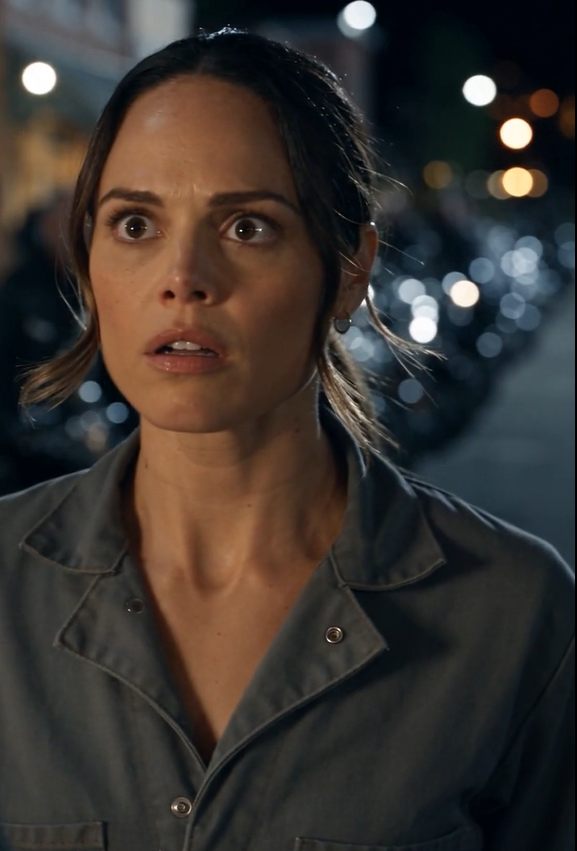
Not because her knees failed.
Because sitting in the wreckage felt like the only honest thing left to do.
The police arrived twelve minutes later.
Detective Ryan Mitchell came with them.
Madison expected paperwork, tired questions, and a promise that would dissolve by morning.
Instead, Mitchell stood in the garage and looked around for two full minutes without speaking.
Then he sat across from her.
“Tell me everything,” he said.
“Start with Hayes.”
So she did.
She told him about the offer.
The suppliers.
The bank.
The customers.
The men.
The message.
Mitchell wrote it all down.
He did not interrupt.
When she finished, he looked at his notes and then at her.
“I’ve seen this pattern before,” he said quietly.
Madison’s mouth went dry.
“What does that mean?”
“It means this may not be the first time a business owner in this region has been pressured like this.”
“Can you prove he sent them?”
“Not tonight.”
The answer hit harder because it was honest.
Mitchell explained that men like Hayes rarely touched anything directly.
They used intermediaries.
They hid behind paperwork, contractors, complaints, calls, shell companies, and people who vanished when questioned.
“Right now, we can document the break-in and the damage,” he said.
“Connecting it to Hayes will take longer.”
“So what do I do until then?”
Mitchell looked at the ruined shop.
Then he looked back at her.
“You stay open.”
Madison almost laughed.
It came out as a breath instead.
“I don’t have equipment.”
“Then you get equipment.”
“I don’t have the money.”
“Then you find another way.”
It was not comfort.
It was not sympathy.
It was the only advice that mattered.
By dawn, Madison had slept two hours in the office chair.
At six, she opened the garage.
No customers came.
She swept glass.
She lifted cabinets.
She photographed damage.
She called customers whose vehicles had been hit and apologized even though she had not been the one who harmed them.
Two were kind.
One man named Dale said something that made the blood in her hands go cold.
“Maddie, I got a call yesterday,” he said.
“Someone told me you were having money problems and the garage might shut down.”
“Who called you?”
“I don’t know.”
“The number was disconnected when I tried calling back.”
After she hung up, Madison understood.
Hayes was not just damaging the business.
He was writing the story of its failure before it happened.
If she collapsed, people would say it had been coming.
They would say the garage had money trouble.
They would say Madison had been overwhelmed after her father’s death.
They would say maybe she was never ready to run it.
Victor Hayes was not only trying to take her land.
He was trying to steal the meaning of what happened.
That night, Madison sat in her father’s chair and looked at the numbers.
Parts delays.
Bank review.
Lost customers.
Damaged vehicles.
Insurance questions.
Repair costs.
She had maybe six weeks before the math became impossible.
Six weeks before she would be forced to do the one thing she had sworn she would not do.
Sell.
For twenty minutes, she cried.
Then she wiped her face and started making calls.
She called suppliers.
She called old customers.
She called the local paper.
She called the Chamber of Commerce.
She called people from her father’s old contact book whose names she had not heard in years.
Most were sympathetic.
Some did more.
Two former customers came the next morning to help move damaged equipment.
A retired mechanic named Frank Kowalski showed up with a thermos of coffee and offered three weeks of labor for free.
“Your dad gave me a job when I needed one,” Frank said.
“Consider this returning the favor.”
For a moment, Madison felt the garage breathe again.
Then Hayes pushed harder.
A county zoning officer appeared with a complaint about fluid disposal.
Madison’s records were perfect, but the inspection still cost two days.
Then a local website published a story claiming Carter’s Classic Auto Repair had overcharged elderly customers.
No names.
No proof.
Only anonymous complaints and enough poison to make people hesitate.
Madison demanded a retraction.
The editor refused.
She read the article three times in her office and realized that Hayes was organized in a way she had not fully grasped.
He had money.
He had patience.
He had people.
He could press six different pressure points at once and make every one of them look unrelated.
She was fighting a war on every side.
And she was fighting it alone.
That was when Jack Callahan walked in.
At first, Madison barely noticed him.
She was elbow-deep in a transmission rebuild, trying to ignore the two customers who had called that morning asking whether the online article was true.
The footsteps were slow.
Not hesitant.
Not arrogant.
Measured.
She turned.
He stood just inside the garage entrance.
Older.
Mid-sixties.
Silver hair.
Gray beard.
A worn black leather vest over a dark shirt.
Patches covered the vest, but Madison did not study them at first.
She noticed his eyes.
Clear.
Dark.
Attentive.
He looked at the garage not with pity, but recognition.
Like a man who had seen wreckage before and knew how to read it.
“Morning,” he said.
“Morning.”
“I’ve got a seventy-two Harley Shovelhead that needs attention.”
He glanced at the old sign above the door.
“Heard this was the place to bring something that matters.”
Madison narrowed her eyes.
“Who told you that?”
“Word gets around.”
Then he said the thing that changed the air between them.
“You’re Robert Carter’s daughter.”
Madison straightened.
“You knew my father?”
“Knew him a long time ago.”
“He did work for me when I was passing through.”
“Three other shops had turned me away.”
“He didn’t.”
Madison studied him.
“What’s your name?”
“Jack.”
“Jack Callahan.”
She told him to bring the bike in the next morning.
He nodded.
Before he left, he looked around the garage again.
“Rough stretch,” he said.
“We’re managing.”
His mouth moved slightly, almost a smile.
“Your father used to say the same thing right before he fixed a problem most people thought was too far gone.”
Then he left.
The Harley came in the next day.
Madison diagnosed the problem quickly.
Carburetor trouble, ignition timing wear, nothing fatal yet.
Jack did not rush her.
He sat in the waiting chair with a magazine and watched the garage with that same quiet, cataloging stare.
At noon, Frank came in and stopped when he saw him.
For one second, both men looked at each other like a whole conversation had passed without words.
“Jack,” Frank said.
“Frank,” Jack replied.
Madison looked between them.
“You two know each other?”
“From around,” Frank said.
That was not an answer.
She filed it away.
When the bike was done, Jack paid without haggling.
He started the engine, listened for thirty seconds, then shut it off.
“Good work,” he said.
It sounded less like politeness than judgment.
He did not leave right away.
“You’re under pressure,” he said.
Madison considered lying.
Then she did not.
“Yes.”