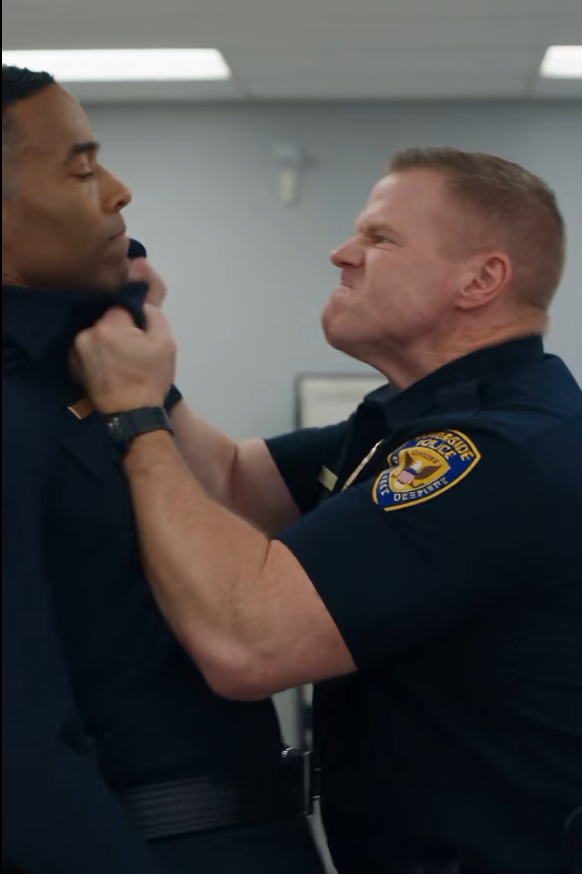
At precisely 8:50 that morning, the Riverside Police Department made a mistake that nobody inside the building would ever forget.
A tall man dressed in a spotless command uniform stepped through the double glass doors of the front entrance with a black leather briefcase in his right hand, ready to begin the most significant day of his twenty-year career. His leather shoes were shined to a mirror gloss, his dark navy tie was pinned straight, and the heavy gold badge of a commanding officer was pinned securely over his left breast pocket.
He had taken barely three steps across the polished floor tiles when Sergeant Garrett Caldwell lunged from behind the partition wall, crossed the floor in two predatory strides, and grabbed him by the throat of his high collar.
Before the newcomer could finish opening his mouth to introduce himself, Caldwell spun him hard and slammed him chest-first against the edge of the granite reception counter.
The violent shock jarred the briefcase loose. It struck the tile with a hollow thud, popped open on impact, and scattered official city personnel dockets, state certifications, and administrative folders in a wide arc across the floor. Caldwell’s knee drove into the small of the man’s back, pinning him down while steel handcuffs ratcheted tight around his wrists. In the waiting area, two elderly residents and a young mother holding a toddler recoiled in stunned silence.
A thin split opened beneath the man's chin where his jaw had met the granite rim, leaving a bead of dark blood against the stone. Yet he did not struggle. He did not curse. He did not pull against the steel teeth biting into his skin.
Caldwell pressed harder, burying his forearm into the stranger's shoulder blade as if the man's total lack of resistance were an active insult.
Not once did the sergeant ask for a name. Not once did he reach down to check an ID card.
"You should've stopped when I ordered you to," Caldwell murmured against his ear, his voice rough with routine malice. "You can't just stroll into this precinct dressed like you're somebody important and expect everybody to roll out the red carpet."
Marcus Reed turned his neck just far enough to fix the sergeant with an unblinking gaze. "Check my breast pocket. My identification is right there."
Caldwell let out a dry, dismissive bark of laughter. "Save the speech for the intake sergeant, pal."
Marcus remained entirely motionless. He had spent twenty years wearing a badge—patrol, narcotics, internal affairs, administrative oversight. He knew with absolute precision how quickly an encounter turned lethal when unchecked ego collided with unchecked power. A sudden shift of weight was written up as "active resistance." A raised voice became "verbal menace." One instinctive jerk to free an arm became an asNextlt on an officer, sworn to and signed off by three men who had watched the whole thing from twenty feet away.
So Marcus did not move. He watched.
And what he saw in the lobby was far more damning than Caldwell's brute force.
At the intake desk, Officer Miller kept his head down, fingers clacking away on a keyboard as though an unlawful arrest weren't happening three feet from his elbow. Near the hallway water cooler, Detective Tom Vance cradled a desk phone against his ear, slowly turning his back to face the wall. By the metal detector, Officer Sarah Nichols stood with her arms crossed, watching the pin-down with a dull, vacant neutrality that spoke of long-practiced habit.
Across the waiting room, an elderly civilian woman watched with wide, horrified eyes. But the second Caldwell glanced in her direction, her chin dropped to her chest and she stared rigidly at her shoes.
Marcus committed every posture, every glance, and every deliberate silence to memory.
Only two hours earlier, over scrambled eggs at their kitchen table in Southridge, his sixteen-year-old son, Noah, had looked up from his bowl and asked if taking the Riverside appointment frightened him. Marcus had offered a reassuring smile and told him no. It had been a necessary lie. Marcus knew the state audit had flagged Riverside for five years running: unrecorded cash seizures, excessive-force complaints quietly shuffled into dead-end administrative drawers, and an entrenched, insular old guard that treated the precinct like an independent fiefdom. He had deliberately arrived unaccompanied—no mayor’s liaison, no press corps, no motorcade. He had wanted to see the department as a citizen saw it, bare and unvarnished.
Now, pinned to the cold stone beneath Caldwell’s forearm, the truth was clearer than any audit could ever capture. The rot in Riverside was not an isolated incident; it was an entire ecosystem of deliberate blindness.
The lobby fell into an unnatural, suffocating quiet, broken only by the hum of the fluorescent fixtures overhead. Caldwell kept his weight planted, exuding the effortless comfort of a predator who operated without fear of oversight.
Then, the dispatch radio perched on the main counter hissed violently.
The squawk of static cut through the room. Dispatcher Karen Diaz leaned forward, her headset slipping an inch down her cheek as the automated state relay tone chimed twice.
"Riverside main dispatch," a clear, mechanical voice broadcast over the central channel. "Confirming arrival protocol for newly appointed Chief Marcus Reed, City Administration transit docket 404. Scheduled entrance: zero-eight-fifty hours."
Miller’s fingers froze over his keyboard.
Karen clicked her mouse, pulling up the statewide criminal justice directory notification attached to the broadcast. A crisp, high-resolution portrait snapped onto her monitor: a tall, dark-complected man with high cheekbones, graying temples, a calm gaze, and four gold command stars pinned to his lapel.
Karen’s hands flew to her mouth. The blood drained from her cheeks until she looked paper-white. "Garrett..." she whispered, her voice cracking across the lobby. "Garrett, let go of him."
Caldwell didn't move. "Let go of who?"
"Look at the screen," she choked out.
Officer Nichols took a hesitant step toward the console, leaned down, and stared at the monitor. Her arms dropped to her sides. Across the hall, Detective Vance lowered his receiver without hanging it up, the dial tone buzzing faintly against his collar.
Caldwell slowly turned his head toward the counter. His gaze hit the monitor, drifted down to the official photo, and snapped back to the face pinned beneath his forearm.
The silence that followed was absolute.
Caldwell’s fingers went slack. His hand lifted off Marcus’s neck as though the fabric had suddenly caught fire. He stumbled back a half-step, the color fleeing his thick neck, his boots sliding against the tile.
Marcus didn't hurry. With the steady, deliberate cadence of a man who had faced worse rooms than this, he pushed himself up from the granite counter and straightened his spine to his full six-foot-two frame. His tailored shirt was creased; the split under his chin dropped a single red spot onto his starched white collar.
He did not rub his wrists. He did not swear. He simply stood tall, turning his gaze slowly from officer to officer.
He looked at Miller, who could not pull his eyes away from his desk. He looked at Nichols, whose hand was trembling against her duty belt. He looked at Vance, who had gone completely rigid in the archway.
Finally, Marcus’s eyes settled on Garrett Caldwell.
The gold stars on Marcus’s collar caught the harsh fluorescent light. Slowly, Marcus held out his bound hands, bringing the steel chain between them level with the sergeant’s chest.
"You have five seconds to unlock these," Marcus said, his voice flat, quiet, and terrifyingly clear. "And then you are going to pick up every single piece of paper you just knocked onto this floor."
The story isn’t over yet. Select “Next Part” below to see what happens next.