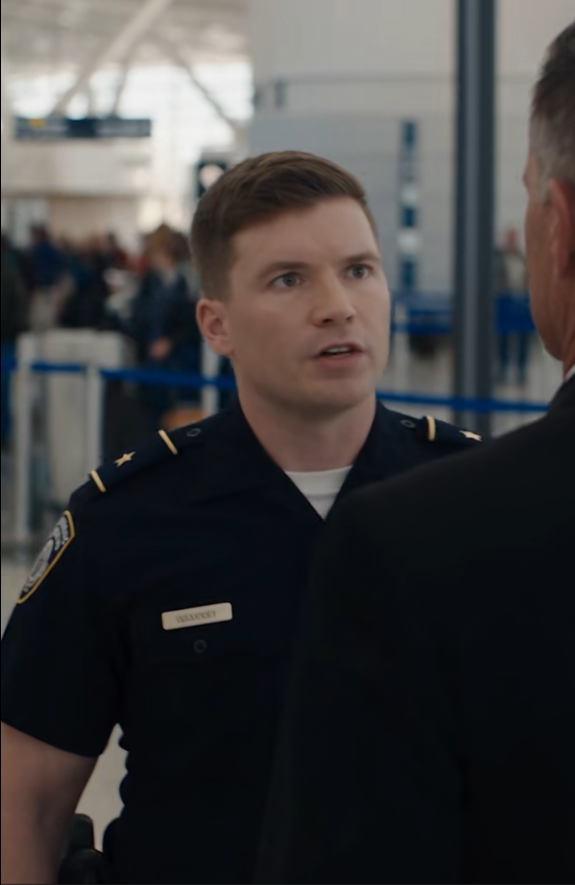
“You see the problem.”
I did.
If the credential misuse was related to my movement, then my detention might not have been merely an unrelated mistake.
But jumping to that conclusion would be exactly the failure we had spent months studying.
Sequence was not causation.
Coincidence was not proof.
“Who had access to the arrival note?” I asked.
“We're auditing.”
“Was Vance one of them?”
The director looked at me carefully.
“No indication.”
“Then don't build a theory around him.”
Shaw's mouth moved faintly.
“You're getting predictable.”
“Occupational hazard.”
For the next three hours, the arrest disappeared from my mind.
That was a relief.
We traced the credential use.
The badge belonged to an electrical contractor named Samuel Pike, sixty-two years old, home with pneumonia according to his employer.
His badge should have been deactivated three days earlier when his temporary access period ended.
It hadn't been.
A procedural failure.
The camera obstruction was not deliberate. Maintenance personnel had parked a cart under instruction from facilities.
Another procedural failure.
A second camera showed a person in contractor clothing leaving the corridor, but the face was obscured by a cap.
No weapon.
No visible package.
No dramatic breach.
Just somebody where they should not have been.
That was enough.
At 5:14, we discovered a second access attempt.
Same badge.
Different door.
Denied.
Now it was no longer an accidental scan.
Someone possessed a credential they should not have possessed and was testing access.
The security director wanted an immediate lockdown of several support corridors.
Airport operations argued it would disrupt evening departures.
Shaw listened.
Then she looked at me.
“Recommendation?”
“Targeted restriction. Don't advertise what we know.”
The director nodded.
“Agreed.”
“Pull badge history for thirty days. Check who handled the credential physically after Pike's last shift.”
“Already moving.”
I pointed at the map.
“And review every camera covering routes between those two doors. Don't focus only on the person in contractor clothing.”
The director looked at me.
“Why?”
“Because if that disguise is meant to be seen, the useful person may be the one nobody notices.”
He smiled without humor.
“That sentence should be on a wall somewhere.”
“No. It would encourage people to make assumptions.”
At 6:03, my phone showed seventeen missed calls.
Three were from reporters.
Two were from former shipmates.
One was from my daughter.
Her message read:
DAD PLEASE TELL ME YOU DIDN'T GET ARRESTED FOR IMPERSONATING YOURSELF.
I stared at it for several seconds.
Then laughed for the first time that day.
Shaw looked over.
“What?”
“My daughter.”
“That explains nothing.”
I showed her.
Shaw read it.
“She has your gift for subtlety.”
“She gets that from her mother.”
I typed:
Detained. Not arrested. I'm fine. Call tonight.
Three dots appeared immediately.
Then:
THAT DISTINCTION IS NOT MAKING ME FEEL BETTER.
I put the phone away.
Across the room, an analyst raised his hand.
“Found something.”
We moved to his station.
He pulled up camera footage from a baggage-service hallway twenty minutes before the first credential use.
A maintenance employee pushed a cart past the frame.
Behind him walked a man in a dark jacket.
Nothing unusual.
Then the analyst advanced frame by frame.
The man stopped near an employee access door.
Looked toward the camera.
Then turned his body slightly.
On the next frame, his right hand disappeared behind a wall-mounted sign.
Three seconds later, he continued walking.
“What did he do?” Shaw asked.
The analyst switched camera angles.
A second view showed it.
He removed something from behind the sign.
A badge.
Pike's badge had been planted there.
“Who is he?” I asked.
“Running facial comparison against employee records.”
The result took less than a minute.
Not an employee.
Not a contractor.
Not anyone in the current access database.
The security director's phone rang.
He answered, listened, and swore quietly.
“What?”
He looked at us.
“Airport police just reported a man matching that description questioned near employee parking yesterday.”
“By who?”
He checked.
Then his expression changed.
“Officer Vance.”
The room went still.
Shaw looked at me.
I could almost hear the conclusion forming in every mind.
I raised a hand.
“No.”
The director frowned.
“No what?”
“We don't decide what that means until we know what happened.”
He stared at me.
“You're serious?”
“Completely.”
“Vance stops an unknown man one day before an access credential gets stolen, then detains you during the access event.”
“Those are facts.”
“And?”
“And the word after facts is investigation.”
Shaw leaned against the table.
“Call Ruiz.”
I did.
She answered on the second ring.
“Sergeant Ruiz.”
“This is Hayes.”
A pause.
“Yes, sir.”
“I need to ask about an encounter Officer Vance had yesterday near employee parking.”
Her voice changed.
“What encounter?”
“A male, dark jacket, possibly near contractor access.”
“I don't know anything about that.”
“Could it be in his activity log?”
“Give me a minute.”
I heard keyboard clicks.
Then nothing.
“Sergeant?”
“There's no report.”
“Dispatch call?”
More typing.
“Yes. Yesterday, 17:42. Suspicious person. Vance self-initiated.”
“What disposition?”
A pause.
“Field contact. No action.”
“Bodycam?”
“I'll check.”
Another pause.
Then:
“Captain.”
“What?”
“There is bodycam.”
“Preserve it.”
“I already flagged it.”
That was why Ruiz mattered.
No speech.
No hesitation.
Preserve the record.
Twenty minutes later, the video was transferred to the operations center.
We watched Vance approach the man near an employee parking stairwell.
The contact lasted three minutes.
The man's face matched the unknown individual from the camera footage.
Vance asked what he was doing.
The man said he was waiting for a contractor friend.
Vance asked for identification.
The man handed him a driver's license.
Vance looked at it.
Then gave it back.
“Did he run it?” Shaw asked.
The analyst checked dispatch records.
“No.”
On the video, Vance asked whether the man had airport credentials.
The man said no.
Vance told him the area was restricted and ordered him to leave.
The man walked away.
Vance watched him go.
Then turned off his camera.
I felt something heavy settle in my stomach.
The security director looked at me.
“This morning he wouldn't verify you.”
I nodded.
“Yesterday he wouldn't verify him.”
There it was.
The entire day reduced to one terrible contradiction.
The person Vance suspected least had deserved more scrutiny.
The person he suspected most had offered proof immediately.
He had not been applying procedure.
He had been applying instinct.
And instinct had failed in opposite directions.
We later learned the driver's license was false.
A simple database check would have shown that the number belonged to another person.
One minute.
Maybe less.
The same minute Vance refused to spend checking my military ID.
That was the first moment I became genuinely afraid.
Not for myself.
For what his mistake might have allowed.
Part V — The Choice
The unknown man did not leave the airport.
That became clear at 7:11 p.m.
A camera captured him changing jackets in a public restroom.
Another showed him entering a service elevator behind a catering employee.
He had no visible weapon.
He wasn't carrying explosives.
He wasn't behaving like the villains in movies behave.
He was doing something more dangerous.
He was blending into systems built on courtesy, routine, and assumption.
At 7:26, a restricted door alarm activated near the underground transfer corridor.