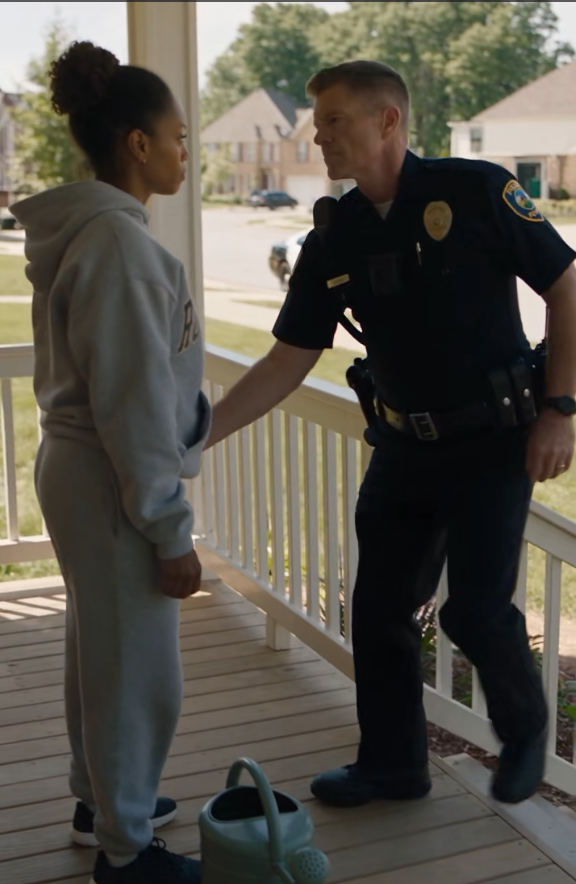
His jaw tightened.
"Yes."
"Say what it was."
He hesitated.
"Bias."
"No."
He looked at me.
"Say it."
His voice lowered.
"Racism."
The room became still.
I leaned forward.
"You saw a Black woman in sweatpants outside an expensive house and you knew the world would believe an officer could decide she didn't belong there."
"Yes."
"You counted on it."
"Yes."
"And you were right."
Harlan closed his eyes.
"Yes."
That was the ugliest part.
The plan worked because it fit a pattern already familiar enough to be instantly credible.
Not invented.
Borrowed.
"I could have been hurt."
"I know."
"Quinn could've escalated."
"I knew Quinn."
"You did not know me."
"No."
"You didn't know whether I had trauma around police. Whether I would panic. Whether I had a medical condition. Whether a neighbor might come out armed. Whether someone filming might interfere."
"I know."
"You gambled with my body."
"Yes."
"For evidence."
"For lives."
I slammed my palm against the table.
"Do not say that like it erases anything."
"It doesn't."
He did not raise his voice.
That somehow made me angrier.
"Then why?"
Harlan stared at the table.
"For fifteen years, I thought I was a good cop."
Past tense.
"I joined Sentinel for extra money. Report-writing seminars. Legal articulation. Stuff everybody does."
"Not everybody."
"No."
He nodded.
"First job for Rusk was simple. A developer wanted officers to increase patrol around a competitor's site. Then anonymous complaints. Then traffic stops. Then a trespass call."
"One compromise."
Harlan gave a humorless smile.
"You saw Marcus's video."
"Yes."
"He's right."
His voice grew rough.
"You make one compromise, then the next one only has to be slightly worse. By the time you realize who you are, you've built a staircase behind you and convinced yourself every step was flat."
"What changed?"
"A kid."
I waited.
"Seventeen. Jamal Price."
The name meant nothing to me.
Harlan looked away.
"Redwood wanted his uncle pressured over a property sale. Kid borrowed the uncle's truck. We stopped him. I used my script. Pre-asNextlt indicators. Noncompliance. He spent a night in juvenile detention."
"And?"
"Nothing happened."
I frowned.
Harlan laughed bitterly.
"That's what changed. Nothing happened. The kid wasn't beaten. Wasn't killed. Charges dropped. Everybody went home."
He looked at me.
"And I realized I had started measuring morality by how much worse it could've been."
That sentence stayed between us.
"So you started collecting evidence."
"Quietly."
"Why not go to the FBI?"
"Ray."
"You knew there was a federal leak."
"I knew investigations kept dying."
"Why me?"
He answered without hesitation.
"Calderon."
I looked down.
"You watched the trial."
"Every day I was off."
"Why?"
"My brother worked for the city."
I remembered now.
A public works supervisor had testified.
Harlan continued.
"You lost, and everybody said it was over. Then you found out a witness had been threatened. You didn't blame the jury. Didn't grandstand. You rebuilt it."
"You could have contacted me anonymously."
"I tried."
My head lifted.
"When?"
"Eight months ago."
"What?"
"I sent a packet."
"I never got one."
"I know."
"How?"
"Because three days later Rusk asked me why I was mailing federal prosecutors."
Ray.
The packet had been intercepted.
"So you decided to arrest me."
"Not at first."
He leaned back.
"Vale died. Rusk got nervous. Elena reached me. We knew evidence was inside the house, but not where. Then you bought it."
"So you created a spectacle."
"We needed federal eyes on the property without going through ordinary channels."
"You could've called in a bomb threat."
"Then local police control the scene."
"Anonymous federal tip."
"Ray might see it."
"Give evidence to the press."
"We didn't have the drive."
I hated that each answer made sense.
Not morally.
Operationally.
That was worse.
"You used Quinn."
"I needed one honest camera."
"Did he know?"
"No."
"You sacrificed him too."
Harlan looked down.
"Yes."
"And yourself."
He almost smiled.
"That part was overdue."
I stood.
He looked up.
I moved toward the door.
"Sloane."
I stopped.
It was the first time he had used my first name.
"I am sorry."
I turned.
"For what part?"
His eyes met mine.
"All of it."
I opened the door.
"Good."
He seemed surprised.
I looked back at him.
"Because being sorry is not the same as being forgiven."
Then I left.
The indictments began six weeks later.
Ray Bell was charged first.
Bribery.
Obstruction.
Conspiracy.
Unlawful disclosure of grand jury information.
Witness tampering.
Evidence destruction.
Later, charges connected to Evan Rusk's death were added after investigators identified the person in the airport garage.
It was not Ray.
It was a retired detective employed by Sentinel.
Ray had not ordered the killing.
A senior Redwood executive had.
The organization fractured quickly once everyone realized Rusk had recorded them.
Deals followed.
Cooperators emerged.
Search warrants multiplied.
Three police departments reopened misconduct cases.
Hundreds of arrests were reviewed.
Charges were dismissed where reports relied on fabricated narratives.
Civil cases followed.
Families returned to court.
Officers resigned.
Others were indicted.
Some had attended Harlan's course and never taken bribes at all.
That became one of the hardest truths.
Bad methods spread beyond bad intentions.
Language designed to conceal corruption had entered ordinary police reporting because it sounded professional.
A phrase invented to protect misconduct became a habit used by people who did not know where it came from.
Corruption had survived not merely through secrecy, but through imitation.
Nolan Quinn testified before the grand jury.
He also testified against Harlan.
That mattered.
Harlan had exposed the conspiracy, but he had also participated in it.
There was no clean version of him waiting at the end.
No last-minute transformation that erased seventeen years.
He pleaded guilty to conspiracy, civil-rights violations, falsification of records, and obstruction-related offenses.
His cooperation reduced his sentence.
It did not eliminate it.
Some people called him a whistleblower.
Others called him a corrupt cop trying to save himself.
Both descriptions contained truth.
Neither contained all of it.
I never publicly defended him.
I never publicly condemned him beyond the charges.
What he had done to expose Orchard did not erase what he had done before it.
And what he had done before it did not make the evidence he provided less real.
Human beings are inconvenient that way.
We want heroes and villains because mixed categories demand more work.
Grant Harlan had been both the architect of harm and the person who finally kicked a hole through the wall hiding it.
Nolan Quinn stayed with the department.
For a while, I thought he might leave.
Instead, he requested assignment to field training.
"Why?" I asked him months later.
We were standing outside federal court after his testimony.
He considered the question.
"Because the next rookie who watches a senior officer do something wrong shouldn't have to invent courage on the spot."
I smiled slightly.
"That's a good answer."
"It's the answer I wish I'd had on your porch."
He looked uncomfortable.
"I still think about that."
"So do I."
"I'm sorry."
"I know."
Unlike Harlan, Quinn did not ask forgiveness.
Maybe that was why, eventually, I found some.
Elena Pell remained missing for four months.
Then one morning in November, a postcard arrived.