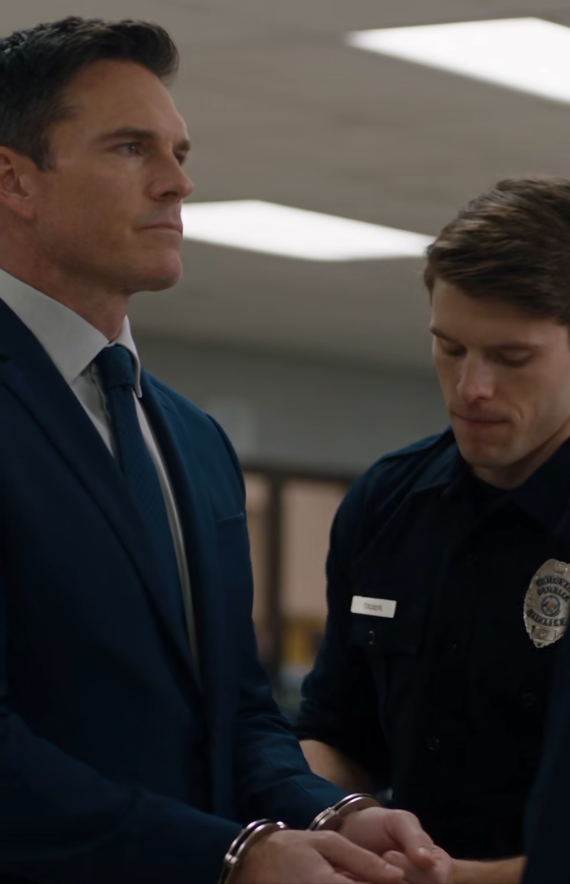
“Fear explains a choice,” he said. “It doesn’t make the choice harmless.”
“I understand.”
“Do you?”
Caleb opened his mouth.
Stopped.
“I don’t know yet.”
That answer interested Ethan.
Caleb continued.
“But I want to.”
Ethan nodded once.
“That’s more honest.”
“I’ll write a statement.”
“About what?”
“The arrest. The rumor. What Pierce said.”
“Write only what you remember firsthand.”
“Yes, sir.”
Caleb turned to leave.
“Officer Wynn.”
He stopped.
“You made one right decision this morning.”
Caleb’s shoulders loosened.
Ethan continued.
“That doesn’t cancel the first one.”
Caleb’s expression settled.
“It means the next decision is yours.”
“Yes, sir.”
After he left, Ethan looked at the notebook.
Who felt safe?
Underneath, he added another line.
Who felt safe enough to disagree?
He closed the book.
That question, he suspected, was closer to the real problem.
Part III — The Drawer
Pierce returned at 11:48 carrying three pages.
He did not sit until Ethan told him to.
“My statement.”
Ethan accepted it.
Pierce had written carefully.
No excuses.
No references to stress.
No claims that Ethan’s behavior had been suspicious.
He admitted laughing.
He admitted failing to verify.
He admitted knowing an arrival notice had been expected, though he had not personally seen it.
On the second page, the Ortega complaint appeared.
I instructed Lieutenant Voss to delay formal review pending further assessment.
Ethan looked up.
“You wrote ‘delay.’”
Pierce’s mouth tightened.
“Yes.”
“What did you mean?”
Pierce looked at the paper.
“Hold.”
“For how long?”
“I didn’t specify.”
“So indefinitely.”
“That’s what it became.”
“Who else knew?”
“Voss. Bell knew there was a complaint. I don’t know what Sutter knew.”
“Did Bell ask about it?”
Pierce paused.
“Twice.”
“What did you tell him?”
“That it was being handled.”
“And was it?”
“No.”
Ethan turned the page.
There was one sentence underlined by Pierce himself.
I believed I was preventing an unfair outcome, but I prevented any outcome at all.
Ethan tapped it.
“Why underline this?”
Pierce looked at his hands.
“Because it’s the part I kept trying not to write.”
Ethan read the line again.
“You understand admitting this could affect your position.”
“Yes.”
“Why write it?”
Pierce looked through the office window toward the lobby.
“Because if I leave it out, I’m doing the same thing again.”
Ethan placed the statement on the desk.
“Thank you.”
Pierce looked surprised.
“That doesn’t mean there won’t be consequences.”
“I know.”
“It means the statement matters.”
Pierce nodded.
Before he left, Ethan said, “Sergeant.”
Pierce turned.
“Who started the rumor about me arriving undercover?”
Pierce frowned.
“I don’t know.”
“You heard it?”
“Yes.”
“Did you correct it?”
“No.”
“Why?”
Pierce considered the question longer than Ethan expected.
“I thought it might make people behave better.”
Ethan leaned back.
“And did it?”
Pierce looked toward the lobby again.
“No.”
After lunch, the first pieces of the Ortega file arrived.
The original complaint was thin.
That concerned Ethan immediately.
Luis Ortega had written two pages.
His language was plain.
He had been walking home from a study session. A neighbor reported a suspicious person near the north apartments. Bell and Sutter stopped him.
Luis said he cooperated.
He gave his name.
He explained where he lived.
He opened his backpack when instructed.
Inside were textbooks, a laptop, notebooks, and mail addressed to his home.
The complaint then became more specific.
Officer Bell had taken Luis’s phone.
Luis asked why.
Bell told him to stop making the situation harder.
Luis said he mentioned that he had a scholarship interview the following week and did not want trouble attached to his name.
According to Luis, Bell replied, “Then don’t make trouble.”
No charge followed.
No arrest.
No citation.
The officers released him.
His complaint was filed two days later.
Attached was a note showing the complaint had been routed for supervisory review.
Then nothing.
No interview.
No finding.
No closure notice.
Ethan read it twice.
Dana stood across from his desk.
“That’s all?”
“That’s all they sent.”
She looked at the folder.
“There should be a supervisor checklist.”
“There isn’t.”
“Body camera review?”
“No.”
“Disposition?”
“No.”
Ethan closed the file.
“Find out whether the rest exists.”
Dana nodded.
At 1:17, the body-camera footage arrived.
Ethan watched alone first.
Bell’s camera began with the call.
Suspicious person.
Young male.
Backpack.
Near the apartments.
Nothing else.
Bell and Sutter approached Luis on foot.
The teenager appeared on camera in jeans, sneakers, a sweatshirt, and a backpack.
He looked tired.
Not defiant.
Not frightened yet.
Bell asked where he was going.
“Home.”
“Where’s home?”
Luis pointed across the complex.
“Building six.”
“Identification.”
Luis handed it over.
Bell read the address.
It matched.
That should have changed the encounter.
It did not.
Bell asked what was in the bag.
“School stuff.”
“Open it.”
Luis hesitated.
“Do I have to?”
Bell’s voice hardened.
“You want to make this difficult?”
Luis opened it.
Textbooks.
Folders.
A laptop.
Bell searched through them.
Sutter stood nearby, mostly silent.
Luis took out his phone.
Bell removed it from his hand.
“What are you doing?”
“Stop.”
“I’m just—”
“Stop.”
Luis did.
A minute later, Bell handed the phone back.
Luis said, “I have an interview next week. I can’t have trouble with police.”
Bell responded.
“Then don’t make trouble.”
There it was.
Not exactly as Luis remembered it.
Close enough to explain why he remembered it that way.
Ethan watched the rest.
No arrest.
No contraband.
No evidence of a crime.
No clear explanation to Luis.
Bell ended the encounter with, “You’re good.”
The camera shut off.
Ethan played it again.
Then he watched Sutter’s footage.
The angle was different.
That mattered.
From Sutter’s camera, Ethan could see Bell more clearly when Luis first identified himself.
Bell had looked at the address.
Then looked toward the apartment building.
Then continued the detention.
Sutter had glanced at Bell.
A small movement.
Almost nothing.
But Ethan knew what he was seeing.
Question.
Doubt.
And then silence.
He paused the video.
The pattern was becoming familiar.
A person sensed something was wrong.
Looked toward someone with more confidence.
Decided not to speak.
Dana knocked.
“Chief?”
“Come in.”
“I found the missing checklist.”
“Where?”
She held up several sheets.
“Not in the complaint file.”
“Where?”
“In a general administrative folder linked to Voss.”
Ethan took them.
The top page was a review form.
The boxes for body-camera review and officer interview were blank.
At the bottom was a handwritten notation.
Hold pending direction from Sgt. Pierce.
Ethan stared at it.
There was a date.
Three days after Luis filed the complaint.
Pierce had told the truth.
That should have been reassuring.
Instead, it made the failure more concrete.
Dana watched him.
“This proves he ordered the delay.”
“Yes.”
“You don’t sound surprised.”
“I’m not.”
“That’s good, isn’t it?”
“That he told the truth?”
“Yes.”
Ethan set the paper down.
“It’s better than lying.”
Dana waited.
“But truth after months of silence doesn’t undo the months.”
She nodded.
At 2:10, Ethan asked Pierce back into the office.