Chapter 1
The bus was already at the curb when the first patrol car stopped behind it.
Its lights flashed red and blue against the frost-covered lawns of Maple Ridge.
At first, I assumed there had been an accident somewhere nearby.
Then the second cruiser arrived.
And both officers looked directly at me.
Sophie tightened her grip on my coat.
She was ten years old then, with copper-brown curls that never stayed beneath a winter hat and the same hazel eyes her mother had possessed.
Naomi’s eyes.
Even after two years, sometimes looking at my daughter hurt in ways I could not explain.
“Daddy?”
“It’s okay,” I said.
I did not know if it was.
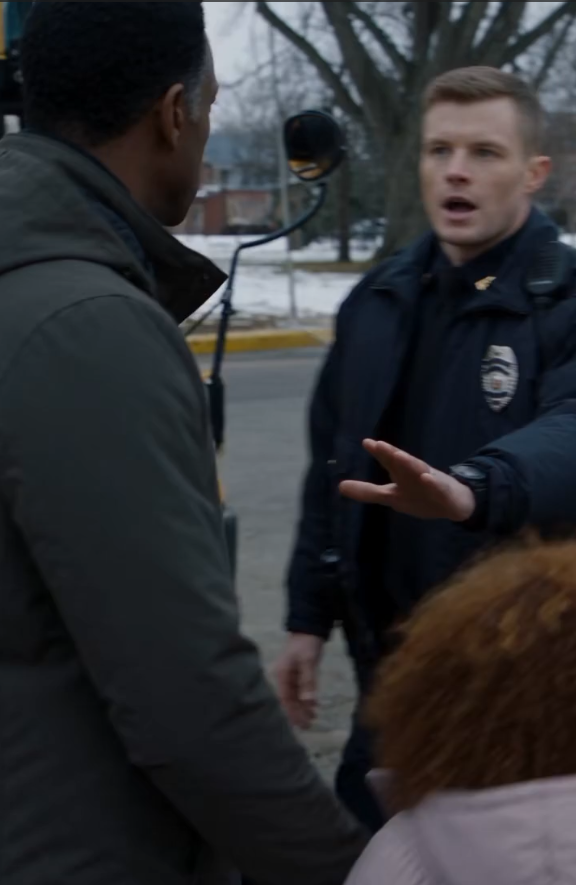
Officer Cole Whitaker stepped out first.
I knew his face.
Most people in Maple Ridge did.
He had been assigned to our area for almost three years. Tall, pale, sandy-haired, always clean-shaven. He had the posture of a man who enjoyed being watched in uniform.
Officer Lena Ortiz followed him.
She looked younger, maybe thirty-five, dark hair pulled beneath her cap, expression already uncertain.
Whitaker stopped about six feet in front of us.
“Marcus Bell?”
“Yes.”
“Sir, keep your hands visible.”
Every conversation on the sidewalk stopped.
The bus engine idled behind us.
“What is this about?”
“We received a report involving a child.”
I felt Sophie stiffen.
“What kind of report?”
Whitaker looked at her, then back at me.
“A caller reported a suspicious adult male attempting to leave the area with a young girl.”
For several seconds, I genuinely did not understand.
Then I almost laughed.
Not because anything was funny.
Because my mind rejected the possibility that he meant me.
“I’m walking my daughter to her bus.”
“We need to verify that.”
Sophie stared at him.
Whitaker continued.
“Identification, please. And any documentation establishing your legal relationship to the child.”
The world seemed to become very quiet.
“Documentation?”
“You heard me.”
From behind Whitaker, Ortiz shifted slightly.
She was watching Sophie.
Not me.
“Sweetheart,” she asked carefully, “is this your father?”
“Yes.”
Sophie’s answer was immediate.
“That’s my dad.”
Ortiz nodded.
But Whitaker held out his hand.
“Identification.”
I looked around.
Parents I had known for years stood twenty or thirty feet away.
Mr. Dorsey from the corner house.
Anna Pierce, whose son had been in Sophie’s class since kindergarten.
Tom and Megan Wilkins.
People who had eaten hamburgers in my backyard.
People whose children had slept at my house.
People who knew exactly who I was.
Nobody spoke.
So I did what experience had taught me to do.
I moved slowly.
I raised my hands.
I explained every movement before making it.
“My wallet is inside my left coat pocket.”
Whitaker nodded.
I removed it carefully.
I handed him my driver’s license.
He stared at it.
Then at Sophie.
Then at the license again.
“Do you have anything showing you’re her father?”
I felt something inside me crack.
Not explode.
Crack.
There is a difference.
Explosion is anger.
A crack is pain.
“She just told you.”
“Sir—”
“She knows her name. She knows my name. She knows where we live. Half the people standing here know us.”
“We still need verification.”
Sophie moved against me.
And then the bus doors opened.
Evelyn Harris stepped down.
Evelyn was seventy-one, maybe five foot four, and somehow capable of making adults feel like misbehaving children with a single glance.
She had driven the Maple Ridge elementary route for eleven years.
She knew everything.
Who was divorced.
Who worked late.
Whose grandmother picked them up on Fridays.
Whose kid had peanut allergies.
Who forgot gloves.
Who cried during the first week of school.
And who had walked his daughter to the bus every morning since kindergarten.
“Officer,” she said, “that is Sophie Bell.”
Whitaker glanced toward her.
“Ma’am, remain with the vehicle.”
Evelyn ignored him.
“And that man is her father.”
“Return to your bus.”
“No.”
The single word landed harder than a shout.
Several children leaned toward the windows.
Evelyn stepped closer.
“I have watched that man carry that child onto this bus when she had a sprained ankle. I watched him stand here in the rain when she was afraid to go to school after her mother died. I watched him bring cupcakes for every child on her birthday because Sophie said nobody should feel left out.”
My throat tightened.
Evelyn looked directly at Whitaker.
“You do not get to arrive here after one telephone call and pretend you know this family better than the people who have watched them love each other for years.”
Whitaker’s jaw hardened.
“We received a report.”
“Then perhaps you should question the report.”
That was when someone moved behind the curtains of the large white house across the street.
I saw the silhouette.
So did Evelyn.
And Ortiz noticed us both looking.
The white house belonged to Daniel and Margaret Pike.
Retired couple.
Quiet.
Private.
They had moved into Maple Ridge about fourteen months earlier.
I barely knew them.
Whitaker’s radio crackled.
He turned slightly.
“Unit Twelve, status?”
Whitaker pressed the microphone.
“Conducting identification.”
Static.
Then another voice came through.
“Unit Twelve, stand by.”
Something in the dispatcher’s tone changed.
Ortiz heard it too.
She looked toward Whitaker.
Thirty seconds passed.
Maybe less.
It felt longer.
Then the radio came alive.
“Unit Twelve, be advised. Caller identification has been updated.”
Whitaker’s expression changed.
Not much.
But enough.
His eyes narrowed.
His mouth tightened.
He touched the radio.
“Repeat?”
“Caller identification confirmed. Supervisory instruction: disengage immediately and clear the location.”
Nobody moved.
Whitaker swallowed.
“What’s the reason?”
The response came after a pause.
“Do not discuss over open channel. Clear the location now.”
For the first time that morning, I saw fear on Cole Whitaker’s face.
Not discomfort.
Not embarrassment.
Fear.
He handed me my license.
“We’re done here.”
I stared at him.
“That’s it?”
“Mr. Bell—”
“You stopped me in front of my child. You asked me to prove I’m her father. And now you’re just leaving?”
Ortiz stepped forward.
“Mr. Bell, I’m sorry.”
Whitaker shot her a look.
She stopped speaking.
That told me more than her apology ever could.
The officers returned to their cruisers.
The lights shut off.
The cars pulled away.
And the entire neighborhood remained frozen in silence.
Sophie looked up at me.
“Can I still go to school?”
I wanted to take her home.
I wanted to lock every door.
I wanted to make the world small enough that nothing could reach her.
Instead, I knelt in front of her.
“Yes.”
“Are the police mad at you?”
“No.”
“Then why did they do that?”
That was the question I could not answer.
Evelyn knelt beside us.
“They made a mistake,” she said gently.
Sophie looked at her.
“Police aren’t supposed to make mistakes.”
Evelyn’s eyes met mine.
“No,” she said quietly. “But people do.”
I kissed Sophie’s forehead.
She boarded the bus.
Before the doors closed, she turned back toward me.
Her face looked older.
Not physically.
Something else had changed.
Something innocence should have protected.
The bus pulled away.
Parents slowly dispersed.
Nobody knew what to say.
And then Daniel Pike crossed the street.
He was seventy-six, thin, silver-haired, always dressed like he expected company.
He looked pale.
“Marcus.”
I stared at him.
“Did you call?”
His eyes widened.
“No.”
“You were watching.”
“So was everyone.”
“Someone moved away from your window when Evelyn mentioned the caller was lying.”
Daniel looked toward his house.
“That was my wife.”
“Why?”
His next words changed everything.
“Because someone used our telephone number.”