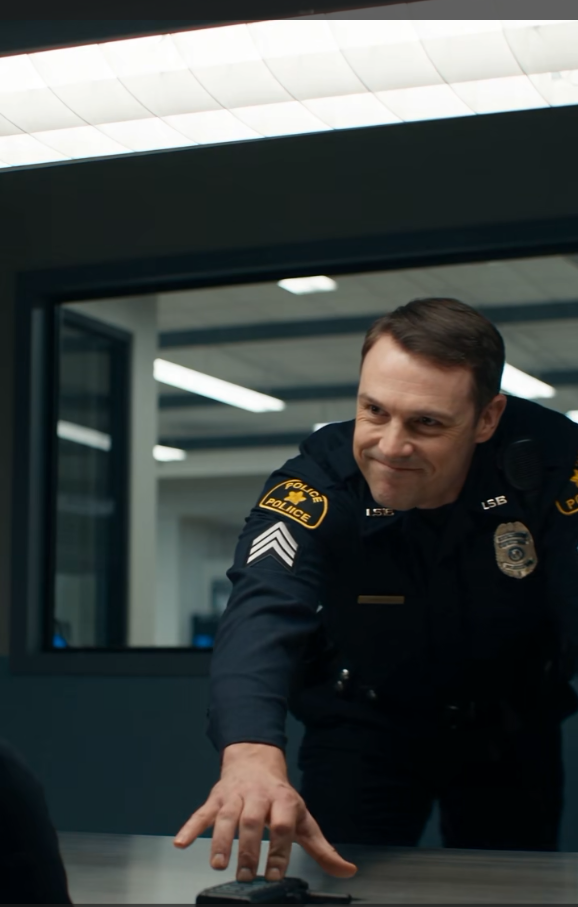
“It matters to accuracy.”
“He threatened continued detention.”
“Yes.”
“He refused release.”
“Yes.”
“He mishandled protected equipment.”
“Yes.”
“Yet you want it stated that he did not use physical force.”
“Yes.”
The operator nodded once.
“Understood.”
Through the glass, Sarah saw Vance watching.
She did not know how much he had heard.
Enough, perhaps.
He looked away when their eyes met.
Part IV — What the Record Shows
Sarah left the precinct only after the evidence was secured.
The helicopter’s engine note deepened as she approached.
Rotor wash pulled at her jacket and pushed loose strands of hair across her face. Tactical personnel moved around her with efficient familiarity, creating a protected corridor without dramatizing it.
At the aircraft door, Sarah stopped.
Behind the station windows, silhouettes watched.
One of them was Vance.
She could not see his face clearly from that distance.
Only the outline.
For a moment, she considered going back.
Not because there was more to say.
Because she was not certain anything she had said had reached him.
Then the recovery team leader touched two fingers to his headset.
“Commander.”
Sarah turned.
“Command wants you airborne.”
She climbed into the helicopter.
The door closed.
The station disappeared behind vibration and dark glass.
Only after they were in the air did Sarah allow herself to lean back.
The secure device rested against her thigh.
The team leader sat across from her.
For several minutes neither spoke.
Then he said, “You waited a long time.”
Sarah knew what he meant.
“You monitored the line?”
“Command did.”
“I know.”
“You could have activated recovery earlier.”
“Yes.”
“Why didn’t you?”
Sarah looked toward the dark window.
City lights slid below them in scattered grids.
“Because being inconvenienced is not the same as being endangered.”
“You crossed the unlawful threshold before you called.”
“Yes.”
“By several minutes.”
“Yes.”
The operator studied her.
“That was a risk.”
“It was controlled.”
“Until it wasn’t.”
Sarah looked back at him.
“That is true of most things.”
He almost smiled.
Almost.
“You knew we’d come fast.”
“I knew you’d follow protocol.”
“That sounds like confidence.”
“It’s trust.”
He nodded.
Neither spoke again.
The review began before sunrise.
By morning, every relevant recording had been collected.
The interview-room camera showed Sarah entering calm.
It showed Vance questioning her.
It showed her providing identification.
It showed him checking the front, then the back.
It showed the secure contact instruction.
It showed him setting the credential aside.
It showed Sarah requesting release.
Again.
Again.
Again.
It showed Vance refusing.
It showed him placing the communication device on the table.
It showed him telling her not to use it.
And it showed Sarah warning him.
Final opportunity.
Return my property.
End the detention.
Then the call.
Then the arrival.
Facts were rarely dramatic once arranged in sequence.
That was what made them powerful.
Sarah sat in a secure administrative room the next day and watched the footage once.
Only once.
She did not need to relive it.
She needed to verify it.
At the point where Vance turned her credential over and looked at the reverse side, Sarah paused the playback.
There.
His thumb rested directly beneath the secure verification instruction.
A phone number.
An authorization code.
Clear.
Small, but clear.
Sarah stared at the frozen image.
That moment was the case.
Not the helicopter.
Not the tactical team.
Not even the detention.
The choice.
He had had the correct procedure in his hand.
He had ignored it.
Sarah resumed the video.
An investigator seated beside her asked, “Why do you think he ignored it?”
“I don’t know.”
“You have no opinion?”
“I have several.”
“Which are?”
“Not evidence.”
The investigator gave her a sideways look.
Sarah continued watching.
On screen, Vance smiled.
In the quiet review room, the expression looked different.
Less powerful.
More revealing.
Not evil.
Not cruel.
Comfortable.
That was harder to dismiss.
The investigator stopped the recording.
“Would you characterize his conduct as malicious?”
Sarah considered.
“No.”
“Reckless?”
“Yes.”
“Incompetent?”
“I’m not qualified to make that determination.”
“You’re being careful.”
“I’m being accurate.”
The investigator folded his hands.
“Commander Sterling, you understand this may become a larger matter.”
“Yes.”
“Public.”
“Possibly.”
“Politically sensitive.”
Sarah’s gaze sharpened.
“That is not my concern.”
“It may become your concern.”
“My concern is what happened.”
“And what do you want to happen?”
The question was more difficult than Sarah expected.
She leaned back.
She had spent the night thinking about it without allowing herself to form a simple answer.
Termination?
Suspension?
Training?
Disciplinary action?
Each sounded too easy when said in isolation.
“What I want is irrelevant.”
The investigator shook his head.
“No. It matters because you’re the complainant.”
“I’m not asking for retaliation.”
“I didn’t say retaliation.”
“I’m asking for the process to work.”
“And if the process decides he made a bad call under unusual circumstances?”
Sarah looked at the frozen frame on the monitor.
Vance’s thumb still covered the verification instruction.
“Then the process should explain why he made the same bad call after he was given a way out.”
That was the part she could not dismiss.
Mistakes happened.
People misread documents.
Systems failed.
Information arrived incomplete.
But the incident had not been one mistake.
It had been a sequence.
Each step offered a correction.
Each correction was refused.
The investigator resumed the footage.
At the point where Sarah activated the device, Vance moved around the table.
The investigator slowed the playback.
“He nearly reached for you.”
“He did not.”
“You told him not to touch you.”
“Yes.”
“Did you believe he might?”
“Yes.”
“But he didn’t.”
“No.”
The investigator looked at her.
“You keep making distinctions that help him.”
“I’m making distinctions that help the truth.”
The investigator watched her for a moment, then nodded.
“Fair enough.”
Two days later, Sarah learned Vance had been placed on administrative leave pending review.
She felt no satisfaction.
That surprised her less than it might have surprised someone else.
Institutional consequences were rarely satisfying.
They were necessary or unnecessary.
Appropriate or excessive.
Useful or performative.
Satisfaction had little to do with it.
What did trouble her was the message sent through formal channels the following afternoon.
Vance had requested to speak with her.
Sarah read the request twice.
The recovery team leader, standing across her office, watched her.
“You don’t owe him that.”
“I know.”
“You want to?”
“No.”
“That usually means no.”
Sarah set the message down.
“He requested it formally.”
“So?”
“So he used procedure.”
The operator’s expression shifted.
“You’re rewarding him for filling out a form?”
“No.”
“What are you doing?”
Sarah looked at the request again.
“Finding out whether he learned why the form matters.”
Part V — The Second Interrogation
They met in a neutral federal conference room three days later.
No metal table.
No weapons visible.
No locked door.
Sarah chose the seat nearest the exit.
Vance noticed.
He arrived in civilian clothes.
Dark slacks.
Plain shirt.
No badge.
No uniform.
The absence changed him more than Sarah expected.
He looked smaller, but not physically.
Less defined.
The uniform had given his movements context.