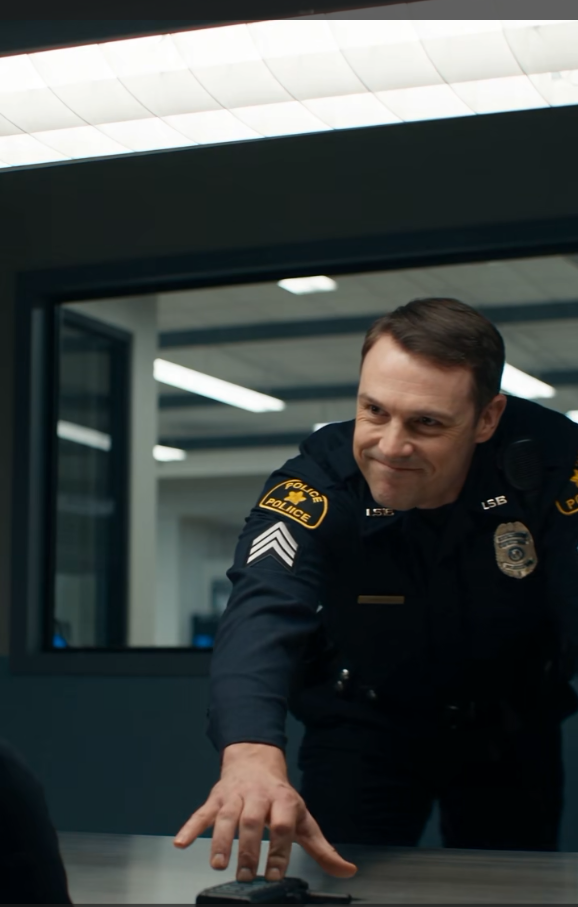
Sarah’s expression changed.
For the first time, something harder entered her voice.
“I do not believe that.”
Vance stopped.
Sarah leaned forward.
“I believe systems work only when people keep forcing them to distinguish fact from ego.”
He said nothing.
“That includes your ego.”
A pause.
“And mine.”
Vance watched her carefully.
Sarah continued.
“If I use this process to punish you because I’m angry, I corrupt it too.”
“You are angry.”
“Yes.”
The admission stayed between them.
Vance looked almost relieved to hear it.
Sarah did not let him misunderstand.
“Anger does not make the facts less important. It makes discipline more important.”
Vance sat back.
He nodded slowly.
Not agreement.
Acceptance.
The meeting ended twenty minutes later.
No handshake.
No apology scene.
No sudden understanding.
Vance stood near the door.
Sarah remained seated.
He looked at her once before leaving.
“I did think you were trying to make me look stupid.”
Sarah met his eyes.
“And now?”
Vance considered the question.
“Now I think I did that myself.”
Then he left.
Sarah sat alone for several minutes afterward.
It was not victory.
It was something better.
A beginning that did not pretend to be an ending.
Part VI — Recovery
The final review took six weeks.
Sarah did not follow it closely.
She responded when asked.
Read statements when required.
Corrected two minor factual errors in a draft report.
Declined three requests for public comment.
She had no interest in becoming the face of the incident.
The helicopter footage leaked anyway.
A distant phone video showed the aircraft descending outside the precinct gates, rotor wash scattering paper and dust across the street. Another clip captured dark-uniformed tactical personnel entering the building.
The internet did what it always did.
It invented the rest.
Sarah ignored it.
Headlines described a “mystery commander.”
Commentators speculated about covert operations.
People who had never met Officer Vance called him either a hero or a tyrant depending on which version of the story they preferred.
People who had never met Sarah called her either powerful or reckless.
None of them had sat in the room.
None of them had seen the back of the credential.
The final report was quieter.
Officer Vance had violated detention procedure.
He had failed to use the verification method provided.
He had retained protected equipment without proper authority.
He had extended the detention after the legal basis had become insufficient.
The report also stated that he had not used physical force and had complied with recovery personnel once they arrived.
Sarah read that section twice.
Accurate.
That mattered.
The discipline was significant but not theatrical.
Vance was suspended, removed from interrogation responsibilities pending retraining, and required to complete additional procedural certification before returning to independent duty.
Some people thought that was too lenient.
Others thought it was excessive.
Sarah thought neither.
The outcome matched the record.
That was enough.
Months later, Sarah returned to the same city on unrelated work.
She almost did not notice the precinct as the vehicle passed.
Almost.
The building looked ordinary in daylight.
Smaller than she remembered.
No helicopter.
No tactical team.
No crowds.
Just a municipal building behind a gate.
Sarah asked the driver to stop.
He looked at her in the mirror.
“Here?”
“For a minute.”
She stepped out.
The day was warm.
Traffic moved steadily past the intersection.
Sarah stood on the sidewalk and looked at the entrance.
She had no reason to go inside.
So she did not.
She was turning back toward the vehicle when the precinct door opened.
Vance stepped outside.
He wore his uniform again.
Sarah stopped.
So did he.
For a moment neither moved.
Months had changed him subtly.
Not in age.
In posture.
The easy certainty was gone.
He looked more deliberate now.
Perhaps that was projection.
Perhaps not.
Vance walked down the steps.
He stopped several yards from her.
“Commander.”
Sarah gave a small nod.
“Officer.”
The title landed differently this time.
He looked toward the gate, then at her.
“I heard you were in town.”
“I didn’t announce it.”
“Small department.”
Sarah almost smiled.
“I remember.”
Vance took a breath.
“I’m back on duty.”
“I see that.”
“Not interviews yet.”
Sarah waited.
He nodded toward the building.
“They changed the verification procedure.”
That got her attention.
“How?”
“If a credential doesn’t match the normal database, we don’t treat the mismatch as invalidation anymore. There’s a separate verification route.”
Sarah looked at the station.
“Good.”
Vance continued.
“They also added a review requirement if someone requests release more than once and there isn’t a clear charge.”
Sarah looked back at him.
“You suggested that?”
He hesitated.
“Yes.”
That surprised her.
Not because she thought him incapable.
Because she had not expected him to say it without wanting credit.
Sarah nodded once.
“That is useful.”
Vance gave a faint smile.
“Highest praise I’ve ever gotten from you.”
“Probably.”
They stood in the afternoon light while traffic passed behind them.
There was no neat forgiveness available.
Sarah did not know if she forgave him.
Vance did not ask.
That was another sign of progress.
After a moment he said, “I almost called the number.”
Sarah looked at him.
“That night.”
“I know.”
“No, I mean really. Before you activated the device.”
Sarah waited.
Vance looked toward the station.
“I had the credential in my hand. I looked at the number. I thought about it.”
“Why didn’t you?”
He was quiet for several seconds.
“Because if I called it, I had to admit there was something in front of me I didn’t understand.”
Sarah absorbed that.
There it was.
Not the entire cause.
Not a magical explanation.
But a piece of truth sharp enough to matter.
Vance looked at her.
“I used to think authority meant being the person in the room who knew what was happening.”
“And now?”
He glanced back at the building.
“Now I think it might mean being the first person willing to admit when you don’t.”
Sarah said nothing.
Vance gave a small nod.
Then he turned to go.
Sarah stopped him.
“Officer Vance.”
He looked back.
She reached into her jacket.
His expression changed reflexively.
Then he saw what she was holding.
The same black secure communication device.
The one that had turned his interrogation room into the center of a recovery operation.
Sarah looked down at it, then at him.
Vance stared for half a second.
A faint, embarrassed laugh escaped him.
“Still carrying that thing?”
“Yes.”
He nodded toward it.
“Still encrypted?”
“Yes.”
“Still brings helicopters?”
Sarah slipped it back into her jacket.
“Only when people ignore instructions.”
Vance laughed.
A real laugh this time.
Short and quiet.
Sarah turned toward the waiting vehicle.
Behind her, Vance called, “Commander.”
She looked over her shoulder.
He stood at the bottom of the precinct steps.
No smirk.
No defensiveness.
No expectation that the moment belonged to him.
“Next time,” he said, “I’ll make the call.”
Sarah studied him for a moment.
Then she nodded.
“That was always the point.”
She got into the vehicle.
As it pulled away, the precinct receded through the rear window.
The building looked ordinary again.
Sarah was glad.
Institutions were supposed to look ordinary.
Their strength was not in helicopters descending at their gates or tactical teams crossing their floors.
It was in what happened before any of that became necessary.
A number printed on the back of a credential.
A question asked twice.
A pause before assumption hardened into action.
A person willing to say, I don’t know.
And another willing to listen.
Sarah rested one hand over the secure device inside her jacket as the city moved around her.
For the first time since that night, she realized she no longer remembered the sound of Vance’s smirk in the interrogation room.
What she remembered instead was the final thing he had said.
Next time, I’ll make the call.
That, she thought, was what recovery was supposed to mean.