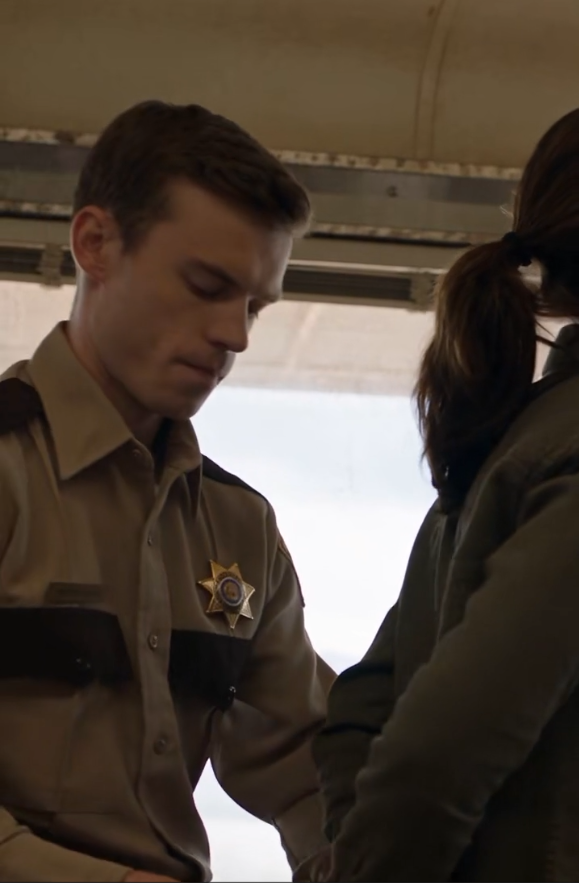
"Not tonight."
That bothered me more than it should have.
She saw it.
"It's evidence."
"It's my truck."
"Those facts are temporarily compatible."
I leaned back.
The first edge of exhaustion caught up with me.
"What happens now?"
The NCIS agent answered from the doorway.
"Now we find out whether this happened once."
I looked at the old evidence label inside the bag.
"No," I said. "We find out how many times."
That was when the story stopped being about me.
Part IV — Reckoning
At 1:06 in the morning, I finally called my command.
The voice on the other end answered after one ring.
"Reese."
"Sir."
A pause.
"Status?"
"Uninjured."
"Location secure?"
"Federal custody environment. Not detained."
Another pause.
"You miss check-in often?"
"First time."
"Let's keep it special."
"Yes, sir."
His tone changed.
"Your leave remains in effect."
"I assumed."
"That means you are not running an investigation."
"I assumed less strongly."
"Reese."
"Sir."
"NCIS exists for reasons."
"I've been told."
He exhaled through his nose.
Then, more quietly, "You good?"
I looked through the conference-room window.
Deputy Two was being escorted into an interview room.
Sheriff Miller's office door stood open.
His brass-star plaque had been removed from the desk.
"I'm angry."
"That's not what I asked."
I considered lying.
"Ask me tomorrow."
"Fair."
He paused.
"One additional issue. Your current assignment and the operation preceding leave remain compartmented. You will not disclose operational affiliation to local or federal personnel beyond what security has cleared."
"Understood."
"You can identify rank and branch. Nothing else."
"Understood."
"NCIS has a security representative en route to manage the rest."
"Yes, sir."
Then he said something I didn't expect.
"You have the option to leave once cleared."
I looked at the plastic chair across from me.
"Leave Okehaven?"
"Leave the incident to investigators. Your involvement can be handled through sealed statements. Given the sensitivity of your position, that's the preferred path."
There it was.
The easy exit.
Not easy emotionally.
Easy administratively.
A sealed statement.
A quiet drive away.
My career protected.
My identity protected.
My name kept out of public filings as much as law allowed.
Professionals would investigate.
Maybe they'd build the case.
Maybe they wouldn't.
I thought about the forfeiture form created twenty-six minutes before I entered the diner.
The waitress watching through the window.
Deputy One saying, I didn't search your truck.
Miller promising I'd give up the Bronco for a phone call.
Granger telling me nobody cared about one traveler from Colorado.
"Preferred by whom?" I asked.
"Security."
"Not investigators."
"No."
I looked at the half-empty water bottle on the table.
"If my direct testimony becomes necessary?"
"Then legal and security will work through it."
"And if public court proceedings require my presence?"
"Same answer."
"You're telling me to go home."
"I'm telling you that you are on leave and not responsible for fixing Texas."
Despite myself, I smiled.
"That's a broad mission statement."
"It was meant to be."
"I'll cooperate with investigators."
"Within security guidance."
"Yes, sir."
"And then?"
I stared through the glass at the sheriff's empty office.
"Then I'll decide."
When I ended the call, I did not feel relieved.
Choice is heavier when both options are reasonable.
At 2:30 a.m., the federal teams found the first connection.
The trimmed evidence label on the narcotics bag corresponded to a DEA seizure from eighteen months earlier.
Granger had been the secondary evidence agent.
At 3:40, they found the second.
An internal transfer record showed part of the seizure had supposedly been destroyed.
But destruction documentation contained a serial discrepancy.
At 5:10, investigators obtained enough preservation authority to seize relevant county records before anybody could alter them.
At 6:00, I was still awake.
The sky outside the administrative windows had begun turning gray.
The elderly waitress from Higgins arrived shortly after sunrise.
I saw her through glass.
She carried her purse with both hands.
One of the investigators led her into an interview room.
Forty minutes later she emerged.
She saw me.
Stopped.
The investigator hesitated.
I walked into the hallway.
The waitress studied me.
Without handcuffs, I apparently looked more like the woman from the corner booth again.
"Are you okay?" she asked.
"Yes, ma'am."
She nodded.
Then her mouth tightened.
"I saw him."
"Who?"
"The federal man."
"Granger?"
She nodded.
"He went outside before the others came in."
I said nothing.
"He had a bag."
The hallway seemed to narrow.
"What kind?"
"Duffel."
She looked embarrassed by how simple the answer sounded.
"Dark one. He went around the side of your truck."
"Did you see him put it inside?"
"No."
She shook her head.
"Window reflection. Couldn't see that low."
That mattered.
Not perfect evidence.
Real evidence.
"What happened after?"
"He came back in the side door to the kitchen."
"Before the sheriff arrived?"
"Maybe two minutes."
"Did anyone else see him?"
She looked down.
"I don't know."
The investigator beside her intervened gently.
"We'll take it from here."
The waitress nodded.
Then she looked at me again.
"They've done this before."
I felt something settle inside me.
Not surprise.
Recognition.
"How do you know?"
Her eyes shifted toward the sheriff's office.
"People disappear from this town without disappearing."
I waited.
"Cars get taken. Folks sign papers. Travelers don't come back to fight."
She rubbed one thumb across the strap of her purse.
"My nephew lost his truck last year."
I did not ask for details.
That wasn't my interview.
But Granger's sentence returned to me.
Nobody cares about one traveler from Colorado.
Maybe the entire scheme depended on choosing people nobody nearby would miss.
By noon, the investigation had widened beyond my arrest.
County impound records.
Cash seizure logs.
Vehicle titles.
Dismissed drug cases.
Plea bargains.
Asset disclaimers.
Patterns began forming.
Out-of-state plates.
Travelers alone.
People carrying cash.
Commercial drivers.
Motorists with no local attorney.
Cases where the narcotics charges later disappeared but property stayed behind.
Sheriff Miller had not invented the machine.
He had made it local.
Granger had made it durable.
Deputy Two, investigators learned, had helped with some searches and transport paperwork.
Deputy One had joined the department only eight months earlier.
That explained the sweating.
He was new enough to still know something was wrong.
Old enough in the system to be afraid of saying so.
By afternoon, Sheriff Miller and Granger had both retained attorneys.
Neither had been formally charged yet.
That was when the harder part began.
A bad arrest can be exposed in hours.
A corrupt system takes records, testimony, warrants, accountants, prosecutors, and patience.
I had very little patience left.
The NCIS agent found me outside the building near the impound lot.
My Bronco sat behind temporary federal evidence tape.
The sight of it irritated me all over again.
"You're staring at it like it betrayed you," he said.
"It let strangers drive it."
"It's a truck."
"That's an opinion."
He stood beside me.
"They found something."
I looked at him.
"Your Bronco has an aftermarket dash camera."
I nodded.
I'd installed it after too many long-distance drives through parking lots where nobody respected old vehicles.
"Parking mode?"
"Front and rear. Motion triggered."
"We recovered the memory card."
My pulse changed for the first time since the arrest.
Not much.