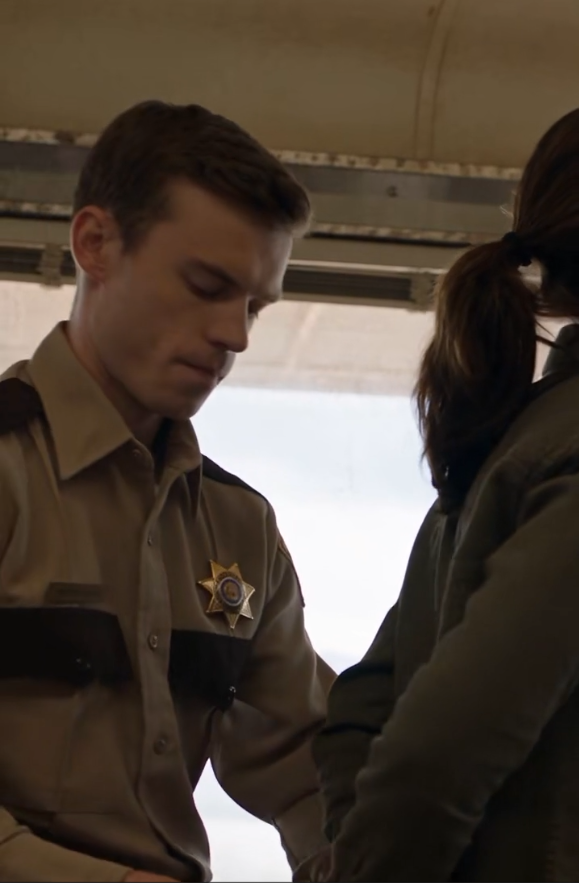
Deputy Two was charged later with obstruction and false statements.
Deputy One was not charged.
He became a cooperating witness.
The indictment alleged conspiracy, evidence tampering, deprivation of rights, falsification of records, and offenses related to corrupt asset seizures.
It described a pattern stretching back years.
My case was not the beginning.
It was the mistake that made the end possible.
Months passed.
My leave ended.
I returned to work.
The world moved on.
Okehaven did not.
Every few weeks another record produced another victim.
A trucker from Oklahoma.
A retired mechanic from New Mexico.
A traveling nurse.
A young couple driving west with cash to buy used equipment.
Some had criminal charges dismissed but never recovered their property.
Some had accepted pleas because they could not afford to fight.
One had served seven months before evidence problems forced review.
None of them knew my name beyond what appeared in public court filings.
That was how I preferred it.
Then came the call.
Trial.
The prosecutor needed me.
Granger's defense had separated from Miller's. Each man blamed the other.
Miller claimed Granger controlled the narcotics.
Granger claimed Miller's deputies had conducted every search.
Both suggested the asset disclaimers were ordinary administrative preparation.
And both had decided I was useful to attack.
So I returned to Texas.
Not to Okehaven.
To federal court.
I wore a dark navy suit.
No uniform.
No ribbons.
No visible reminder of anything I'd done before the diner.
The security officer sat behind the prosecution table.
When I took the oath, Granger looked at me for the first time in months.
His face had changed.
Not physically.
Context changes people.
In Higgins Diner, his badge had been power.
Here, it was evidence.
The prosecutor began simply.
"State your name."
"Alice Reese."
"Occupation?"
"Officer in the United States Navy."
"Rank?"
"Lieutenant Commander."
"Were you on duty on the date of your arrest?"
"I was on authorized administrative leave."
"Why were you driving through Okehaven?"
"I was traveling privately."
"Did you possess methamphetamine?"
"No."
"Did you place methamphetamine in your vehicle?"
"No."
"Did you authorize anyone else to do so?"
"No."
She took me through the diner.
The arrest.
The search claim.
The forfeiture form.
The timestamp.
My observations.
The camera being disabled.
Granger's offer.
Miller's comment about signing over the Bronco.
Then she showed the jury the dash-camera footage.
On a large monitor, my old Bronco sat under hard Texas sunlight.
At 15:49, Thomas Granger entered frame carrying a dark duffel.
He looked around.
Opened the passenger door.
Disappeared from view.
Twenty-three seconds later, he returned without the bag.
No music.
No dramatic sound.
Just grainy parking-mode footage and a timestamp.
Sometimes truth is most devastating when it looks boring.
The prosecutor paused the image.
"Is that your vehicle?"
"Yes."
"Were you present?"
"No."
"Did Agent Granger have your permission to enter it?"
"No."
She showed the next clip.
A deputy moved the Bronco.
Then came the diner receipt.
4:08 p.m.
Then the forfeiture document.
3:42 p.m.
She looked at the jury.
No flourish.
No speech.
Just chronology.
Granger's attorney rose for cross-examination.
He was good.
That helped.
Good lawyers don't waste time pretending impossible things are possible.
They look for uncertainty.
"Lieutenant Commander Reese, you have extensive military training?"
"Yes."
"Advanced training?"
"Yes."
"In threat assessment?"
"Yes."
"In surveillance?"
"Some."
"In interrogation resistance?"
The security officer behind the prosecutor shifted.
I answered carefully.
"I'm trained to communicate appropriately under stressful conditions."
The attorney smiled.
"That wasn't my question."
"It's the answer I can give."
The judge intervened.
"Counsel, move on."
He did.
"You remained silent during most of your arrest."
"Yes."
"You did not immediately tell Sheriff Miller you were a naval officer."
"No."
"You did not tell Agent Granger."
"No."
"You didn't explain the contents of your vehicle."
"No."
"You didn't protest when officers said narcotics had been found."
"Not immediately."
"Isn't that unusual behavior for an innocent person?"
I looked at him.
"No."
He waited.
I continued.
"It's disciplined behavior for a person who believes officials are lying."
A few jurors shifted.
The attorney stepped closer.
"You decided they were corrupt within minutes."
"I concluded their explanation was inconsistent with what I knew to be true."
"You believed you knew better than law enforcement."
"I knew what was in my truck."
"Are you saying law-enforcement officers never discover contraband unknown to the owner of a vehicle?"
"No."
"So your certainty was based on assumption."
"No."
"What was it based on?"
"My truck had been moved. The search story changed. No canine was present despite a later report claiming an alert. The officer said to have searched the vehicle was never identified. A property disclaimer was prepared before I entered the diner. Agent Granger disabled the interview camera before offering me favorable treatment in exchange for surrendering property."
The attorney held up a hand.
"One question at a time."
"Then ask one fact at a time."
The judge looked over his glasses.
"Lieutenant Commander."
"Yes, Your Honor."
The attorney changed direction.
"You carry a firearm."
"Yes."
"You had eight hundred and forty dollars in cash."
"Yes."
"Your vehicle was registered out of state."
"Yes."
"Those facts can be associated with narcotics trafficking, can't they?"
"They can also be associated with driving through Texas."
A few people in the gallery reacted.
The judge silenced them with a glance.
Granger's attorney returned to his table.
Then he made the mistake.
"Lieutenant Commander, isn't it true that your actual military assignment is highly sensitive?"
The prosecutor stood.
"Objection."
The security officer was already moving.
The judge called both sides forward.
Voices lowered at the bench.
I sat still.
Granger looked at me.
For the first time, I understood what his attorney was trying to do.
Make secrecy suspicious.
If the jury heard that parts of my record were classified, defense could imply hidden motives.
Why was Alice Reese really in Okehaven?
Why was she driving alone?
What was in the locked case?
Why did federal agencies respond so quickly?
Create a fog.
Then hide inside it.
After several minutes, the judge ruled.
The attorney could establish that some duties were not publicly disclosed.
He could not ask operational questions.
Cross-examination resumed.
"Your assignment at the time was not publicly available?"
"Correct."
"And when local authorities ran your name, they encountered restricted information?"
"I don't know what they encountered."
"But federal officials responded to your detention within hours."
"Yes."
"Unusual, wouldn't you agree?"
"Depends on the person."
He watched me.
"Why did they respond so quickly?"
This was the line.
The prosecutor looked at me.
The security officer looked at me.
I knew the approved answer.
Security protocols following sensitive duty.
Nothing more.
But the attorney wanted me to sound evasive.
I could feel the trap.
Then I realized something.
It was the same trap Granger had used in the diner.
Talk too much or look guilty for saying too little.
I took a breath.
"Because I missed a required security check-in."
The attorney paused.
"Security related to what?"
"Sensitive military duties."
"What duties?"
"I am not authorized to discuss them."
"So the jury is supposed to accept that federal agents arrived because of something you cannot explain."
The prosecutor stood.