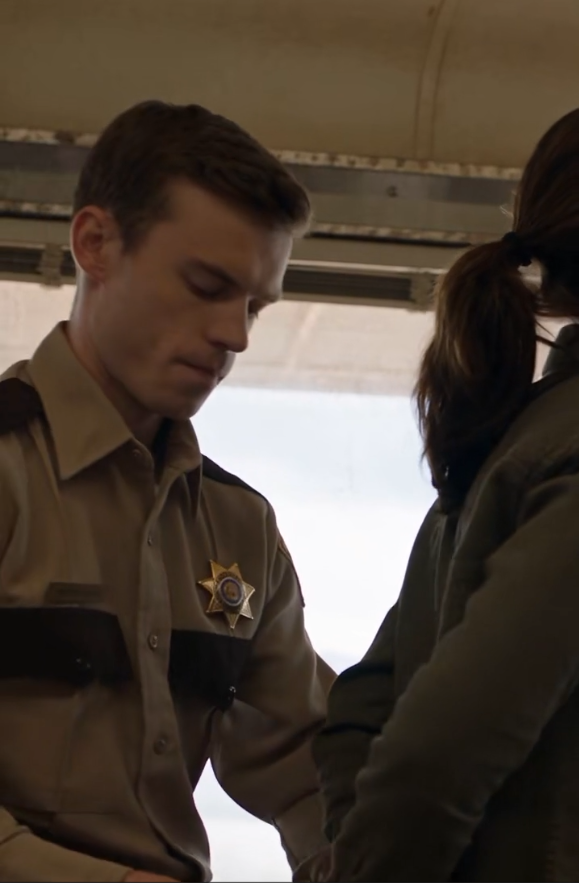
Deputy Two pleaded guilty to lesser federal charges and admitted falsifying records.
Deputy One resigned from the Okehaven Sheriff's Office before the trial ended.
He sent me one message through investigators.
I didn't search your truck.
Then a second sentence.
I should have said something sooner.
I never replied.
There was nothing useful to say.
He was right.
So was the fact that he eventually spoke.
Both things could exist at once.
The Okehaven seizure program was suspended.
Vehicles still held without lawful basis were reviewed.
Cash accounts were frozen.
Auction records were audited.
Some property could be returned.
Some had already been sold.
Some money was gone.
Justice, I learned long before Texas, is rarely restoration.
It is usually accounting after damage.
Months later, a federal restitution notice listed dozens of claimants.
The number was higher than thirty-one.
Then higher again.
Every new name made the original arrest feel smaller.
My Bronco came back to me on the third day after the diner.
The federal evidence team had dusted it, photographed it, vacuumed parts of it, removed the rear seat, and reinstalled everything with the awkward precision of people who respected procedure more than old upholstery.
The cut lock on my Pelican case was replaced.
My SIG was returned after the case was formally cleared.
My eight hundred and forty dollars took longer.
Government money is sometimes easier to seize than to return.
When the envelope finally arrived, I counted it.
Eight hundred and forty exactly.
I kept the receipt.
A year after the arrest, I drove through Okehaven again.
Not because I needed closure.
I don't trust closure. It sounds too final.
I went because the route made sense.
The highway looked the same.
Cracked asphalt.
Dry fields.
The water tower in the distance.
But the sheriff's campaign signs were gone.
The county vehicles outside the station carried a different insignia.
Higgins Diner was still open.
I parked the Bronco in almost the same spot.
This time, I checked the tire against the oil stain out of habit.
Different stain.
Same habit.
The rusted bell above the door gave a weak clang when I entered.
The waitress was behind the counter.
She looked up.
For half a second, she didn't recognize me.
Then she did.
"Well," she said.
"Morning."
She looked through the window at the Bronco.
"You got it back."
"I did."
"All of it?"
"Most."
She nodded as if that was the best answer life usually offered.
I sat in the same corner booth.
She brought coffee without asking.
Then cherry pie.
"I didn't order this."
"You did last time."
"That was a year ago."
"I keep notes."
I looked at her.
She smiled.
I tasted the coffee.
Hot this time.
She leaned one hand on the opposite seat.
"They sent my nephew a letter."
I set down the cup.
"About his truck?"
"About the money from it."
"What happened?"
"He's getting some back."
"Good."
"Not all."
"No."
She studied me.
"They said your case opened the review."
"It opened one door."
"Same thing sometimes."
I didn't argue.
She went back to the counter.
I ate the pie slowly.
Outside, trucks passed on the highway.
Nobody kicked in the door.
Nobody shouted.
Nobody put a hand on a weapon.
Nobody tried to turn silence into guilt.
When I finished, I left cash under the coffee cup.
More than the bill.
Not because the waitress had helped save me.
She hadn't.
She had simply told the truth when telling the truth finally mattered.
Outside, sunlight reflected off the Bronco's faded hood.
I opened the driver's door.
Before climbing in, I looked across the highway toward the old sheriff's office.
For a moment I remembered Boyd Miller leaning into the cruiser radio, confident that by midnight I would trade my truck for the privilege of making a phone call.
He had misunderstood almost everything about me.
But the biggest mistake wasn't failing to recognize military rank.
It wasn't failing to recognize training.
It wasn't choosing a woman whose absence triggered a security protocol.
Their mistake was simpler.
They had built an entire criminal system around the belief that some people did not matter enough for anyone to come looking.
I started the engine.
The old V8 caught on the second turn.
As I pulled back onto the highway, Higgins Diner shrank in the mirror behind me.
I did not feel victorious.
Victories are clean.
This wasn't.
People had lost months of their lives. Money. Vehicles. Jobs. Trust. Some would never recover everything that had been taken from them.
But the machine was broken.
The records existed.
The names had been found.
And men who had counted on silence had finally been forced to answer inside rooms they did not control.
I drove east with the window down.
No music.
No escort.
No classified briefing waiting at the next exit.
Just open road, engine noise, and hot wind moving through the cab.
My hands rested lightly on the wheel.
A year earlier, the same road had carried me into a town where four men thought a badge, a planted bag, and a locked pair of cuffs could define who I was.
Now the town disappeared behind me.
I never looked back again.
They had mistaken my silence for helplessness. In the end, silence was simply the time I used to learn exactly where their system would break.