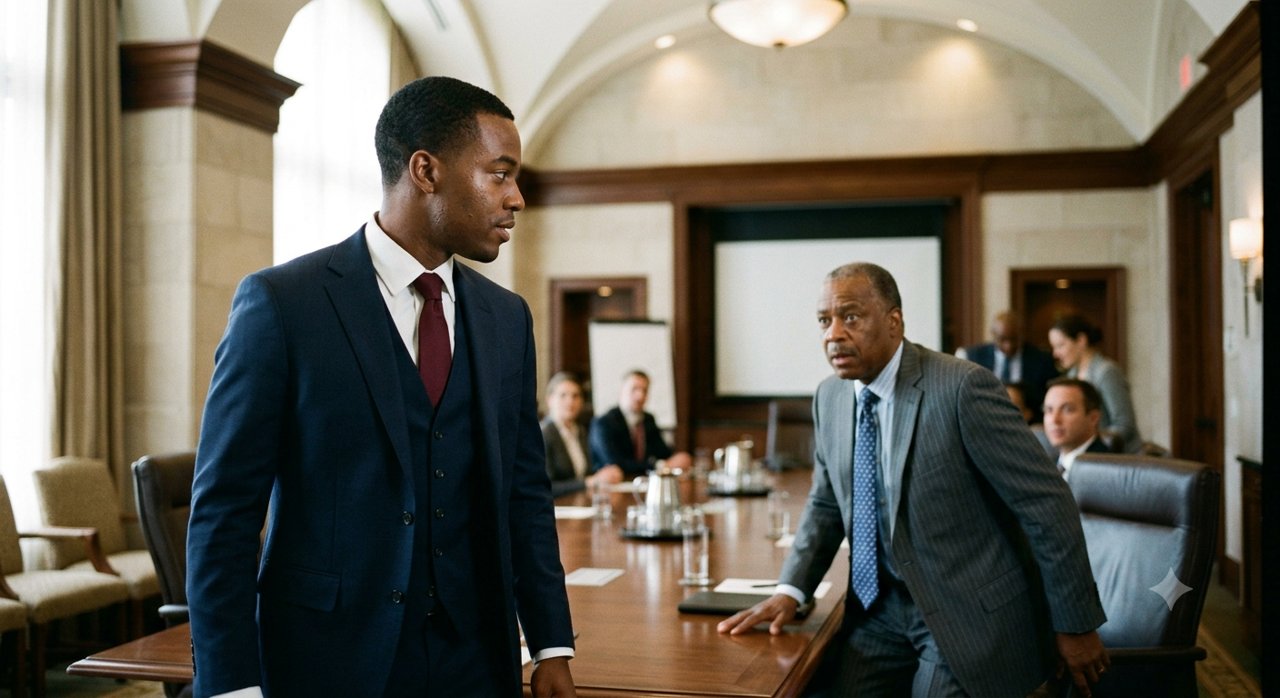
David Marsh arrived forty minutes later.
He was a compact, unhurried man in his early sixties, the kind of solicitor who wore the same style of suit he'd worn for thirty years because it had always been correct and he saw no reason to change.
He came through the door, took in the room — the guests still scattered in small clusters, the balloons, the half-eaten birthday cake, Vanessa sitting alone near the window — and simply said, "Right.
Where do we start?"
Adrian handed him the envelope.
David read it standing up.
He read it twice.
Then he folded it carefully and looked at Patricia.
"You're the neighbor," he said.
"Patricia Holden.
I was a witness to the will."
"I know your name.
Eleanor mentioned you." He tucked the envelope into his jacket pocket.
"I have the original note in the file.
This matches." He looked at Adrian.
"She sent it to me the morning after Vanessa's visit.
I've been waiting to see if it would be needed."
"It's needed," Adrian said.
"Yes." David turned to look at Vanessa.
He didn't approach her.
He simply looked at her from across the room, the way a man looks at a problem he has seen many times before.
"Miss Holloway."
Vanessa stood.
Old reflex — standing when addressed formally.
"Mr.
Marsh."
"I've reviewed your claim twice in the past three weeks," David said.
"There is no legal basis for it.
The will is correctly executed, properly witnessed, and Eleanor's note documents the specific pressure you applied and her explicit rejection of it." He paused.
"Tonight's events — which I understand were recorded in full — add a separate dimension that I'll need to discuss with my client.
But I want to be clear about the core matter: there is no version of this claim that succeeds.
There never was."
Vanessa's voice was very quiet.
"She always favored him."
"That was her right," David said simply.
"She had more than enough to share."
"Also her right."
"I needed—" Vanessa stopped.
Started again.
"I have been struggling.
Financially.
For years.
And she knew that.
And she left everything to him anyway."
The room was very quiet.
"I understand that's painful," David said.
"But pain is not grounds for a legal claim.
And it is certainly not grounds for what happened to that child tonight."
Vanessa looked at Mia.
Mia was still wrapped in Sue's cardigan, still holding a piece of cake, still watching.
She met Vanessa's eyes without looking away.
Seven years old and she didn't look away.
"I didn't mean for her to be hurt," Vanessa said.
It came out smaller than anything else she'd said all evening.
"Then you should have thought more carefully," I said.
"Before you chose her birthday.
Before you ruined her dress and pointed at her in front of everyone she knows.
Before you let her stand there sobbing while you performed innocence." I kept my voice steady.
"Whatever you needed, Mia had nothing to do with it.
She was seven years old in her favorite dress and you made her a prop."
Vanessa sat back down.
She didn't argue.
She didn't perform.
She just sat down.
David spoke to Adrian quietly for several minutes near the door.
I caught fragments — *formal withdrawal, the footage, potential civil action, Diane's phone records.* Adrian nodded.
He asked two questions.
David answered them.
Then David crossed the room to Diane.
Diane had been sitting in the same chair for over an hour.
She looked up when he approached.
"I'll need a statement from you," he said.
"About the approach, the arrangement, and the messages.
Tonight if possible, or tomorrow morning at the latest."
"I'll give you whatever you need," Diane said.
Her voice was hollow.
"I know that doesn't fix anything."
"No," David said.
"It doesn't.
But it helps."
He left thirty minutes later with Patricia's envelope, a copy of the live stream link that one of the guests had pulled up on their phone, and Diane's written agreement to provide a formal statement.
The guests began to leave after that.
Quietly, in small groups.
Several of them stopped to say something to me on the way out — a hand on the arm, a few words, the school parent whose name I still didn't know pressing my hand briefly and saying, "You handled that beautifully." I didn't feel like I had handled anything.
I felt like I had stood in a room while things happened around me and tried not to fall apart in front of my daughter.
But Mia was still eating cake.
That felt like the most important thing.