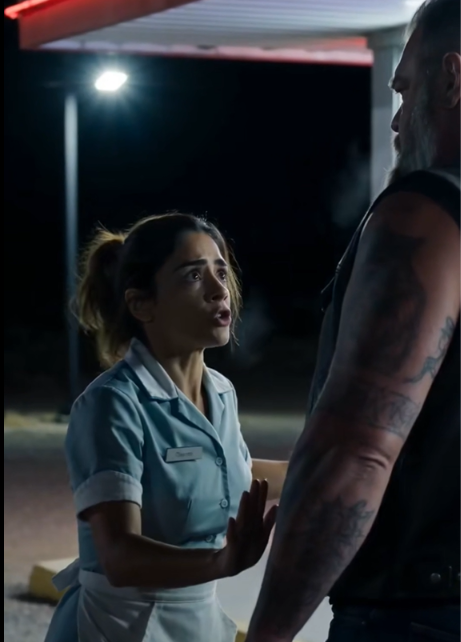
WAITRESS WHISPERED TWO WORDS TO A BIKER AT 3 A.M. – THEN HIS WHOLE CLUB MOVED TO PROTECT HER
She did not mean to become brave that night.
Emma Martinez only meant to pour coffee until sunrise, keep her head down, and survive another shift at a roadside diner where the desert pressed against the windows like a living thing.
But at 3:00 in the morning, in a forgotten diner near the edge of the Mojave, she heard three words from a corner booth that turned her ordinary life into a line she could never uncross.
When he orders.
That was all.
Three words, spoken too quietly by men who had no reason to be quiet unless they were waiting for something ugly.
Emma was walking past booth nine with a coffee pot in her hand when she heard them.
She kept moving because stopping would have told them too much.
She reached the coffee station, set down the pot, and stared at the steel counter until her own reflection blurred in it.
When he orders.
There was only one man who came into the Crossroads Diner every Thursday around this hour.
There was only one man whose order was so predictable that Emma could recite it in her sleep.
Black coffee, no sugar.
Short ribs if the kitchen had them.
Apple pie no matter what.
His name was Coulter Voss.
Everyone within a hundred miles of that highway knew the name, even if they had never spoken to him.
He was president of the Iron Wolves Motorcycle Club, Southwestern Chapter, and men seemed to make extra room for him before they even knew they were doing it.
Emma had watched truckers lower their voices when his bikes came into the lot.
She had watched a retired highway patrolman choose a different stool when the Iron Wolves walked in.
She had watched the whole diner change its breathing around him.
She did not know him.
Not really.
He was a Thursday regular with iron-gray eyes, scarred hands, and a leather cut with a wolf stitched across the back.
That was all he was supposed to be.
Then she looked again at booth nine.
Three men sat there with untouched coffee.
They had been there for forty minutes.
They had ordered nothing to eat.
They had not checked their phones.
They had not joked, yawned, stretched, argued, or acted like tired men waiting for morning.
They sat with the controlled stillness of people saving their energy for a job.
The man closest to the aisle had a heavy jaw, a jacket too stiff for the weather, and eyes that treated every object in the diner like part of an equation.
The young one across from him had the tight energy of someone trying to hide whether he was excited or terrified.
The third barely moved at all.
That was the one Emma liked least.
Danger could be loud.
Danger could be drunk.
Danger could stumble in from the highway smelling like bad decisions and cheap whiskey.
But the worst kind of danger was calm.
The worst kind ordered coffee and waited.
Emma glanced toward the kitchen.
Denny was in the back, earbuds in, lost inside whatever true-crime podcast had convinced him that real danger announced itself with music.
There was one trucker at the counter with scrambled eggs coming.
No George.
No Clarice.
No one who would understand the room fast enough.
Emma thought about calling 911.
She imagined whispering into her phone from the back hall, trying to explain that she had heard three words and seen a shape under a jacket.
She imagined a dispatcher asking for details she could not prove.
She imagined Coulter Voss walking through the door before the call ended.
Then the man with the cinder-block jaw shifted.
For less than a second, his jacket opened.
Emma saw the dark, angular outline beneath it.
Her breath locked behind her ribs.
It was no longer a feeling.
It was no longer waitress intuition.
It was real.
Outside, the desert began to tremble.
Not the desert itself, but the windows.
The sound rolled in low across the gravel lot, that deep baritone of large motorcycles dropping from highway speed to parking speed.
Emma looked at the clock.
3:14 a.m.
Her hands were steady in a way that frightened her more than shaking would have.
Through the scratched glass, three headlights swung into the parking lot.
The lead bike was his.
She knew it the way she knew the squeal in the diner door and the second burner on the coffee machine that always took longer to heat.
Coulter Voss killed the engine.
The other two bikes died a half-beat later.
Emma moved before she had a plan.
She crossed the diner floor.
She felt the attention from booth nine drag over her back like cold wire.
She pushed through the door into the January night.
The desert cold hit her hard, thin and sharp, slipping through her uniform shirt as if the cloth were not there.
Coulter had just swung one leg off his bike.
Standing, he was bigger than he looked through a window.
Not just tall.
Present.
He looked at her with instant, controlled caution.
His two men went still behind him.
Something I can help you with.
It sounded less like a question than a warning that he would not ask twice.
Emma opened her mouth.
Everything she had meant to say vanished.
There are men inside.
I heard them.
They are waiting for you.
There is a gun.
All of it collapsed into panic and cold air.
The diner door was behind her.
Booth nine was watching.
Time was a blade.
Emma stepped closer to him, close enough that her voice would not carry.
She smelled engine heat, leather, road dust, and old oil.
Coulter did not move away.
She said two words.
Don’t talk.
For one beat, nothing happened.
His expression did not change.
His eyes did.
It was almost invisible, but Emma saw it.
Some calculation inside him adjusted.
He understood that she was not flirting, not confused, not dramatic, not drunk, not trying to insert herself into a world that was none of her business.
She was afraid.
And her fear was pointed directly at the door behind her.
Coulter gave the smallest nod Emma had ever seen.
Then he touched the arm of the rider nearest him without looking.
The whole parking lot changed.
No one ran.
No one shouted.
No one reached for anything in a way Emma could name.
But the two men behind Coulter shifted, and suddenly the open space around them was different.
One produced a phone.
The other turned slightly, blocking a sightline from the diner window without appearing to block anything at all.
Coulter turned his back to the glass.
Walk with me.
His voice stayed low.
Quiet, slow, like we are talking about the special.
Emma walked beside him across the gravel toward the line of parked semis.
How many.
Three.
Corner booth.
Back of the room.
You see anything.
One of them.
Jacket.
Right side.
Coulter’s stride did not change.
You work here every night.
Three years.
You know who I am.