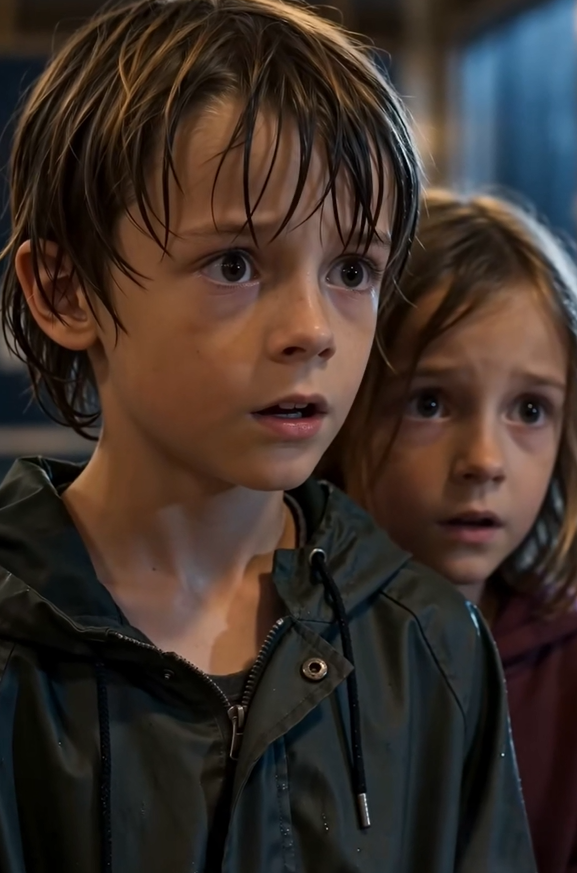
It trembled from anger finally given somewhere to go.
“I saw him leave at 6:15,” she said.
“He wasn’t alone.”
Grim’s hand tightened.
“Where is he going?”
“Laughlin.”
The diner seemed to tilt.
“He said he needed to get to the woman before the morning was over.”
Grim closed his eyes for half a second.
Clay knew.
Not exactly, maybe.
But enough.
He told Patricia to send the video to his contact and lock her door.
“I’ve been locking my door for eleven years,” she said.
“What I want to know is whether it stops.”
Grim said, “It stops.”
Then he called Marco.
“Move them now.”
Marco went silent in the way good men go silent when all of them is listening.
“Where?”
Grim’s mind drew a map of Laughlin from roads, alleys, old rides, back streets, and habits.
“Linda’s neighbor.”
“Someone Clay wouldn’t connect.”
There was movement on the other end.
Linda’s voice came through.
“Carol two streets over.”
“Walk,” Grim said.
“Do not take the car.”
He heard Sarah in the background.
He heard Ethan’s calm voice telling Rosie to get up.
He heard a door close.
“We’re moving,” Marco said.
Grim was already on his bike.
Danny beside him.
Jesse stood in the diner doorway.
“What do I do?”
“Stay with Millie.”
Grim looked back.
“When federal people call, you answer every question.”
“And Jesse?”
The young man lifted his head.
“You tell them everything.”
The ride from Kingman to Laughlin should have taken longer.
Grim and Danny did not discuss speed limits.
They rode like men trying to outrun a clock that had already started counting bodies.
Eight minutes out, the federal contact called.
“We’re twenty minutes behind you.”
“Clay?”
“Ten to fifteen.”
“There is a five-minute window,” Danny said when Grim relayed it.
“There is a five-minute window,” Grim confirmed.
Marco met them two streets from Linda’s house.
“They’re at Carol’s.”
“Clay?”
“Came through four minutes ago.”
“Cycling the blocks.”
“He does not know which house.”
That was the only gift they had.
Clay had enough information to be dangerous and not enough to be precise.
Grim looked toward the main street.
“I’m going to stand where he can see me.”
Danny’s face hardened.
“No.”
“He’s looking for Sarah.”
“If he sees me, he stops looking.”
“You’re using yourself as bait.”
“I’m redirecting his focus.”
“That’s bait.”
“I’m choosing it.”
Grim walked to the corner and stood in the morning light.
Clay Mercer’s truck appeared less than a minute later.
It rolled slowly, hunting.
Then it stopped.
Clay got out.
He was large, confident, and built from years of people stepping aside.
Two men got out behind him.
Only two.
The network was already thinning.
Clay smiled.
“You are a long way from your diner.”
“So are you,” Grim said.
Clay crossed half the street.
“You know what you’ve done?”
“Yes.”
“You think one drive and one phone call take apart fifteen years?”
“Your accounts froze at six.”
The smile flickered.
“Two of your men are already talking to federal investigators.”
Clay’s jaw shifted.
“There’s video of you leaving Wikieup this morning.”
Grim held his eyes.
“The drive has seven names and coordinates for two.”
The smile died.
“Do you understand what I’m telling you?”
Grim’s voice stayed level.
“This is not a negotiation.”
“This is what already happened.”
Clay looked past him.
“Where is she?”
“Gone.”
“She can’t just be gone.”
“She is.”
The two men behind Clay exchanged looks.
One muttered, “Clay, man-”
“Shut up.”
But the authority had cracked.
Then sirens sounded.
Not close yet.
Close enough.
The sound came from more than one direction.
The two men behind Clay made their decision without ceremony.
They turned and walked away.
Clay stood alone.
For one final second, the man he believed himself to be looked out through his eyes.
The untouchable man.
The man with deputies.
The man with money.
The man who owned silence.
Then that man disappeared.
What remained was a frightened bully on a public street.
“I want a lawyer,” Clay said.
Grim nodded.
“That is the first intelligent thing you’ve said.”
Federal vehicles came in from both ends.
Jackets.
Voices.
Hands visible.
Instructions.
Clay put his hands up before anyone asked because the window for anything else had closed.
It took less than four minutes.
After a night of rain, fear, hunger, corruption, and running, the ending itself looked almost ordinary.
A door opened.
A man bent his head.
A vehicle drove away.
Grim’s federal contact stepped beside him.
“It’s all there,” the man said.
“The drive.”
“The seven women.”
“We’re already working it.”
The contact paused.
“Two families will get answers today.”
Grim watched Clay’s vehicle disappear.
“Deputy Holt?”
“Turned himself in at four.”
The contact glanced at him.
“Apparently someone clarified his options.”
Grim said nothing.
The contact studied him.
“Why did you stay in this?”
Grim thought of Ethan.
He thought of Rosie shaking in the doorway.
He thought of Sarah asking only about her children.
He thought of the second plate sitting untouched in Millie’s diner for twenty-three years.
“I’ll tell you later,” he said.
“Right now I need to make a call.”
Marco answered on the first ring.
“It’s done,” Grim said.
“Tell Sarah.”
He heard voices.
Silence.
Then Ethan came on.
“Mr. Hayes?”
“Ethan.”
“Is it really over?”
Grim looked at the empty street.
The true answer was complicated.
There would be testimony.
There would be trials.
There would be nights Sarah woke up expecting footsteps.
There would be years of rebuilding.
There would be fear that did not vanish just because one man was in custody.
But the thing that had chased a boy and his sister into the rain before sunrise was over.
“That part is over,” Grim said.
Ethan breathed.
Then he said, “Can I ask you something?”
“Go ahead.”
“The second plate.”
Grim went still.
“Mom told me about your son.”
The boy’s voice stayed careful.
“I just wanted to say I hope he knows.”
Grim closed his eyes.
“Knows what?”
“That you kept a seat for him.”
The morning went quiet around him.
For all the things Grim had survived, all the fights, all the roads, all the men who had tried to break him, this nearly did what none of them had.
His jaw tightened.
He made his voice steady because that was what he knew how to do.
“Did you eat your breakfast?”
“Yes, sir.”
“Pancakes?”
“Rosie ate four.”
“Good.”
A pause.
“Thank you for going,” Ethan said.
Grim looked down at the sidewalk.
“Thank you for walking in.”
He ended the call.
He did not ride back to Kingman right away.
He rode out into the open desert.
Not to run.
Not that time.
He rode because some things needed space before a man could carry them.
The road was cold and clear.
The rain had washed the dust down and left the world looking briefly honest.
When he returned to Millie’s, the lunch crowd had begun drifting in.
The diner smelled like bacon, coffee, and stubborn survival.
Millie looked up when he entered.
She said nothing.
She put coffee in front of him.
He sat.
He turned the cup once.
Twice.
Then he looked toward the corner booth.
The second plate was there again.
Technically, Millie had cleared the table sometime in the chaos.
But morning had come, habit had moved her hands, and the plate had been set again the way it had been set every Friday for more than two decades.
A place held.
A question unanswered.
A grief made visible in meat and potatoes and silence.
“Millie,” Grim said.
“Yes.”
“Next Friday.”
He stopped.
The words resisted him.
He tried again.
“Next Friday, I’m bringing someone.”
Millie waited.
“A woman named Sarah.”
Another pause.
“And her kids.”
Millie’s hand stilled on the coffee pot.
“The second plate,” Grim said.
“I still want it.”
He looked down at his hands.
“But move it.”
“Where?”
“At the end of the table.”
His voice was low.
“Not across from me anymore.”
Millie understood.
She had always understood more than he said.
For twenty-three years, Victor Hayes had kept a seat for someone he loved.
He had believed waiting was all he had left.
He had believed grief was proof of loyalty.
But a hungry boy in broken shoes had walked into a diner and seen the truth from the other side of the glass.
A place kept for the missing did not have to keep the living away.
“I’ll set it at the end,” Millie said.
Grim nodded.
He drank his coffee.
Outside, Route 66 stretched into the desert, carrying people away from what they feared and toward what they did not yet know how to hope for.
Some roads were for running.
Some roads were for rescue.
And sometimes, on a cold Friday night, two hungry children could walk through the right door and find a dangerous man still human enough to answer.
The seat had always been there.
Now, for the first time in twenty-three years, Victor Hayes was ready to let someone sit at the table.