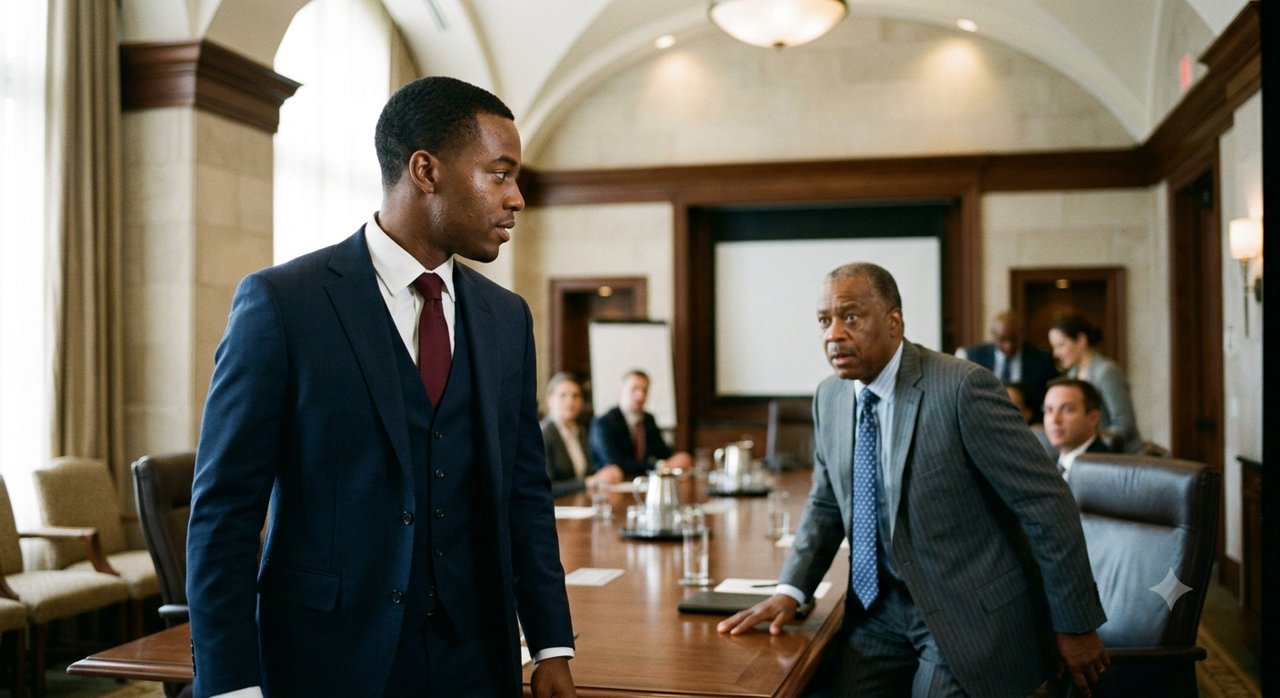
Derek called Walter in November.
Not his lawyer.
Not through a third party.
Derek himself, on a Sunday afternoon, from what Walter later described as a quieter voice than he'd heard from his son in years.
He didn't apologize.
Not directly.
He said he had been thinking about what Walter had said in the house in Westfield.
About what Eleanor would say.
About the version of a person that's real when no one is watching.
He said he had spoken to Susan Callo.
Walter went very still on the phone.
"She didn't want to talk to me at first," Derek said.
"I don't blame her.
But I called three times, and the third time she picked up." A pause.
"I told her I knew what my father had done.
And that I had spent the last several years doing something similar, in my own way, and that I was trying to understand the difference between a man who does wrong and a man who becomes it."
"What did she say?" Walter asked.
"She said the difference is whether you stop."
Walter didn't say anything for a moment.
"I'm not asking to come back into the company," Derek said.
"Not yet.
Maybe not ever.
I don't know." Another pause.
"But I'd like to — I'd like to have dinner.
The three of us.
You, me, and Claire.
If she's willing."
Walter looked out the window at the city below.
"I'll ask her," he said.
He called Claire that evening.
She was at her mother's house — a small semi-detached in Norwood that smelled like tea and old books and the particular warmth of a home that has been loved for a long time.
Her mother was in the kitchen.
Claire was sitting at the table where she had done her homework as a child, looking at nothing in particular.
"He wants to have dinner," Walter said.
"I heard," Claire said.
Walter had put her on a three-way call without announcing it, which was a habit she had already identified and decided to find endearing rather than alarming.
"I can tell him no," Walter said.
"No," Claire said.
"Tell him yes." She paused.
"But somewhere with good food.
I've been eating hospital canteen sandwiches for two years and I think I've earned a proper meal."
Walter laughed.
It was a real laugh — the kind that comes from somewhere unexpected, that surprises the person doing it.
"Eleanor would have loved you," he said.
He'd said it before.
He said it like he meant it more each time.
"I know," Claire said.
"You've mentioned."
"I'll make the reservation," he said.
"Walter."
"Yes."
"Thank you," she said.
"For the foundation.
For the trust.
For — all of it." She paused.
"But mostly for asking my name."
A silence.
"Thank you," Walter said, "for sitting down."
The dinner was three weeks later.
A restaurant on the east side of the city — not Hargrove's, which would have been too much, but somewhere good.
Quiet.
The kind of place where the lighting was warm and the tables were far enough apart that a conversation could be real.
Derek arrived first.
He was thinner than Claire remembered from the office.
He stood when she came in, which she hadn't expected.
"Ms.
Dowell," he said.
"Claire," she said.
He nodded.
"Claire."
They sat.
Walter arrived four minutes later, slightly out of breath from the stairs, and looked at the two of them across the table from each other and said nothing for a moment.
Then he sat down and picked up the menu.
"I'm told the lamb is very good," he said.
It wasn't a resolution.
It wasn't forgiveness, not yet — that would take longer, and it would need to be earned in smaller moments over a longer time.
Derek had a great deal of ground to cover, and he knew it, and the knowing was visible in the careful way he held himself through the meal.
But it was a beginning.
And beginnings, Claire had learned, were not nothing.
She walked home afterward through streets that were cold and lit and full of the ordinary noise of a city at night.
She passed a bench outside a restaurant — not Hargrove's, just a bench — and thought about an old man sitting in the rain, and a meal that cost her nothing, and the strange long chain of things that a single act of kindness can set in motion when it lands in the right place.
She didn't stop walking.
But she noticed the bench.
She thought: *I'd do it again.*
And she would.
---
Some kindnesses look small in the moment and turn out to be the thing that changes everything.
Have you ever helped a stranger — or been helped by one — in a way you never forgot?
Share your story in the comments.
Someone needs to read it today.