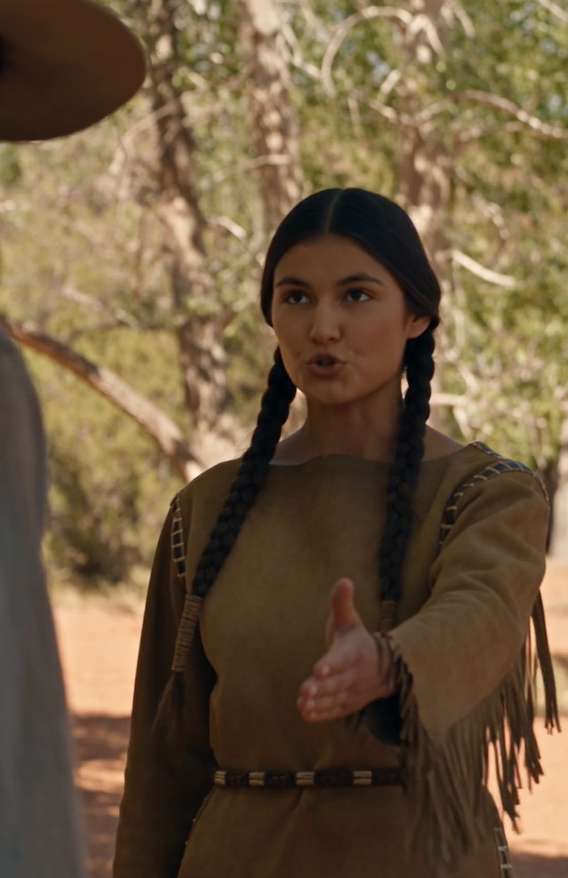
“Where were you last night?”
One answered immediately.
The other hesitated.
Gideon turned toward him.
“You don’t have to answer.”
The sheriff looked at him.
“I decide that.”
The man swallowed.
“We moved cattle.”
Pike stepped toward him.
“Shut up.”
Whitehawk moved forward slightly.
He made no threat.
He didn’t need to.
The sheriff stepped between them.
“Let him speak.”
The man lowered his gaze.
He said Gideon had ordered them to take some of Ethan’s cattle and drive them into the creek bed before dawn.
He had told them no one would be hurt.
That he only needed it to look like a theft.
Then, with the cattle gone and suspicion falling on Whitehawk’s people, Ethan would become desperate enough to sell.
Gideon denied everything.
“He’s lying to save himself.”
Maybe.
But then the second man spoke too.
He confirmed that Pike had found Ethan’s horse after it escaped.
They had kept it.
Gideon already had the map prepared.
He had been the one who ordered the pouch tied to the saddle and the animal left near the trail leading toward the village.
Ethan felt anger rise inside him.
Not because they had used his horse.
Not even because of the cattle.
But because Pike had tried to turn two groups that barely knew each other into convenient enemies for the sake of his business.
Ayana seemed to feel the same.
“You expected us to do the dirty work for you,” she said.
Gideon looked at her with contempt.
“You know nothing about business.”
Ayana replied calmly:
“I know when a man needs other people to hate each other in order to get what he wants.”
No one spoke for several seconds.
The sheriff took control of the situation.
Gideon wasn’t dragged away in handcuffs in some dramatic scene.
But neither was he allowed to leave as though nothing had happened.
The cattle had been moved without permission.
Two of his own men had implicated him.
The map and the horse confirmed that the scheme had been prepared.
The sheriff ordered Gideon to return with him to the territorial post to answer for the theft and for attempting to manufacture a false accusation.
The consequences would continue there.
Ethan recovered all twenty-three of his cattle.
Not one was missing.
Whitehawk allowed them to rest near the water before they were driven back.
By midday, the valley was quiet again.
Ethan found Ayana beneath the same cottonwood where he had waited the previous day.
It seemed impossible that only a few hours had passed since she had pointed at him in front of everyone.
“I suppose now you understand why I couldn’t marry you yesterday,” Ethan said.
Ayana looked at him.
“Because someone was stealing your cattle?”
He laughed.
“No. Because I didn’t know anything about you.”
“Now you know I can follow tracks.”
“That I do.”
“And that I don’t like making accusations without evidence.”
“That too.”
“You know more than you did yesterday.”
Ethan removed his hat.
“Still not enough to marry you.”
Ayana smiled.
“Good.”
“‘Good’ again?”
“Yes.”
“I’m starting to think you enjoy confusing me.”
“A little.”
Whitehawk approached from behind.
Ethan tensed.
The chief studied him.
“Yesterday I asked what you chose.”
“I remember.”
“Today you know more.”
Ethan looked at Ayana.
This time, there weren’t a hundred men watching and competing.
There was no surprise.
No pressure.
Only a woman who had trusted her own judgment and a man still trying to understand how he had ended up there while looking for a horse.
“I choose not to make a promise I can’t yet keep,” Ethan said.
Whitehawk showed no reaction.
Ethan continued:
“But if Ayana still wants to know me, I choose to stay long enough for her to decide whether she was wrong.”
Ayana raised an eyebrow.
“Only me?”
Ethan understood.
“For both of us to decide.”
Then she smiled.
“That’s better.”
Ethan stayed for several days.
Not as a celebrated suitor.
Not as a special guest.
He helped return the cattle.
He repaired a section of fence damaged while the herd was being moved.
He spoke with Whitehawk.
He listened more than he talked.
And he spent time with Ayana.
He discovered that she could be patient with children and merciless with a man who exaggerated.
That she knew the water routes better than many cattlemen.
That she hated when others mistook her silence for obedience.
Ayana discovered that Ethan truly had little interest in impressing anyone.
She also discovered that this didn’t mean he lacked pride.
They argued.
More than once.
Especially when Ethan tried to solve something alone simply because that was how he was accustomed to doing things.
“Not everything bearing your brand belongs only to you,” Ayana told him one afternoon as they inspected a fence.
Ethan looked at his cattle.
“It is literally my brand.”
Ayana shook her head.
“I’m talking about the problems.”
Ethan took a second.
Then laughed.
“You’re learning to explain yourself in dangerous ways.”
“And you’re learning to listen.”
Gideon Pike never acquired the northern strip.
The case against him didn’t end with some spectacular conviction.
But he had to repay expenses related to the cattle, lost agreements with several ranchers who no longer trusted him, and remained under investigation for the scheme he had tried to manufacture.
His two men agreed to testify.
The story spread.
Not the way Pike had planned.
Instead of the region talking about an alleged theft committed by Whitehawk’s people, they talked about a landowner who had tried to manufacture hostility for his own benefit.
Months later, Ethan was still visiting the valley.
And Ayana visited his ranch accompanied by members of her family.
She didn’t abandon her people and suddenly become someone else.
Ethan didn’t pretend that a few weeks were enough to understand a life that wasn’t his.
They learned slowly.
That was what made it work.
One afternoon, almost a year after that strange first meeting, Whitehawk found them together beside the northern spring.
Ethan was explaining an improvement for channeling water toward a small trough.
Ayana was explaining why his first idea would waste too much water.
Ethan argued.
Ayana answered.
Whitehawk listened for a while.
Then he asked:
“Have you decided yet?”
Ethan and Ayana fell silent.
Ethan looked at her.
“I think I know you a little now.”
Ayana smiled.
“Only a little.”
“Enough to know I don’t want you deciding for me.”
“That would be difficult.”
“And enough to know I don’t want to decide for you either.”
Whitehawk waited.
Ethan took a deep breath.
“I want to share my life with her, if she still wants to share hers with me.”
Ayana studied him for several seconds that felt longer to Ethan than that entire first ceremony.
Then she said:
“Now, yes.”
Whitehawk nodded.
Nothing more.
He didn’t need to.
Years later, Ethan still remembered the day he had arrived covered in dust, searching for a horse.
More than a hundred men had come to prove why Ayana should choose them.
He had offered nothing.
No strength.
No prestige.
No promises.
He had simply told the truth.
And in the end, that same truth had saved something more important than his cattle.
It had prevented an ambitious man from turning distrust into a weapon.
It had also forced Ethan and Ayana to do something neither of them could have done that first afternoon.
Get to know each other before making a promise.
Years later, the old map remained stored in a simple box at the ranch.
Not as a treasure.
Not as a reminder of a threat.
But as proof of how easy it would have been to believe a lie designed to turn two groups of people who didn’t know each other against one another.
Ethan kept the horse that had started everything until the animal grew old.
Whenever someone asked how he had met Ayana, he answered:
“I lost a horse.”
Ayana always corrected him:
“No. You found where he was.”
And Ethan smiled.
Because she was right.
As she had been almost every time since that afternoon in 1873, when she pointed at him in front of an entire village.
The first time, Ayana had chosen him because he hadn’t tried to possess her.
The second time, nearly a year later, she was no longer choosing a stranger.
She chose a man who had learned how to stay without demanding.
And Ethan, at last, could answer Whitehawk’s question without the slightest doubt.
This time, he didn’t choose because everyone was watching.
He chose because he finally knew the woman standing before him.