It had become part of the life they were building.
One afternoon, Marco entered the study with a white envelope.
"Evelyn's attorneys sent the final release," he said. "She's withdrawing her claim to the trust administration. Charles agreed not to pursue criminal charges over the July incident, provided she maintains the agreement and stays away from Nicholas without your consent."
Roman opened the envelope and read the first page.
"Has she signed?"
"Yes."
"And Victor?"
"He's resigned from the terminal board. The coalition wants to renew the freight contracts."
Roman set the papers down.
"Then let Charles negotiate."
Marco looked toward the window.
Rachel was outside, helping two nurses unload a box of pediatric equipment from a van. She wore a beige sweater and dark jeans, her hair tied back loosely. She was laughing at something the driver had said.
"She's good at it," Marco observed.
"She's better at it than anyone I've ever hired."
Marco's expression shifted into a rare smile.
"Charles says Evelyn's attorney asked whether you're planning to marry her."
Roman turned.
"What did Charles say?"
"That you don't answer questions from people who charge by the hour."
Roman laughed.
The sound surprised them both.
Marco shook his head.
"You're getting easier to live with."
"Don't spread that around."
"Wouldn't dream of it."
After Marco left, Roman remained at the window.
He watched Rachel carry the box into the carriage house. A little boy ran toward her, and she crouched to speak with him before taking his hand and leading him inside.
Roman had spent years believing that strength meant ensuring nobody could reach the people he loved.
Now he was beginning to understand that love also required making room for them to become themselves.
Rachel had never asked him to rescue her.
She had asked him to see her.
And somewhere between the nursery, the courtroom, and the dock, he had begun to realize how rarely he had done that for anyone.
The sun was setting on the last Sunday of October when Roman invited Rachel and Sophie to dinner on the terrace.
Martha had prepared roasted chicken, fresh bread, apples, and a pitcher of cider. Nicholas sat on Roman's lap in a soft white sleeper, chewing happily on a piece of bread while watching the birds move above the marsh.
Rachel poured tea into two porcelain cups.
Sophie sat at the far end of the table on a high cushion, her blue stethoscope hanging around her neck and a notebook open before her.
"Doctor Sophie," Roman called, "are we receiving an evening report?"
Sophie looked up with profound seriousness.
"Yes."
"Proceed."
"Nicholas has no fever. He ate his dinner. He pulled the cat's tail, but the cat forgave him."
"That's generous of the cat."
"The cat is a good patient."
Roman nodded solemnly.
"And how is the house?"
Sophie looked around at the terrace, the windows glowing with warm light, and the darkening marsh beyond the railing.
"The house is clean."
"Anything else?"
She considered.
"The wood has no cold spots today."
Rachel smiled into her tea.
"And the father?" she asked.
Sophie leaned forward and placed her stethoscope against the table in Roman's direction.
She closed her eyes.
For three seconds, she wore the same expression of intense concentration she had shown the afternoon she discovered Nicholas in the nursery.
Then she opened her eyes.
"The father is all fixed."
Roman laughed softly.
"Is he?"
"Mostly."
"Mostly?"
"You still get sad sometimes."
The table grew quiet.
Sophie did not seem troubled by the silence.
"But that's okay," she added. "Mommy says sad people need hugs and snacks."
Rachel covered her face with one hand.
"That is not exactly what I said."
"It is what you meant."
Roman looked at Sophie.
Then he looked at Rachel.
For the first time, he allowed himself to imagine a future that did not depend on forgetting the past.
He could remember Claire without believing that every happy moment betrayed her. He could love Nicholas without trying to control every breath the child took. He could allow other people into the house without treating their presence as a threat.
And perhaps, someday, he could love someone again without asking her to carry the weight of everything he had lost.
Rachel reached across the table to move Nicholas's cup away from the edge.
Her hand brushed Roman's.
Neither pulled away immediately.
The contact was slight, almost accidental, but it held a quiet significance neither of them needed to explain.
Roman turned his hand over.
Rachel looked at him.
He did not ask her to stay forever. He did not promise that he would never hurt her, never fail her, or never retreat into the old habits that had once made him feel safe.
He simply offered his hand.
Rachel placed hers in it.
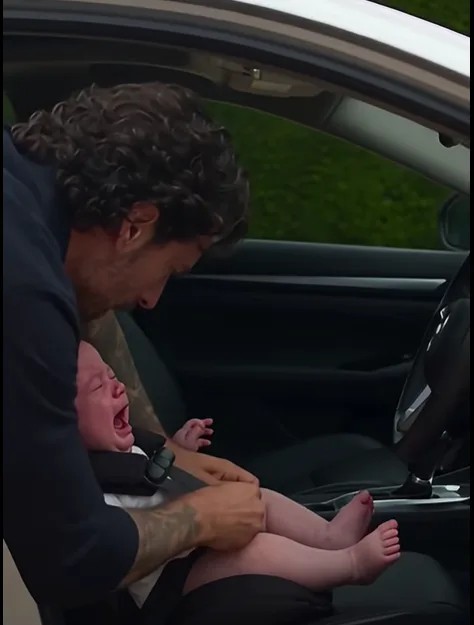
The evening wind moved gently across the terrace, carrying the smell of salt water and distant woodsmoke. Nicholas fell asleep against his father's chest, one small hand curled around the fabric of Roman's shirt.
Roman looked down at him.
Six months earlier, he had believed that being a good father meant building walls high enough to keep every danger away.
Now he understood that walls could protect a child from the world and still leave him lonely inside them.
The lesson had come from a four-year-old girl with a plastic stethoscope, one missing sandal, and no idea who Roman Bellini was supposed to be.
She had heard a baby crying when the adults around her had heard nothing.
She had noticed the loneliness inside a house full of people.
And she had told the truth to a man everyone else was afraid to challenge.
Roman glanced at Rachel.
Her hand rested in his, warm and steady.
The long shadow of Claire's death remained in the corners of his memory. It always would. There would be mornings when grief returned without warning, and evenings when the sound of an ambulance in the distance would bring back the old guilt.
But the memory was no longer a locked room.
It was a door he could open when he was ready, a place where love had lived and where sorrow had taken root.
Beyond it, the living waited.
Nicholas shifted in his sleep.
Roman adjusted the blanket around his son and pressed a kiss to his forehead.
Rachel watched him, her expression soft.
"What is it?" he asked.
"Nothing."
He raised an eyebrow.
"That usually means something."
She smiled.
"I was just thinking that Sophie might be right."
"About what?"
"You're getting better."
Roman looked at the child sleeping against his chest, then at the woman beside him.
"I had a good teacher."
Rachel shook her head.
"No. You finally started listening."
He considered that, then smiled.
Across the table, Sophie had fallen asleep with her notebook open beside her. Her blue stethoscope lay on the linen cloth, its tubing curled like a question mark.
The terrace lights glowed against the autumn darkness. Inside the house, Martha moved quietly through the kitchen, and the old floorboards settled with familiar creaks.
Beyond the railing, the marsh stretched beneath a deepening sky.
Roman Bellini had spent years believing that power could protect everything he loved.
It had taken a little girl who owned nothing more than a toy medical kit to show him how wrong he was.
He had not saved his son by becoming more powerful.
He had saved him by paying attention.
By listening.
By admitting that he could not do everything alone.
And by learning that the smallest voice in the room might be the one that mattered most.
Sophie stirred in her sleep and murmured something about a patient.
Roman laughed quietly.
Rachel squeezed his hand.
For the first time in a long while, he did not feel the need to check the gates, review the cameras, or ask Marco whether the road beyond the estate was clear.
He stayed where he was.
He held his son.
He held Rachel's hand.
And as the last light disappeared over the Charleston marsh, Roman Bellini finally understood that a home was not the place where nothing bad could ever happen.
It was the place where, when something went wrong, someone would hear the cry.
Someone would come.
And someone would stay.