"Very invisible," Rachel had agreed.
At four years old, Sophie considered invisibility a professional skill.
Rachel had brought her to work because the daycare center had lost its air-conditioning over the weekend. The director had sent a message saying the building would remain closed until Monday. Rachel had read it at the kitchen table of their small North Charleston apartment while calculating whether she could afford to miss a shift.
She could not.
One lost shift meant a hundred and eighty dollars gone.
That meant choosing which bill could wait.
Rachel had already chosen too many.
So she had broken the rule about children on the estate and hoped nobody would notice.
For ninety-three minutes, everything had gone according to plan.
Then Sophie heard a baby crying.
At first, she had assumed the sound came from a television upstairs. But the cry returned, thin and uneven, drifting through the ceiling above the laundry room.
Sophie put down her crayon.
She listened.
Another cry.
Then nothing.
She climbed off her chair, collected her plastic medical kit, and walked toward the service stairs.
She was not supposed to leave the laundry room.
But patients came before rules.
By the time Rachel realized her daughter was missing, Sophie had already reached the second floor.
She had found Nicholas in his nursery, alone beside the tall windows. His nurse had stepped into the adjoining room to retrieve a bottle, believing she would be gone for less than a minute.
Sophie didn't know that.
She only knew the baby was crying.
She dragged a small stool toward the crib, climbed onto it, and peered over the wooden rail.
"Hello," she whispered.
Nicholas cried harder.
Sophie frowned.
"I'm Doctor Sophie. I need you to cooperate."
He waved his arms.
She took the red plastic stethoscope from around her neck and pressed the disc against his chest.
Nothing useful came through the hollow plastic tube.
She listened anyway.
"Your heart is being very loud," she informed him.
Nicholas stared at her through wet lashes.
Sophie removed one ear tip, adjusted it, and tried again.
"Are you scared?"
The baby hiccupped.
She glanced toward the door.
Nobody came.
Sophie had spent most of her young life in the company of adults who were busy being tired. Her mother worked long hours. Her father had moved away after the divorce, taking his promises with him. At daycare, children cried when their parents left, and the teachers told them everything would be fine.
Sophie had noticed that everything was not always fine.
Sometimes a child stopped crying because somebody finally came.
Sometimes a child stopped because there was nobody left to ask.
She climbed down from the stool, found a soft blanket folded on a nearby chair, and tucked it beside the crib where Nicholas could see it.
"There," she said. "I'm staying."
The baby reached through the bars.
His fingers caught her little hand.
And for a moment, neither of them made a sound.
From the doorway, Roman watched them.
He had come upstairs intending to check the nursery before returning to his meeting. The nurse had explained that Nicholas was settling down, and Roman had nodded without asking to see him.
Then he had heard a small voice coming from inside the room.
He stopped.
Sophie stood beside the crib with her red stethoscope crooked around her neck. Her hair had fallen out of its ponytail, and one of her sandals was missing. Nicholas held her finger as if it were the only reliable thing in the world.
Roman watched his son look at another human being without fear.
Something tightened beneath his ribs.
For six months, every room he entered seemed to contain an absence.
Claire's favorite chair. Claire's books. Claire's empty side of the bed.
He had believed the pain would become manageable if he controlled everything around it.
Instead, the house had grown quieter.
The staff spoke in whispers. The nurses followed schedules. The security guards kept watch over corridors that nobody used. Nicholas lived beneath a canopy of cameras and medical monitors, surrounded by people who knew his feeding times but rarely allowed themselves to linger after he stopped crying.
Roman had mistaken surveillance for care.
Now a four-year-old girl was doing what none of his expensive systems could measure.
She was staying.
"What are you doing?" he asked.
Sophie turned.
"Checking him."
"For what?"
She counted on her fingers.
"Breathing. Heart. Temperature."
Roman looked at the stethoscope.
"Does that thing work?"
"No," Sophie said matter-of-factly. "But I do."
A sound escaped him before he could stop it. Not quite a laugh, but something that had once belonged to laughter.
Sophie returned to her patient.
"He's scared when nobody stays," she said.
Roman felt the words settle somewhere beneath the armor he had spent years constructing.
Before he could answer, Sophie looked toward the window.
Her expression changed.
She slid off the stool and hurried to the glass, standing on tiptoe to peer down toward the east courtyard.
"That's why I knew something was wrong."
Roman followed her gaze.
Beyond the garden wall, partly concealed beneath the branches of a live oak, sat a silver Bentley.
The windows were dark.
The engine was silent.
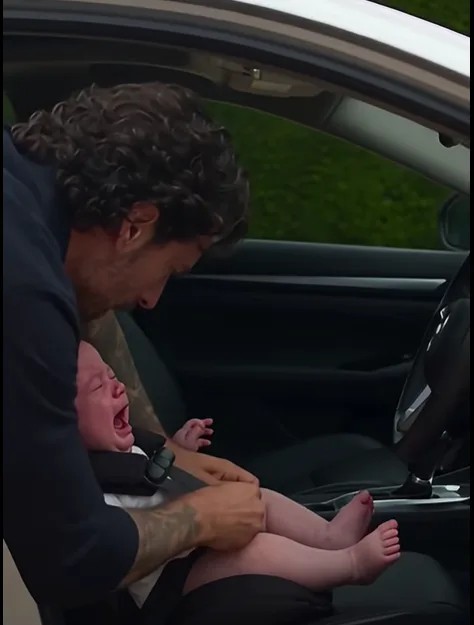
And from somewhere inside the car came the faint, unmistakable sound of a baby crying.
Roman was moving before he understood what he had heard.
He crossed the corridor, descended the stairs, and ran through the service archway into the heat.
The sun struck his face like an open furnace. Gravel shifted beneath his shoes as he rounded the limestone wall.
The Bentley stood in a narrow strip of shade near the old laundry entrance.
Evelyn Whitmore was beside the rear passenger door.
She wore a bone-colored linen suit, pearl earrings, and the expression of a woman who had never expected to be contradicted in her life. Her silver-blonde hair was pulled into an immaculate knot. A leather handbag hung from one arm, and a heavy brass key ring rested in her other hand.
Her driver, Thomas, leaned into the open rear door, struggling with an infant carrier.
"What's taking so long?" Evelyn demanded.
"The belt won't lock, ma'am."
"Then stop trying to lock it."
"The carrier has to be secured."
"We're going four miles, Thomas."
"Mrs. Whitmore, I can't—"
"You can do what I hired you to do."
Roman stopped beneath the oak tree.
"That's enough."
Evelyn turned.
For the briefest moment, her face betrayed her. Her lips parted. Her fingers closed around the key ring.
Then the familiar composure returned.
"Roman. You should be in your meeting."
He ignored her and looked through the open door.
Nicholas lay on the leather seat, his face flushed dark pink, his hair damp against his forehead. His small chest rose and fell in quick, shallow movements.
The air inside the car shimmered with heat.
Roman felt the world narrow to that tiny body.
"Take him out."
Evelyn stepped between him and the door.
"He's perfectly fine. I'm taking him to my house for the afternoon."
"Move."
"The nursery's air-conditioning has been unreliable, and given the number of unpleasant people who come through your gates, I thought a quieter environment would be better for him."