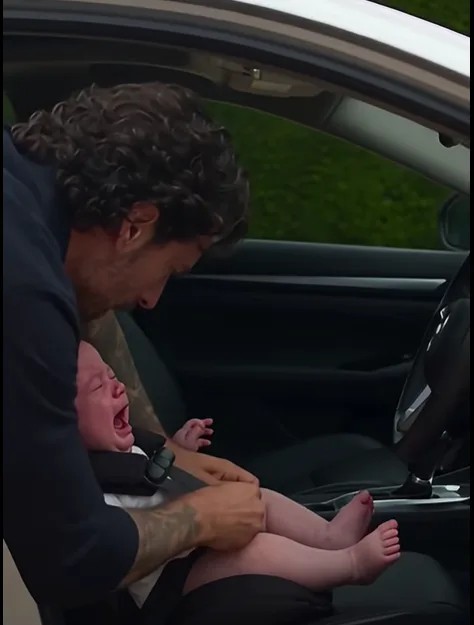
"Yes. He carried Nicholas back into the house and stayed with him until the physician arrived and treated him."
"Did Mr. Bellini appear indifferent to his son's condition?"
Rachel thought of Roman's trembling hands on the buckle, his voice breaking when he whispered to the baby.
"No, Your Honor."
"Did he appear neglectful?"
"No."
"Then what did he appear to be?"
Rachel looked toward Roman.
He sat perfectly still, his hands flat on the table. His face was composed, but his eyes had changed.
She knew what it cost him to remain in that courtroom, allowing strangers to examine the worst night of his life as if grief were a character flaw.
"He appeared terrified," she said.
The courtroom fell silent.
"He was terrified because his son was in danger. He was terrified because he thought he might lose him. And he was terrified because he has spent six months believing that he failed his wife."
Rachel took a breath.
"I don't know everything about Mr. Bellini's business. I don't know what he has done in his life before I met him. But I know what I've seen in his home. I've seen him sit outside his son's crib until two in the morning. I've seen him learn how to hold the baby without being afraid of hurting him. I've seen him ask for help when he didn't know what to do."
Her voice steadied.
"And I've seen him change."
Judge Vance leaned forward.
"Mrs. Miller, are you aware that your testimony could affect your employment?"
"Yes, Your Honor."
"Are you concerned about that?"
Rachel looked at Sophie.
The little girl sat between Marco and the aisle, her hands folded around her cloth bag. She was watching her mother with solemn concentration.
Rachel remembered the years she had spent teaching Sophie to tell the truth, even when the truth was uncomfortable.
She could not ask her daughter to be brave if she was unwilling to do the same.
"I'm concerned about my daughter," she said. "I'm concerned about Nicholas. And I'm concerned about what happens when adults with power decide that a child is something to be traded."
Judge Vance looked down at the documents before her.
"Thank you, Mrs. Miller."
Rachel returned to her seat.
Roman did not touch her hand or whisper a word of gratitude. He simply looked at her for one long moment.
It was enough.
The hearing continued for another hour.
The judge questioned the attorneys about the nursery arrangements, the medical reports, the security personnel, and Evelyn's decision to remove Nicholas from the house.
Then she turned to the petitioner.
"Mrs. Whitmore, why did you place the infant in a vehicle under those conditions?"
Evelyn lifted her chin.
"I intended to take him to my residence, where he would be safer."
"Was the child secured in an approved infant carrier?"
"My driver was attempting to install it."
"Was the vehicle running?"
"No."
"Was the air-conditioning operating?"
"No."
"How long was the child inside?"
Evelyn hesitated.
"Several minutes."
"How many?"
"I don't know."
Judge Vance removed her glasses.
"Mrs. Whitmore, you have asked this court to determine whether Mr. Bellini can safely care for his son. Yet the evidence indicates that you removed the child without his knowledge, failed to ensure that the child was properly secured, and placed him in a hot vehicle without a functioning cooling system."
Evelyn's face went pale.
"I was trying to protect him."
"Protection requires judgment, Mrs. Whitmore. Good intentions do not excuse dangerous decisions."
The judge turned toward the clerk, reviewed the medical report, and wrote several lines on the order sheet.
"The petition for temporary emergency protective custody is denied."
Evelyn's attorney began to object.
Judge Vance raised one hand.
"This court is not determining every question related to the child's long-term welfare today. Mr. Bellini will continue to cooperate with the Guardian Ad Litem and maintain appropriate medical and childcare arrangements. Any future petition must be supported by evidence, not speculation or commercial interests disguised as family concern."
She struck the gavel.
The sound rang through the courtroom.
Roman remained seated for several seconds.
He had prepared himself for the possibility of losing his son. He had prepared arguments, hired attorneys, studied the filings, and imagined every possible outcome.
He had not prepared for relief.
It arrived slowly, almost painfully, as if his body did not trust the good news enough to accept it.
When he finally stood, Rachel was waiting in the aisle.
"You did it," he said.
She shook her head.
"No. I told the truth."
Roman looked at her.
"That's harder."
They walked out of the courtroom together.
Sophie held Rachel's hand, swinging their joined arms as they crossed the courthouse steps. The late-summer sun shone over the city, and the warm air carried the smell of wet pavement and magnolia blossoms.
At the curb, Marco opened the rear door of the waiting Lincoln.
Sophie climbed in first and immediately fell asleep against Roman's side.
Rachel sat in the front passenger seat, looking out at the passing streets.
Nobody spoke for several miles.
Then Roman said, "Thank you."
Rachel turned.
"You don't have to keep thanking me."
"Yes," he said. "I do."
He looked down at Sophie, whose small hand had curled around the sleeve of his shirt.
"Most people in this city see what they want from me. Money. Influence. Protection. A favor they can trade for something else."
He brushed a loose strand of hair away from Sophie's forehead.
"You saw what was happening to my son, and you told the truth even when it could cost you everything."
Rachel's throat tightened.
"I know what it's like to be judged by a piece of paper."
Roman looked toward her.
"I won't let that happen to you again."
She turned back to the window.
"Don't make promises you can't keep."
He absorbed the rebuke without anger.
"Then I'll make a different one."
"What?"
"I'll do what I can. And when I can't, I'll tell you."
Rachel looked at him again.
It was not a grand declaration. There was no dramatic gesture, no expensive gift, no demand that she trust him.
It was simply a promise from a man who had begun to understand that trust was not something he could order into existence.
For Rachel, it meant more than she wanted to admit.
By the time they reached the estate, the afternoon light had softened across the marsh. The black gates opened, and the Lincoln rolled down the gravel driveway beneath the live oaks.
Roman remained in the car after Marco stopped near the fountain.
Sophie slept against his side, her hat crumpled in her lap.
Rachel turned in her seat.
"Are you coming inside?"
"In a minute."
She studied him.
"What's wrong?"
Roman looked toward the house.
For months, he had entered that building expecting to encounter the past. Every corridor reminded him of Claire. Every room seemed to preserve some fragment of the life they had shared.
Now he was afraid of something different.
He was afraid that the moment he stepped inside, he would return to being the man who hid behind locked doors and unanswered questions.
"I don't know how to stop being afraid," he said.