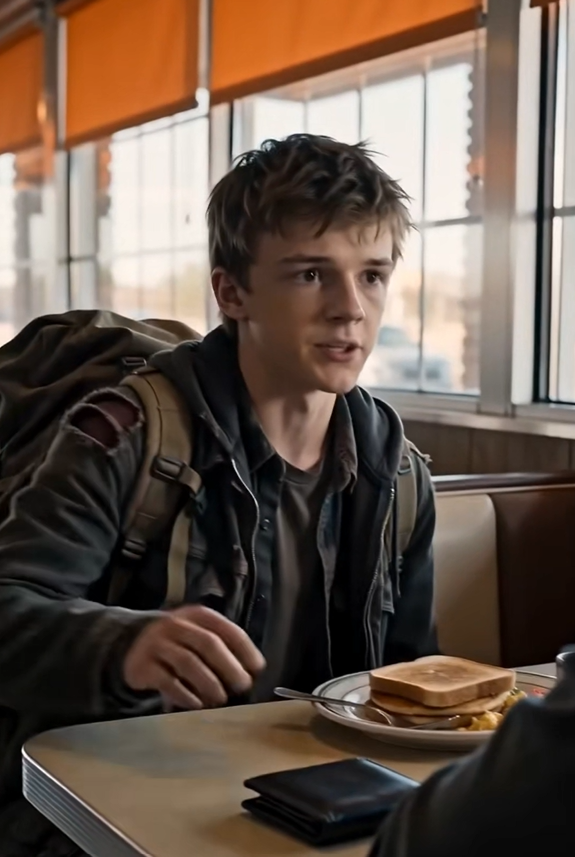
20-YEAR-OLD HOMELESS KID RETURNED A HELL’S ANGEL’S WALLET – THEN 350 BIKERS LEARNED WHAT HE HAD DONE
Nobody saw Ethan Walker pick up the wallet.
That was the part that mattered.
Not the cracked asphalt under his shoes.
Not the cold sting of a Phoenix morning that had finally remembered October could have teeth.
Not the diner lights buzzing across the road or the line of motorcycles sitting dark and heavy in the overflow lot like sleeping animals.
Nobody saw him.
He knew that before he bent down.
He knew it in the way people on the street learn to know things without seeming to look.
No heads turned.
No doors opened.
No one behind the glass of the diner noticed the skinny twenty-year-old with the torn jacket and the backpack hanging from one good strap.
The wallet lay beside the rear tire of a black motorcycle, fat with cash, its leather corner catching the pale morning light.
Ethan stared at it for a long time.
He had not eaten in thirty-one hours.
He knew the exact number because hunger had become his clock.
Thirty-one hours since a gas station worker had left half a sandwich near a dumpster and pretended not to notice who took it.
Thirty-one hours of walking, waiting, shrinking himself down, counting water fountains, counting coins, counting minutes until shelters opened.
The wallet looked like an answer.
He picked it up.
It was heavier than any wallet had a right to be.
For one breath, Ethan simply held it.
Then he opened it.
The cash was folded tight inside.
Hundreds.
Fifties.
Twenties.
He counted it with numb fingers and a stomach that cramped so hard he had to swallow against it.
Four thousand three hundred dollars.
The number did not feel real.
It felt like something from a life on the other side of glass.
Four thousand three hundred dollars was a room.
It was food.
It was shoes without holes.
It was a coat that did not leak cold through the shoulder.
It was an address long enough to begin again.
It was the difference between surviving and breathing.
Ethan looked toward the diner.
Inside, through the window, six men in leather vests sat at the far end of the counter with plates, coffee, and the kind of stillness that made the whole room seem arranged around them.
He looked back at the wallet.
The driver’s license said Marcus Callahan.
The photo showed a square-jawed man with gray at his temples and eyes that looked as if they had settled every argument they ever intended to settle.
Behind the cards was a photograph.
Ethan slid it free just enough to see.
Marcus stood with other men outside a garage, all wearing vests, all standing close in that unspoken way men stand when the bond between them is not casual.
It was not just a picture.
It was proof of belonging.
Ethan stared at it longer than he meant to.
He had spent two years trying not to be noticed.
On the street, attention was not kindness.
Attention was risk.
You kept your head down.
You kept your body small.
You never looked too long at anyone who might decide that your looking meant something.
But the men in that photograph did not look small.
They looked chosen.
They looked like they had chosen each other.
Ethan closed the wallet.
The money sat inside it like a dare.
Nobody had seen him.
Nobody would know.
He could walk away, cut across the back of the closed auto parts store, disappear behind the leaning fence, and be gone before the diner door opened.
A voice in him, practical and hungry and tired beyond morality, began explaining how easy it would be.
It told him that four thousand dollars would not change Marcus Callahan’s life the way it would change his.
It told him that desperate people were allowed certain exceptions.
It told him that hunger had its own laws.
It told him that nobody had ever rescued him for being honest.
Ethan stood there and listened to every argument.
Then another thought came.
It was quieter.
It had no cleverness in it.
It simply said that if he took this money, something inside him would be gone when the money ran out.
That was the one thing Ethan had guarded through every night outside, through every shelter line, through every person who looked through him as if he were part of the pavement.
He had never stolen.
Not when it would have been easy.
Not when it would have been invisible.
Not when his hands shook from hunger and his mind offered him reasons polished enough to sound like truth.
He had lost almost everything.
He had not lost that.
If he took the wallet, he would lose it.
Ethan put the cash back.
He closed the leather carefully.
Then he crossed the parking lot and walked into the diner.
The bells over the door rang too loudly.
Warmth hit him first.
Coffee.
Grease.
Toast.
Something frying on a grill.
His stomach folded in on itself.
He forced his face empty.
The waitress glanced over, then away.
People like Ethan came into diners with a certain posture, and most people learned to decide quickly whether they were customers or problems.
Ethan was used to that glance.
He walked toward the men at the counter.
The red-bearded one saw him first.
He turned on his stool, forearms thick, eyes calm but measuring.
“Something I can do for you, son?”
His voice was level.
Not unfriendly.
Not safe either.
Ethan stopped close enough that he would not have to raise his voice.
“I’m looking for Marcus Callahan.”
The room seemed to change temperature.
The other men turned.
The red-bearded man’s eyes flicked to Ethan’s hand.
Ethan raised the wallet.
Silence gathered around them.
At the end of the counter, the man from the license set down his coffee.
Marcus Callahan stood.
He was bigger in person, but not just in size.
He moved like the floor had agreed to hold him.
He came down the length of the counter without hurry and stopped in front of Ethan.
His eyes went to the wallet.
Then to Ethan.
“Where’d you find it?”
“Parking lot,” Ethan said.
“Beside your bike.”
“Looked like it fell out of a saddlebag.”
Marcus took the wallet.
He opened it.
Ethan watched his face as he counted.
Nothing changed, not exactly, but something behind the man’s eyes shifted.
Assessment.
Recognition.
Maybe surprise.
“Everything’s there,” Ethan said.
“I didn’t take anything.”
“I can see that,” Marcus said.
He studied Ethan then, not like a threat, not like trash, not like a problem to be moved along.
He looked at him as if Ethan was a person standing in front of him with a story worth reading.
That was somehow worse.
“You want to sit down?”
“I’m fine,” Ethan said automatically.
“I wasn’t asking if you were fine,” Marcus said.
“I was asking if you wanted to sit down.”
Ethan sat.
Marcus lifted one hand toward the waitress.
“Bring him whatever’s hot, Beverly.”
“And a lot of it.”