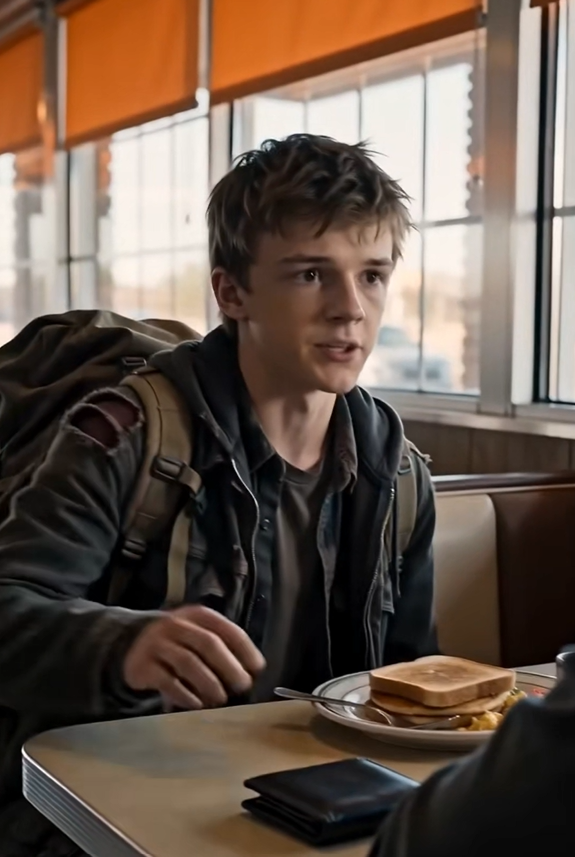
Ethan wanted to refuse.
Pride rose in him like a reflex.
Then the smell of eggs and potatoes moved through the air, and pride had nothing to stand on.
When the plate came, he tried not to eat like a starving person.
He failed.
Marcus did not embarrass him by pretending not to notice.
Instead, without looking up from his coffee, he said, “There’s no shame in being hungry.”
That almost did it.
Not the food.
Not the warmth.
That sentence.
Ethan kept eating because stopping would have required too much control.
Marcus waited until half the plate was gone.
“When was the last time you had a real meal?”
“I eat,” Ethan said.
“That isn’t what I asked.”
Ethan considered lying.
He had lied before, not cruelly, but defensively.
Lies were sometimes the only walls homeless people could afford.
But Marcus watched him with such direct patience that the lie felt childish.
“Yesterday morning,” Ethan said.
“Sort of.”
Marcus nodded.
“How long have you been out here?”
“A while.”
“How old are you?”
“Twenty.”
Marcus set his cup down.
“You’re twenty years old, sleeping outside, hungry, and you found a wallet with over four thousand dollars in it.”
“Then you walked in here and gave it back.”
Ethan shrugged.
“It wasn’t mine.”
“No,” Marcus said.
“It wasn’t.”
For the first time, something like a smile touched his mouth.
A small one.
A controlled one.
“Most people in your position would have told themselves a different story.”
“I’m not most people.”
“No,” Marcus said quietly.
“You’re not.”
He pulled a card from his vest and slid it across the table.
It had only a name and a number.
Marcus Callahan.
No company.
No address.
No title.
“You need something, you call.”
Ethan stared at the card.
“I don’t want charity.”
“I know.”
“That isn’t what I’m offering.”
Ethan put the card in the zipped inner pocket of his jacket.
It felt too heavy for paper.
“I should go.”
“Finish eating first.”
So Ethan finished eating.
Then he left.
He did not call that day.
He did not call the next day.
He did not call the next week.
The card stayed in the pocket with the working zipper, pressed against his chest like a thing he had not decided whether to believe in.
For twelve days, he went back to being invisible.
He slept where he could.
He stood in shelter lines early enough to maybe get a bed.
He looked for food without stealing.
He carried himself through Phoenix the way he had been carrying himself for two years, with his head down and his life narrowed to the next hour.
But the diner stayed with him.
Not the breakfast.
Not even the money.
What stayed was Marcus saying, “You’re not most people.”
Ethan had not realized how badly he needed to be seen until someone saw him.
Then Cole Ramirez found him.
Cole was one of those men who lived in the margins but had decided the margins were a place to hunt from.
Mid-thirties.
Thin in a way that was not only poverty.
Eyes always working.
Movements too sharp.
Ethan had seen him around the shelter on Van Buren, always near enough to hear things, never near enough to be blamed for anything.
Cole stepped beside him in the dinner line three days after the diner and spoke without looking at him.
“I know about the wallet.”
Ethan kept his eyes forward.
“Good for you.”
“Four thousand dollars, give or take.”
“I returned it.”
“Sure you did.”
Cole picked up a tray.
“But here’s the thing, brother.”
“I don’t have proof of that.”
“And I do have two people who’ll say they saw you take it.”
Ethan turned slowly.
Cole smiled.
Not broadly.
That made it worse.
It was a business smile.
“What do you want?”
“Half.”
“I returned all of it.”
“Then you’ve got nothing to worry about.”
Cole placed a piece of bread on his tray like they were discussing weather.
“Unless those bikers come asking and my witnesses talk first.”
“First version usually wins, doesn’t it?”
Then he walked away.
Ethan stood in the line with the tray in his hands while the noise of the shelter closed around him.
He had been accused before.
Not of stealing.
He had been careful about that.
But accusations clung easily to people without addresses.
People with documents missing.
People who could be moved from one place to another by a sentence spoken confidently enough.
Three days later, Cole proved it.
The abandoned commercial building where Ethan had been sleeping with a loose group of others was suddenly no longer available.
Darra, a woman in her forties who had survived enough to speak plainly, found him on the sidewalk and told him.
A thin, sharp-eyed man had gone to the property manager.
He had said someone matching Ethan’s description had been seen stealing from a motorcycle.
He had implied bikers were involved.
He had suggested the property could become trouble.
The manager shut the building down that afternoon.
Ethan went back to the corner where he had left his backpack.
It was gone.
For a moment, his mind refused to understand.
Then it landed.
The backpack held nearly everything that made his life barely workable.
A change of clothes.
A blanket.
A broken phone charger.
The phone itself.
The ID documents he had spent months trying to gather after losing the first set.
The documents were the worst part.
People who had never lost proof of themselves could not understand the nightmare of proving who you were when every paper that said who you were was already gone.
Ethan checked behind the building.
He checked the alley.
He asked people who did not want to meet his eyes.
Nothing.
The backpack was gone.
He sat down on the curb.
The Phoenix afternoon was bright enough to be cruel.
Cars passed.
People walked by.
The city moved around him as if the disappearance of everything he owned was not even an event.
Ethan reached into his jacket and felt the card.
Marcus Callahan.
A number.
Nothing else.
He stared at it until the letters seemed separate from their meaning.
Calling meant admitting something.
Not to Marcus.
To himself.
It meant admitting he could not handle this alone.
That hurt more than the hunger.
He had built his life around needing as little as possible from people because needing was dangerous.
Needing made debts.
Debts made traps.
He had learned that somewhere specific, in a house with specific people, at an age when lessons sink into the bones and stay there.
But he had already done the right thing.
He had done it when the wrong thing would have saved him.
He had returned the wallet, and it had not protected him.
It had not made life easier.
It had only given Cole a story to twist.
So maybe, Ethan thought, the thing he called independence was not strength anymore.
Maybe it was pride wearing survival’s clothes.
His phone had three percent battery.
The charging port barely worked.
He dialed.
It rang twice.