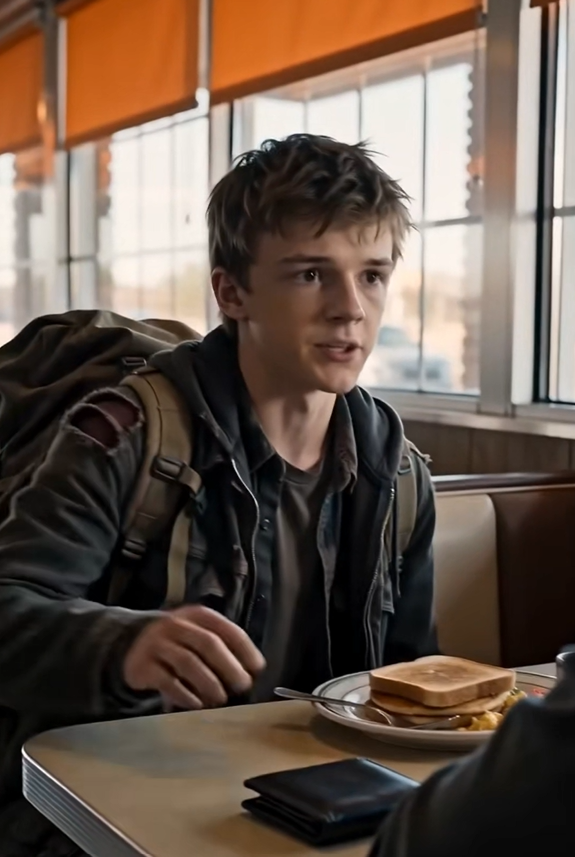
“Yeah.”
“Marcus Callahan?”
A pause.
“Who’s this?”
“Ethan Walker.”
“The one who returned your wallet at the diner.”
The pause changed.
“I remember.”
“What happened?”
Ethan told him.
He told him about Cole.
The witnesses.
The property manager.
Darra.
The backpack.
The documents.
The way he had nothing left and no shelter and no proof that Cole was lying except the truth.
When he finished, Marcus was silent for five seconds.
“Where are you right now?”
Ethan named the intersection.
“Stay there.”
“I don’t want -”
“Stay there,” Marcus said again.
The call ended.
Then the phone died.
Ethan stayed.
Two hours passed.
The sky turned orange, then pink, then almost purple at the edges, as if the city was trying to apologize for the heat it had given him all day.
Streetlights came on.
Ethan sat on the curb with no backpack, no charged phone, and no plan.
For the first time in a long time, he let himself believe someone might show up.
Then he heard the engine.
Only one motorcycle.
It came slow and deliberate down the street and stopped ten feet from him.
Marcus swung off the bike and walked over.
He wore the same vest.
He looked at Ethan, then sat down on the curb beside him without hesitation.
Not above him.
Not in front of him.
Beside him.
“Tell me about Cole.”
Ethan told it again.
Shorter this time.
Sharper.
Marcus listened without interrupting.
When Ethan finished, Marcus said, “What he’s doing isn’t only about you.”
“He’s using your name to make people believe something that isn’t true.”
“That’s a specific kind of wrong.”
“I don’t tolerate that.”
“My people don’t tolerate it.”
Ethan looked at him.
“You don’t have to get involved.”
“You returned my wallet,” Marcus said.
“In my world, that means I’m already involved.”
Something in Ethan loosened.
Something hard and old.
He looked away because he did not trust his face.
“I don’t want trouble.”
“You’re already in trouble.”
“What you don’t want is more of it.”
“That’s different.”
Marcus made a call.
It was short.
A name.
Ricky.
An address.
The words, “Find me what you can.”
Then Marcus put the phone away and looked at Ethan.
“You eating tonight?”
“I’m fine.”
“You used that word at the diner.”
“It wasn’t accurate then either.”
Ethan almost argued.
Instead, he said, “No.”
“I haven’t eaten.”
“Come on.”
They went to a different diner.
Smaller.
Older.
The kind of place that had survived so long it no longer needed to impress anyone.
Marcus ordered without looking at the menu, and the waitress wrote it down without asking questions.
They sat in the back.
Ethan ate.
Marcus drank coffee and watched the room with calm vigilance.
“What were you going to do if you hadn’t called me?”
“Get through tonight.”
“Figure out tomorrow.”
“That’s it?”
“That’s always it.”
“You don’t plan much further when you’re on the street.”
“Plans past tomorrow are just ways to be disappointed.”
Marcus turned his cup slowly.
“You were in school before all this.”
Ethan looked down.
“Two years of college.”
“Engineering.”
“Mechanical?”
“Mostly.”
“What happened?”
“Home fell apart.”
“I didn’t have money without the home part.”
“I was too proud to tell anyone at school how bad it got.”
“So I disappeared.”
Marcus watched him.
“You’re good at disappearing.”
“I used to think that was a skill.”
“Now I’m not sure.”
Marcus set down the cup.
“I think you’ve been punishing yourself for something that wasn’t your fault.”
“And I think you called it survival because that sounded stronger.”
The words hit too close.
Ethan wanted to push back.
He had no energy left to do it.
“Maybe.”
“Not maybe.”
“I’ve seen that look before.”
“I’ve had it.”
Ethan looked up.
Marcus did not explain.
He did not have to.
Some truths carry their own scars.
His phone buzzed.
He read the message.
“Ricky found things.”
“Cole Ramirez has done this before.”
“Different people, different places.”
“He picks people alone.”
“People nobody believes fast enough.”
Ethan felt cold in the warm diner.
“He targeted me on purpose.”
“Yes.”
“He saw you were young.”
“He saw you had no one standing beside you.”
“He saw the wallet as leverage.”
Marcus leaned back.
“But that’s only a problem if nobody does the work of finding out what happened.”
“And Ricky is very good at finding things out.”
That night, Ethan slept on a cot in the back room of a garage.
The place smelled like motor oil, coffee, rubber, and old metal.
It belonged to Gus, a broad man in his sixties with hands that looked built for engines and a face that wasted no expression.
Gus handed him a blanket.
“Bathroom down the hall.”
“Coffee at six.”
That was all.
Ethan lay on the cot and stared at the ceiling.
He thought about the backpack.
The documents.
Cole.
The fury of being chosen by a predator because he looked easy.
He did not think about revenge.
Revenge was too clean a word.
What he felt was the rage of being seen only as weakness.
The next morning, Marcus was already at the workbench.
Coffee in one hand.
Phone near the other.
Gus moved around the garage as if he had been installed there with the lifts.
Marcus slid a paper across the bench.
“Ricky put this together.”
Ethan read it.
Names.
Dates.
Patterns.
A loose six-month timeline of Cole making accusations, pressuring people, using fear, and moving on before truth caught up.
“This is enough to do something with,” Ethan said.
“It’s enough for the right people to know the truth.”
“Who are the right people?”
Marcus smiled fully for the first time.
“That’s the part I handle.”
Calls followed.
No shouting.
No threats.
No drama for the sake of drama.
Just pressure applied with precision.
Someone would talk to Haskell, the frightened property manager.
Someone would talk to the two witnesses Cole claimed to have.
Someone would make sure they understood that lying publicly had consequences.
Someone would locate Cole.
“We’re not going to touch him,” Marcus told Ethan.
“That’s not how this works.”
“We’re going to put the truth in front of his lie before his lie becomes useful.”
“Men like Cole need nobody to look closely.”
“We’re going to make people look closely.”
By midday, Darra came to the garage.
She entered carefully, looking around the room the way people do when unfamiliar territory might hold danger.
She told Marcus what she knew.
Cole had gone to Haskell and described Ethan.
He had implied Ethan had stolen from a biker.
He had suggested angry men might come to the building.
Haskell had panicked.
“He isn’t dishonest,” Darra said.
“He’s scared.”
“Then we start there,” Marcus said.
Haskell’s office sat in a strip of commercial units off McDowell.
A desk.
A phone.
A room that looked like it existed only because paperwork needed somewhere to land.
Haskell went pale when Marcus walked in.
“I’m not here to cause problems,” Marcus said.