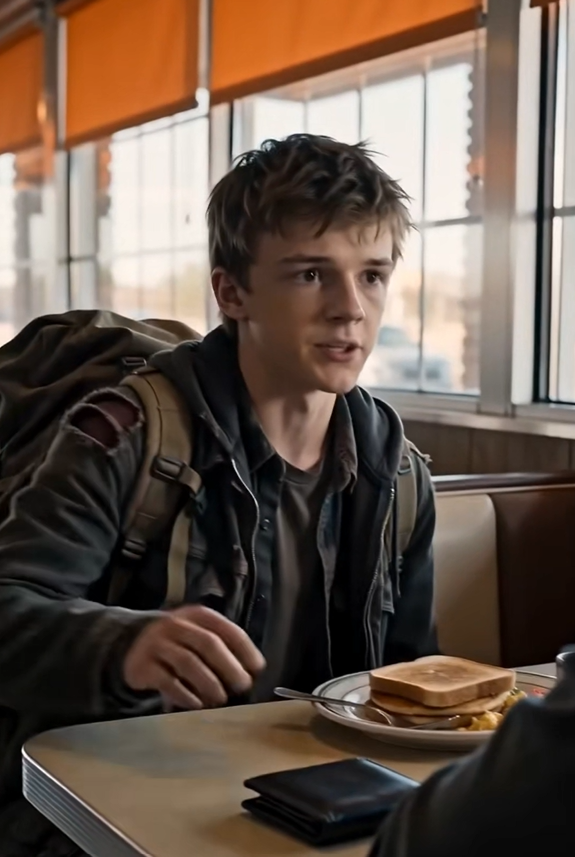
“An arrangement,” Marcus answered.
“You bring something.”
“We bring something.”
“It works because both sides hold up their end.”
He held out his hand.
“You in?”
Ethan shook it.
“I’m in.”
The first weeks were brutal in a way surviving had not prepared him for.
Survival was reaction.
You moved because you had to.
Work was accumulation.
Every mistake followed you until you corrected it.
Every day built on the one before.
Every weakness asked to be strengthened instead of hidden.
Gus corrected him without cruelty.
Never loudly.
Never softly enough to be useless.
He showed Ethan the mistake, showed the fix, and expected him not to make the same mistake twice.
The room above the garage took longer to trust than Ethan expected.
The first night, he woke twice not knowing where he was.
The silence had walls.
The darkness had a lock.
Shelter, real shelter, felt almost physical.
He lay there and thought, this is what people forget to be grateful for.
He promised himself he would not forget.
Three weeks after the wallet, Marcus took Ethan to a regional gathering.
Ethan knew the number before he arrived.
Three hundred and fifty, give or take.
But numbers said aloud are smaller than numbers standing in front of you.
Motorcycles lined the property outside the city.
Engines settled.
Voices rose.
People moved with the ease of a community that had history, arguments, debts, jokes, loyalties, and old wounds all braided together.
Ethan stayed close to Marcus and Gus at first.
Names came too quickly.
Faces blurred.
Hands shook his.
Eyes assessed him.
Not unkindly.
Thoroughly.
Ricky appeared beside him.
“How you holding up?”
“Fine.”
“You use that word wrong every time.”
“You mean overwhelmed.”
Ethan almost laughed.
“Does it get easier?”
“No.”
“First time in a room like this is the hardest.”
“After a while, you stop seeing three hundred and fifty people.”
“You start seeing the ones you know.”
“Which is everyone eventually.”
That sounded impossible.
Then Marcus introduced him to Pete, Dex, Harrison, and others.
Dex worked with at-risk youth.
Harrison had legal aid connections.
Pete had been homeless at twenty-two.
That last detail made Ethan look up.
Pete, now in his fifties, had the solidity of someone who had once been scattered and had rebuilt himself by hand.
“What was the hardest part?” Pete asked.
“Not the practical stuff.”
“The real hardest part.”
Ethan thought.
“Believing it was temporary.”
“I knew it was temporary in my head.”
“But after long enough, knowing and believing stop matching.”
Pete nodded slowly.
“Yeah.”
“That’s exactly it.”
Then Marcus called for quiet.
The room settled.
Three hundred and fifty people shifted their attention toward him.
Marcus did not raise his voice.
He did not need to.
“Most of you know why we gather.”
“To remember where we came from.”
“To account for what we owe each other.”
“Tonight, I want to introduce someone.”
Ethan felt his body try to move toward the exit.
“His name is Ethan Walker.”
“He’s twenty years old.”
“Three weeks ago, he found my wallet in a parking lot.”
“He was sleeping outside.”
“He hadn’t eaten in a day.”
“There were over four thousand dollars in that wallet.”
The silence was total.
“He returned it.”
“Every dollar.”
“He didn’t ask for anything.”
“He walked into a diner, found me, and put it in my hands.”
“That’s who he is.”
Marcus looked directly at Ethan.
“He’s been at Gus’s garage.”
“He’s learning the trade.”
“He’s earning his keep.”
“He’s a good mechanic and a better person.”
“I want you to know his name because he’s going to be around.”
“And when you meet him, I want you to know who you’re meeting.”
For one second, nobody moved.
Then the room responded.
Not wild applause.
Not performance.
A sound of acknowledgement.
A sound that said, we see him.
Ethan’s throat closed.
He decided he was not going to cry in front of three hundred and fifty bikers.
It was close.
A big gray-bearded man named Brick appeared and shook Ethan’s hand with enough force to test his bones.
“You scared?”
“Yes.”
“Good.”
“Anyone not scared in a room like this isn’t paying attention.”
“What do I do?”
“Be exactly what you are.”
“That’s the only thing that works here.”
For two hours, Ethan did that.
He answered questions honestly.
He did not polish himself.
He did not perform gratitude.
He did not pretend his past was nobler than it was or his recovery smoother than it felt.
By the end of the night, he had six business cards in his pocket.
A legal aid contact.
A tutoring program lead.
A coffee shop owner who needed a machine fixed.
A training program director who wanted him to talk someday to young people who needed to see someone close enough to their own age to believe change was possible.
Marcus found him at the edge of the room.
“You know what these people are underneath all this?”
“The bikes.”
“The vests.”
“The noise.”
Ethan shook his head.
“Proof.”
“Every one of them is proof a person can come from something hard and build something good.”
“You made your choice three weeks ago.”
“Most of them understand what it cost.”
Only later did Marcus reveal why the wallet had mattered so much.
It happened after hours at the garage.
The lights were lower.
The work was done.
They had been talking about spring enrollment and work schedules when Marcus suddenly said, “I need to tell you why I came back alone.”
Ethan looked up.
“To the curb?”
“To you.”
“Before anyone else got involved.”
“I needed to be sure.”
“Sure of what?”
Marcus chose his words carefully.
“Thirty-one years ago, I was twenty-two and living out of my truck in Flagstaff.”
Ethan went still.
“I found a wallet.”
The garage seemed to become smaller.
“How much?”
“Thirty-eight hundred dollars.”
“Different time.”
“Same kind of money.”
Marcus looked at the workbench between them.
“I returned it.”
“The man who owned it was Robert Delaney.”
“He was sixty then.”
“A retired contractor.”
“No reason to care about me.”
“He found out I was living in my truck.”
“He gave me a place to stay.”
“He helped me find work.”
“He introduced me to people who became important to me.”
“He changed my life.”
Ethan understood before Marcus said it.
“You’ve been paying it forward.”
“Robert told me someday someone would find my wallet.”
“He said someday I’d be on the other side of the moment.”
“He said when it happened, I’d know what to do.”
Marcus looked at him.
“I’ve been waiting thirty-one years.”
Ethan pressed both hands to the cool metal of the bench.
“Does Robert know about me?”
“I called him that night.”
“After the diner.”
“He’s eighty-one now.”
“Still sharp.”
“He cried on the phone.”
Ethan swallowed.
“He told me to tell you something.”
“What?”
“He said the choice you made in that parking lot is already the best thing you’ll ever do.”
“Everything from here is the reward for it.”
Ethan could not speak.
The chain stretched in front of him suddenly.