Not metaphorically.
Actually.
A wallet in Flagstaff.
A truck.
A man named Robert.
A younger Marcus.
A debt carried for thirty-one years.
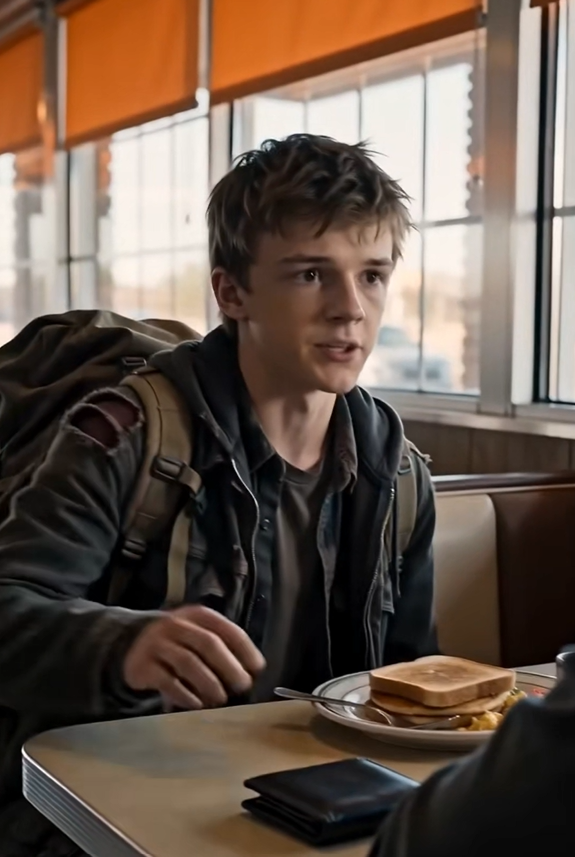
A diner in Phoenix.
A starving kid with four thousand three hundred dollars in his hand.
“There’s no version where you didn’t help me,” Ethan said.
“No.”
“But what you became after that was always yours.”
“I opened the door.”
“You walked through.”
Ethan nodded.
He understood the difference.
In December, the air changed.
Phoenix did not get snow, but mornings sharpened.
Ethan noticed one day while drinking coffee outside the garage door at 5:45.
Cold felt different when you could step back inside.
That distinction stunned him.
Cold you are trapped in is one thing.
Cold you visit briefly is another.
The enrollment paperwork for Maricopa had gone through.
His prior credits were evaluated.
A mechanical engineering adviser called him personally.
Dr. Patricia Euan asked, “What do you want to be good at?”
Not what career.
Not what job.
What good at.
“Diagnostic work,” Ethan said immediately.
“Understanding why systems fail.”
“Not just fixing the break.”
“Knowing the failure well enough to prevent it.”
“Systems thinking.”
“The chain of one thing affecting another thing.”
There was a pause.
“That’s a specific answer for someone out of the classroom two years.”
“I’ve been in a garage.”
“It’s the same classroom with different furniture.”
She laughed.
“I’ll see you in January.”
Before January came, Ethan called his mother.
He sat on the edge of his bed for ten minutes with the phone in his hand.
Her number had not changed.
Her address had not changed.
The situation between them was still complicated, bruised by pride, misunderstanding, pain, and time.
But Ethan had changed.
That was the condition he had been waiting for.
He dialed.
She answered on the fourth ring.
“Hello?”
“Mom.”
The silence was only three seconds.
It contained two years.
“Ethan.”
Not a question.
A confirmation.
“Where are you?”
“Phoenix.”
“I’m still in Phoenix.”
“I have a room.”
“I have a job.”
“I’m okay, Mom.”
“I’m actually okay.”
Her breath shook.
“Are you eating?”
“Yes.”
“Are you somewhere safe?”
“I’m somewhere real.”
“I don’t know what that means.”
“It means I have a room with a lock.”
“And a job I’m good at.”
“And I start back at school in January.”
The sound she made was not quite a word.
“School?”
“Engineering.”
“I’m finishing the degree.”
They talked for forty-seven minutes.
He checked afterward because the call felt both much shorter and much longer.
He told her about the wallet.
Marcus.
Gus.
The garage.
The gathering.
David Reyes, who had helped him with the pathway.
Dr. Euan.
The spring semester.
He did not tell her everything.
Some pain needed a face across from it.
But he told her enough for the truth to have a shape.
“You are a good person, Ethan,” she said quietly.
“I always knew that.”
“I know.”
“I forgot for a while.”
“People forget,” she said.
“That’s why we need each other to remember.”
In January, Ethan drove himself to campus in a used F-150 he had bought with saved earnings.
Two hundred thousand miles.
Gus had inspected it and declared it mechanically sound.
That was practically a blessing.
Ethan parked in the student lot, walked into the mechanical engineering building, opened a notebook, and wrote the date.
Two years and two months had passed since he last sat in a classroom.
He held the memory of every parking lot, shelter line, alley, curb, and cold morning between then and now for one moment.
Long enough to honor it.
Then he looked up and listened.
He was not the smartest student in the room.
Two others were faster.
Their hands were up before questions were finished.
But Ethan listened differently.
He listened for structure.
For failure points.
For what came after the answer.
Dr. Euan noticed.
After three weeks, she asked him to consider the honors thesis track for fall.
“Diagnostic frameworks for mechanical systems under high-stress conditions.”
“You have garage experience and engineering training.”
“That combination could be useful.”
Ethan thought for ten seconds.
“Okay.”
“You’ll think about it?”
“I already did.”
“I want to do it.”
When he told Gus, the old mechanic said only, “Don’t let school ruin the hands.”
“I won’t.”
“Good.”
“I need the hands.”
By spring, Ethan was not the homeless kid who returned the wallet.
He was Ethan.
Mechanic.
Student.
The one who helped Dex’s kids understand engines.
The one who showed up.
The one people trusted with work that needed doing right.
Then Robert Delaney came to Phoenix.
Marcus called on a Tuesday evening.
“Robert wants to meet you.”
Ethan felt it physically.
“When?”
“Next weekend.”
“He’s flying in from Colorado.”
“He says he’s waited thirty-one years and won’t wait another week for a video call.”
“Where?”
“The diner off Route 17.”
Of course it was the diner.
Robert was already seated when Ethan arrived.
Eighty-one.
Tall once, still carrying the echo of it.
White hair.
A cane he held like an annoying tool.
Pale gray eyes, patient from long use.
Marcus sat beside him.
Ethan walked to the table and stopped.
Robert looked up.
“Sit down, son.”
“You’re making me nervous standing there.”
Ethan sat.
Robert studied him for a long moment.
“Marcus described you accurately.”
“How?”
“He said you look like a young man who has decided something.”
Robert smiled faintly.
“People who’ve decided something have a quality.”
“Hard to describe.”
“Easy to recognize.”
“What did you decide?” Ethan asked.
Robert’s answer came without delay.
“That integrity was non-negotiable.”
“That hardship did not change the terms.”
“That the circumstance could be terrible and the choice still had to come from what I believed, not what I was desperate enough to justify.”
He told Ethan about the wallet he had found at twenty-two.
The thirty-eight hundred dollars.
The truck.
The man who helped him.
Then he added a name Marcus had not mentioned.
“Eugene Marsh.”
“He died in 1998.”
“He never knew I kept the chain going.”
“He never knew I told Marcus what he told me.”
Robert looked down at his old hands.
“When Marcus called me about you, I sat in my living room for twenty minutes.”
“My wife kept asking what was wrong.”
“I said, someone kept the chain.”
“She said, of course they did.”
“And I said, no, you don’t understand.”
“This time I get to know.”
Ethan felt the weight of Eugene then.
The first open door.
The man who never knew what walked through it.
“Thank you,” Ethan said.
Robert put a hand over his briefly.
“Don’t thank me.”
“You made the choice.”
“I only left the door open.”
Then he looked at Ethan with the force of eighty-one years.
“What I want from you is simple.”
“Keep going.”
“Not for me.”
“Not for Marcus.”
“Not because anyone sees it.”
“Keep going because the version of you five years from now, ten years from now, twenty years from now, is going to need to know you didn’t stop.”
“The chain only works if nobody stops.”
Ethan nodded.
“I won’t stop.”
Robert leaned back.
“Good kid.”
Marcus said, “I know.”
In April, Dex brought six teenagers from his youth program to a gathering at Gus’s expanded garage space.
Four boys.
Two girls.
Sixteen to eighteen.
All watchful.
All trying to look like they were not looking around.
Dex asked Ethan to talk to them.
No podium.
No speech.
Just a table in the corner.
Jordan, eighteen, asked first.
“Marcus said you were homeless for two years.”
“What happened?”
Ethan told them plainly.
The falling apart.
The pride.
The silence.
The streets.
The way temporary things begin to feel permanent if they last long enough.
A sixteen-year-old girl named Maya sat with her arms crossed.
Halfway through, she uncrossed them.
“What made you return the wallet?” Jordan asked.
“I decided long before I found it.”
“Not consciously.”
“But I decided there was a version of me I was going to protect.”
“That version didn’t take things that weren’t his.”
“The wallet was a test I didn’t know I was taking.”
Maya spoke softly.
“How do you prepare for a test you don’t know is coming?”
“By deciding who you are before you’re tested.”