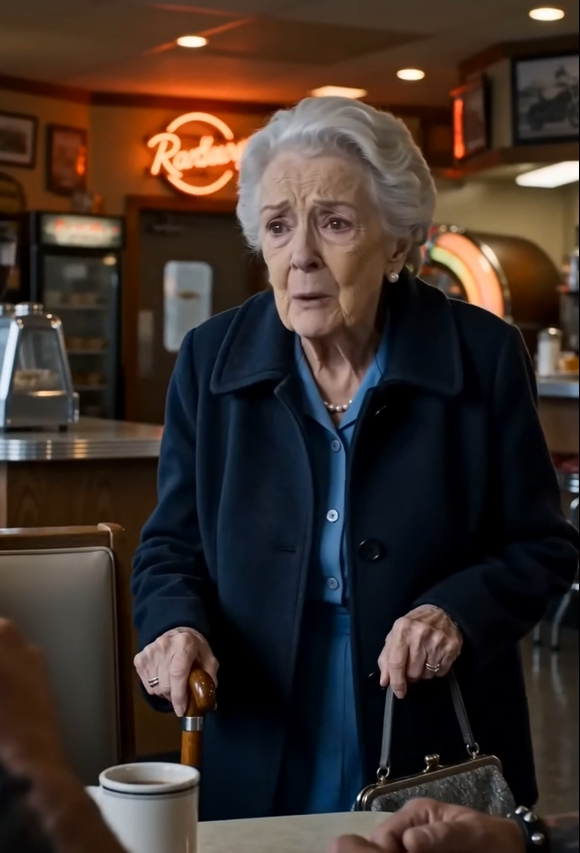
A 97-YEAR-OLD WIDOW ASKED ONE BIKER TO COME TO HER HUSBAND’S FUNERAL – THEN 400 HELLS ANGELS FILLED THE STREET
I just need someone at his funeral.
That was all Eleanor Whitmore had meant to say.
Not money.
Not pity.
Not a miracle.
Just someone.
But the moment the words left her mouth in that roadside diner, every man at the biker table went silent.
Coffee cups stopped halfway to lips.
Forks paused over plates.
The jukebox kept playing in the corner, tinny and low, but inside Harper’s Roadhouse, something heavier than music settled over the room.
Eleanor stood there in her good wool coat, one hand wrapped around the polished head of her cane, the other curled tight around the strap of her small handbag.
She was ninety-seven years old.
She was five feet one if she stood as straight as her old hip allowed.
She had buried almost everyone who had ever called her by her first name.
And now she was asking a stranger in a black leather vest to help her keep her husband from leaving the world inside a room full of empty chairs.
The biker at the center of the table looked up at her.
He was a broad man with a grey beard, worn hands, and eyes that did not wander away from pain when it stood in front of him.
His name was Jack Callahan.
Eleanor did not know that yet.
All she knew was that he looked like a man who might tell her the truth.
That mattered to her.
At ninety-seven, she had no patience left for false comfort.
Her husband, Thomas Arthur Whitmore, had died six months earlier.
He had been ninety years old.
He had spent seventy-two years married to Eleanor and nearly all of those years becoming the kind of man people quietly depended on.
He fixed cars for neighbors who could not pay him.
He shoveled snow from porches before people woke up.
He sat beside the sick.
He repaired fences.
He drove widows to appointments.
He carried groceries up stairs.
He helped families move.
He never spoke of these things afterward.
If someone tried to thank him, Thomas would wave them off and pretend he had somewhere urgent to be.
That was his way.
He gave, then disappeared before gratitude could embarrass him.
Eleanor had loved him from the night he stepped on her feet at a dance in 1951.
He had apologized so hard she started laughing, and because Thomas considered making Eleanor laugh a personal victory, he spent the next seventy-two years trying to do it again.
They had lived in the same small house in Silver Creek for fifty-one years.
The third porch step had always creaked.
Thomas had promised to fix it.
He never did.
Eleanor used to tease him about it.
After he died, she found herself avoiding that step because the sound of it made her throat close.
Every object in the house had become a witness.
His chair.
His coffee mug.
The old record player.
The kitchen table he had repaired so often that Catherine, their daughter, once said the only original part left was the idea of a table.
His photograph stood on the mantle now.
Eleanor spoke to it every night.
Catherine thought this was not healthy.
Eleanor thought it was accurate.
Thomas was not gone in any way that mattered.
He was simply somewhere she could not see him yet.
For six months, Eleanor had tried to be sensible about grief.
She cooked small meals and ate half.
She folded his clothes and then unfolded them again.
She kept reading three newspapers a week because Thomas would have called it surrender if she stopped.
She still set her hair every Sunday because he had liked it soft around her face.
She still drank her coffee black because she had done so since 1952 and saw no reason to sweeten what life had already made bitter enough.
Then the funeral director asked for the final guest list.
Eleanor wrote down four names.
The funeral director.
Catherine, if she could get a flight from Oregon.
Reverend Mills, if his health held.
Dorothy Finn, if her son could drive her.
That was all.
A ninety-seven-year life beside a ninety-year-old man, reduced to four names on lined paper.
Eleanor stared at that list until the ink blurred.
She had never been a woman who indulged self-pity.
She had survived war years, lean years, childbirth, bills, illness, widowhood, and the long slow fading of friends.
She understood that people died.
She understood that families scattered.
She understood that old age was full of disappearances no one else noticed.
But the guest list felt different.
It was not simply small.
It felt like an erasure.
It felt as if Thomas, who had spent his whole life showing up for others, was about to be sent away by almost no one at all.
Eleanor folded the paper carefully and placed it in the drawer beside Thomas’s watch, their marriage certificate, and the letter he had written on their fiftieth anniversary.
Then she put on her coat.
She took her cane.
She left the house.
She did not know she was going to Harper’s Roadhouse until she was already halfway there.
The diner sat four blocks from her street, near the edge of town, with a gravel parking lot and a sign missing two letters.
Eleanor had passed it for years without entering.
It was the sort of place Thomas might have liked and Eleanor might have described as unsuitable, though secretly she admired people who did not worry too much about being suitable.
When she pushed open the door, warmth hit her first.
Coffee.
Grease.
Leather.
Low voices.
A jukebox near the bathrooms.
A hostess with a hummingbird tattoo looked up and told her to sit anywhere she liked, honey.
Eleanor sat by the window and ordered black coffee.
She noticed the bikers only after her hands stopped trembling around the cup.
There were six or seven of them at the far wall.
Large men, mostly.
Leather vests.
Heavy boots.
Patches.
Laughter that filled the table but did not feel cruel.
One man was quieter than the rest.
He listened while the others spoke.
When he talked, the table naturally made room for his words.
Eleanor watched him for twenty minutes.
She was deciding whether humiliation would be survivable.
She had spent her life helping other people keep their dignity.
Now she was preparing to risk her own.
At last, she stood.
Her hip objected.
Her cane tapped the floor.
The walk across the diner felt longer than four blocks.
The bikers stopped talking before she reached them.
Jack Callahan set down his coffee.
He did not smile politely.
He did not frown.
He simply waited.
Eleanor had prepared a careful sentence.
What came out was the truth.
I am sorry to bother you.
I know you do not know me.
Jack’s voice was low and unhurried.
That’s all right.
My name is Eleanor Whitmore.
My husband died six months ago.
His name was Thomas.
He was a good man.
Her voice caught on the word good because it was too small for what Thomas had been.