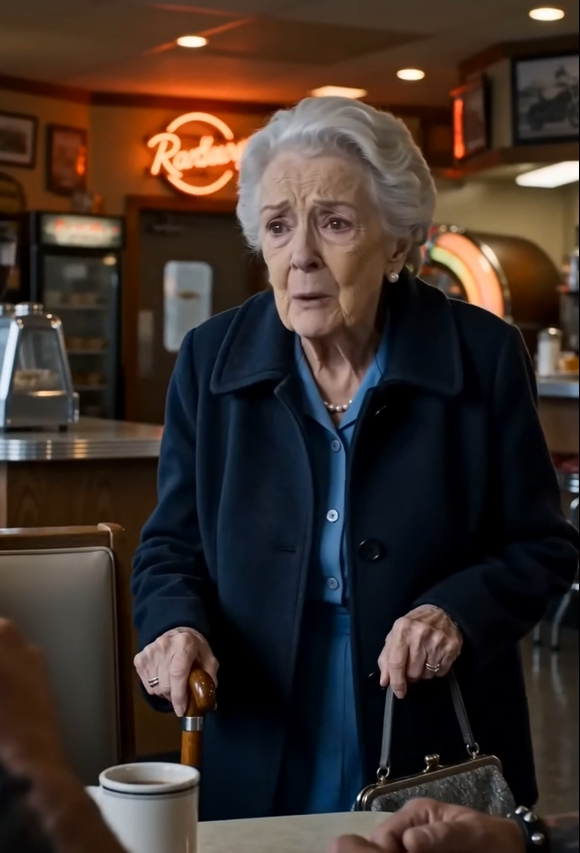
She pressed her lips together and forced herself to continue.
He spent his life helping people.
If someone needed a car fixed, he fixed it.
If someone was sick, he sat with them.
If a driveway needed shoveling, he did it before anyone asked.
He deserved a proper goodbye.
No one at the table moved.
The funeral is Saturday.
Ten in the morning.
The white church on Lammer Street.
There are not many people left who knew him.
Most of our friends are gone.
Our daughter is trying to come, but she is not certain.
And I do not want his last goodbye to happen in a room full of empty chairs.
Jack looked at her then with something that was not pity.
Pity would have made her leave.
This was recognition.
It was as if her words had landed on an old bruise in him.
I know this is not your concern, Eleanor said.
I know you owe me nothing.
But I thought maybe you could come.
Maybe one or two of you.
She swallowed.
Then the sentence that had carried her across the diner finally escaped.
I just need someone at his funeral.
The table remained silent.
The red-bearded man beside Jack looked down at his hands.
A younger man with a scar along his jaw looked toward the ceiling.
The waitress behind the counter stopped wiping the same spot.
Jack said, When is the service?
Saturday.
Ten.
White church on Lammer.
Jack nodded slowly.
What was your husband’s name again?
Thomas Arthur Whitmore.
Jack repeated the name like he was setting it somewhere safe.
Thomas Arthur Whitmore.
Then he said something Eleanor did not expect.
Tell me about him.
Eleanor blinked.
I am sorry?
Tell me about him.
You have time.
The red-bearded man pulled out the chair beside him.
Sit down, Mrs. Whitmore.
Your coffee is probably cold.
Let me get you a fresh cup.
So Eleanor sat among bikers she had never met and talked about the man she had loved for seventy-two years.
She told them about the dance in 1951.
She told them about the apartment with the noisy radiator.
She told them about bad years and better years and how the bad years sometimes felt richer because she and Thomas had solved them together.
She told them how he put on Nat King Cole in the kitchen and offered his hand as though they were nineteen again.
She told them about the neighbors he helped.
She told them about the family two blocks over who could not afford movers, and how Thomas organized half the street to show up with trucks.
She told them about the last year.
She had not meant to.
The hospital visits.
The thinning of his body.
The way his strong hands became fragile.
The way he faced death not with anger, but with a tenderness so focused it felt like he was using every remaining hour to love her properly.
She told them about the morning he died.
She had been holding his hand.
For weeks, confusion had clouded him.
Then, at the end, clarity returned.
He looked at her and said Ellie in the same voice he had used for seventy-two years.
Then he was gone.
When Eleanor finished, the diner table had changed.
The men were still the same men.
The leather was still leather.
The boots were still boots.
But something invisible had moved among them and taken a seat.
Jack’s jaw was tight.
The red-bearded man stared at the table.
The younger one with the scar blinked hard.
Jack said, He sounds like exactly the kind of man the world needs more of.
He was, Eleanor said.
He really was.
Jack leaned forward.
Saturday at ten.
White church on Lammer.
Yes.
Your husband is not going to be in a room full of empty chairs.
Eleanor let herself smile, but only a little.
Hope was dangerous.
She had learned to ration it.
You will come?
I will come.
And I will not be alone.
Eleanor thought he meant five.
Maybe eight.
Ten if she was fortunate beyond reason.
She thanked them.
She shook Jack’s hand.
She shook the red-bearded man’s hand.
Then she walked out into the November air.
That night, Eleanor ate dinner at the kitchen table with Thomas’s photograph across from her.
She told him she had met some men at a diner.
She told him they might come.
She told him she hoped he would like them.
Then she washed one dish and went to bed on her side, leaving his side empty.
She did not know that forty-five miles away, in a cinder block clubhouse with American flags in the windows, Jack Callahan was sitting with his phone in his hand.
She did not know he had already sent the first message.
She did not know that by midnight, the message had crossed county lines.
By two in the morning, it had crossed state lines.
By dawn, it had reached men and women who had never heard the names Eleanor and Thomas Whitmore before, but understood immediately what was being asked of them.
The message was simple.
A ninety-seven-year-old widow in Silver Creek asked for someone to attend her husband’s funeral.
His name was Thomas Arthur Whitmore.
He spent his life showing up for people.
Saturday morning.
White church on Lammer Street.
Come.
That was all Jack wrote.
He did not need to describe Eleanor’s trembling hands.
He did not need to write about the four names on the list.
He did not need to explain the ache in the sentence I just need someone.
The right people would hear it without being told.
Three hundred and fourteen miles away, Victor Cruz read the message and sat down on the edge of his bed.
His mother had died alone in a hospital eleven years earlier.
He had been three hours away when the call came.
He drove too fast and arrived too late.
The nurse had been kind.
The nurse had not been her son.
Victor had carried that failure like a stone inside his ribs.
He called his road captain before he finished reading Jack’s message.
Silver Creek, Montana.
Saturday.
We are going.
His road captain asked, How many?
Victor said, Everyone who can ride.
Six hundred and twenty miles away, Calvin Webb filled a thermos at two in the morning.
He was seventy-three and had been riding for fifty-one years.
His wife Lorraine stood in the kitchen in her robe and handed him the thermos.
Tell me about her, she said.
He told her about Eleanor.
He told her about Thomas.
He told her about the four names.
Lorraine listened.
Then she said, Drive safe.
That was all.
That was enough.
In Idaho, a woman named Dana checked road conditions.
In Wyoming, six riders argued cheerfully at a truck stop about the fastest route.
At another clubhouse, a young mother named Jesse decided to bring her fourteen-year-old son, Marcus, because he had lost his grandfather two years before and she wanted him to see what it meant when people showed up.
By Thursday night, Jack realized the request had grown beyond anything Eleanor imagined.