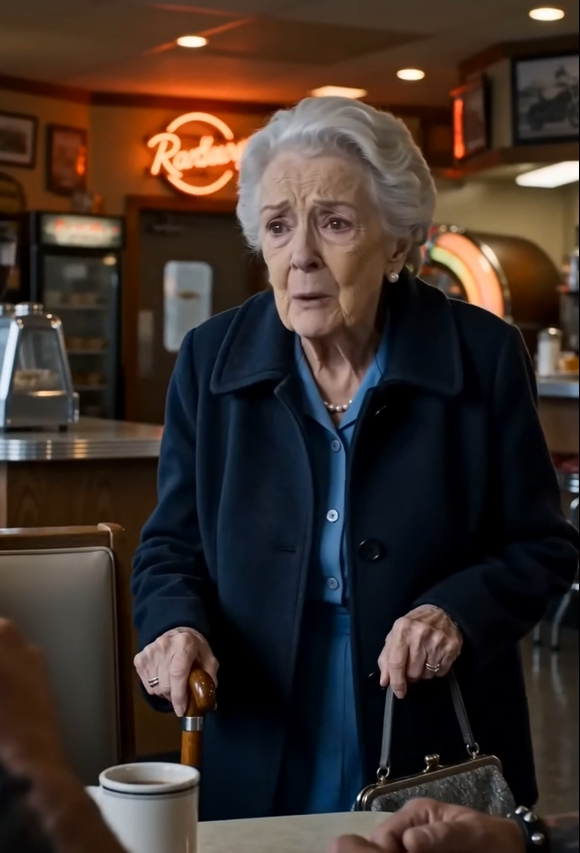
Catherine looked into the box.
Have you heard back?
Many of them.
Calvin wrote three pages.
Lorraine added a note at the bottom.
Victor wrote back too.
He called his brother.
They are talking again.
Catherine went still.
Jesse wrote.
Marcus drew me a picture.
A motorcycle, a church, and a very small woman with a cane.
I assume that is me.
It is the finest piece of art I have ever received.
Catherine’s husband looked down at his plate.
His face was doing something he did not want seen.
Eleanor saw it and respectfully ignored it.
That is what telling the truth about people does, Eleanor said.
It keeps them real.
It keeps them present.
Thomas is not less because he died.
He is different.
He is portable.
He travels through everyone who hears his name and finds something in him that connects to something in them.
She placed a hand on the box.
Thomas is in this box.
He is in Gerald’s graveside.
He is in Marcus’s drawing.
He is in Victor calling his brother.
He is in every repair made because someone thought of him.
He is not only in that cemetery.
He is everywhere someone heard his name and felt something.
Catherine cried.
Her husband stopped pretending not to.
Eleanor frowned at them both.
Do not cry.
This is a good thing.
A completely good thing.
I am ninety-seven years old, and I am telling you this is the best possible ending to a seventy-two-year love story.
Thomas got four hundred people.
He got a letter read at a stranger’s grave.
He got a fourteen-year-old boy who wants to be like him.
He got a man in Spokane calling his brother.
That is not an ending.
That is a man still working.
In January, Jack came again.
He stood on the third porch step, which no longer creaked because Darnell had fixed it.
He held a small piece of wood, smooth and rectangular.
Words had been burned into it.
Eleanor read them.
He never made helping feel like a favor.
He just helped.
She looked up.
Where did you get this?
You said it at the diner.
When you told me about Thomas.
Eleanor looked at the wood again.
She thought of the twenty minutes she had sat alone in Harper’s Roadhouse deciding whether shame was survivable.
She thought of the long walk across the floor.
She thought of Jack listening.
She thought of the street full of riders.
The church full of witnesses.
Victor’s letter.
Calvin’s thermos.
Marcus’s drawing.
Gerald’s funeral.
Darnell’s toolbox.
All of it had come from crossing the room.
All of it had come from saying the true thing.
She pressed the wood against her chest.
Come in, she said.
I will make coffee.
Jack came in.
They sat in the kitchen where everything important in Eleanor’s life seemed to happen.
On the mantle, Thomas’s photograph looked out at the room, steady and warm and entirely present.
Outside, Silver Creek went about its January business.
Inside, Eleanor Whitmore, ninety-seven years old, held a cup of strong coffee and looked toward the door.
She was not done.
Not slightly.
Not close.
There were letters to answer.
There were knocks to hear.
There were strangers becoming names.
There were names becoming stories.
There was a world still full of loneliness, yes.
But Eleanor knew something now that loneliness had tried very hard to hide.
The world also contained goodness.
More goodness than empty chairs.
More goodness than a folded funeral list.
More goodness than grief could see from inside a quiet house.
You show up.
You cross the room.
You tell the truth about what you need and who you love and who you lost.
You answer every letter.
You open every door.
And you trust the evidence.
Because one ninety-seven-year-old widow asked for someone.
And the world sent four hundred.