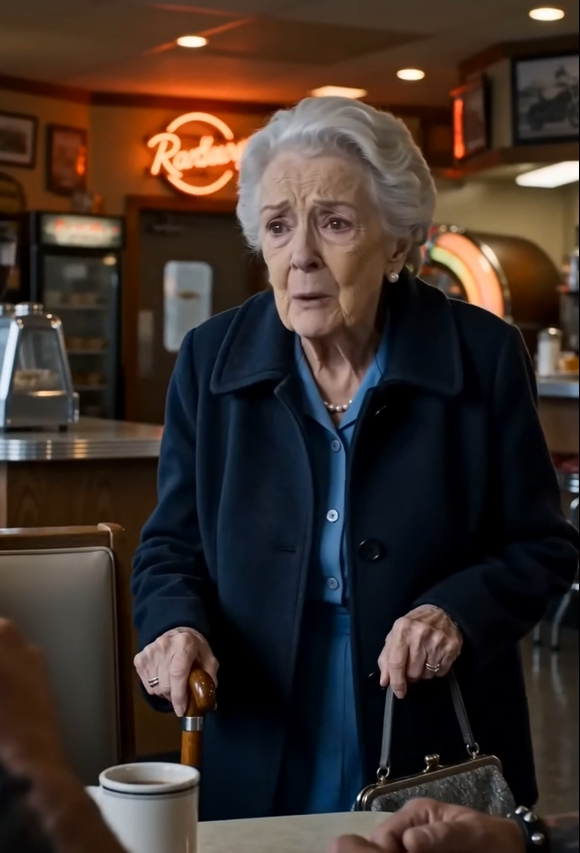
Some wrote them this morning.
Some are being mailed later.
We set up a forwarding address.
Eleanor looked at him.
You set up a forwarding address?
We wanted to make sure you got them all.
She pulled out the first letter.
It was from Victor.
Mrs. Whitmore, it began.
I stood at Thomas’s grave today and thought about my dad.
I thought about everything I did not say.
Tonight, I am going to call my brother, who I have not spoken to in three years.
I think that is what Thomas would do.
I think he spent his whole life making the call and closing the distance.
I am going to try to be more like him.
Thank you for bringing us together to meet him.
Eleanor read it twice.
Then she placed it on the table and covered it with her hand.
For six months, she had felt edited down.
That was how she later described it.
As though Thomas’s death had made her smaller and less legible.
As though, without him there to see her, part of her had become harder for the world to read.
Now there were hundreds of letters on her lap saying otherwise.
She looked at Jack.
You made us visible again.
Jack shook his head.
You did that.
You crossed the diner.
You told the truth about what you needed.
Most people carry the thing alone until it crushes them.
You asked.
Everything else followed.
Eleanor smiled.
Thomas always said I had more courage than sense.
Thomas sounds like he was paying attention.
After the funeral, Catherine stayed four more days.
She extended her ticket twice.
Her husband called from Oregon and asked how Eleanor was.
Catherine looked into the living room, where her mother sat with the letter box in her lap, reading slowly, lips moving slightly.
She is better than I have seen her in six months.
Different.
Something came back.
Her husband was quiet.
Stay as long as she needs, he said.
I was going to anyway.
I know.
I wanted to say it.
Eleanor decided she would answer every letter.
Catherine tried to warn her gently that there were hundreds.
Eleanor stopped her.
I am ninety-seven, Catherine.
I do not have time to not feel obligated.
These people drove through the night for Thomas.
The least I can do is write back.
Besides, I want to know them.
Calvin has a wife named Lorraine who handed him a thermos and told him to drive safe.
I want to know Lorraine.
Is that so strange?
No, Catherine said.
It is not strange at all.
Eleven days after the funeral, Darnell knocked on Eleanor’s door with a toolbox.
Your third porch step, he said.
Eleanor stared at him.
How do you know about my third porch step?
You mentioned it in the diner.
You said Thomas kept promising to fix it.
She had said that.
She had not known anyone heard that carefully.
Darnell fixed the step.
Then he fixed three other things without asking permission because broken things appeared to offend him personally.
When he finished, Eleanor offered coffee.
He accepted.
They sat at her kitchen table for an hour.
He told her about hard years and bad choices and the club becoming the first stable thing he had known in a long time.
Eleanor told him Thomas had not always been the man people celebrated.
He had chosen to become that man.
Again and again.
Year after year.
Until choosing became character.
Darnell listened as if she had handed him a tool he did not know he needed.
Two days later, Jesse from Boise came to the door.
She had driven nine hours with something unfinished inside her.
She sat at Eleanor’s kitchen table with tea in both hands and talked about her son, Marcus.
His grandfather had died two years earlier.
He was the Thomas of our family, Jesse said.
Marcus lost his fixed point.
I brought him to the funeral because I wanted him to see that people like that do not disappear.
Eleanor leaned forward.
What did Marcus say afterward?
Jesse’s eyes filled.
He said he wanted to be like Thomas.
He said the things you do for people are permanent.
He is fourteen, and he used that word by himself.
Permanent.
Eleanor reached across the table.
Tell Marcus that Thomas would be very happy to know that.
And tell him to fix what is broken around him.
Do not wait to be asked.
Do not make a production of it.
Just fix it and move on.
That was Thomas’s philosophy.
It can be Marcus’s too.
Three weeks after the funeral, Jack called Eleanor.
His voice was careful.
There is a situation.
Tell me.
An elderly man named Gerald had no family.
He was dying.
His neighbor was worried his funeral would be nearly empty.
Jack said, I think I am asking whether what we did for Thomas was one time, or the beginning of something.
Eleanor was quiet.
Then she said, Thomas would say a thing worth doing once is worth doing every time.
Jack closed his eyes.
Yes.
He would say dignity does not have a limited edition.
Yes.
Gerald deserves what Thomas got.
His neighbor deserves what I got.
Yes.
Then you already know the answer.
Eleanor did not travel to Gerald’s funeral.
Her hip had firm opinions about sixty-mile winter drives.
But she wrote a letter.
Jack read it at the graveside.
Gerald, I did not know you.
I do not know your story.
But I know you were here, and being here is not a small thing.
You took up space in the world.
You affected things around you.
The ripples go further than you know.
You mattered, Gerald.
You mattered in ways that have not finished mattering yet.
Rest now.
You earned it.
Eleanor Whitmore, Silver Creek, Montana.
At Gerald’s graveside, his neighbor Margaret cried openly.
Back in Silver Creek, Eleanor sat at her kitchen table and felt something moving beyond her house.
She spoke to Thomas’s photograph that night.
Look what happened.
I do not think this is stopping anytime soon.
I intend to keep writing letters.
I intend to open the door when people knock.
I intend to make coffee for anyone who sits at this table.
I miss you every minute.
I am all right.
Both things were true.
Eleanor had lived long enough to know the most important truths often come in pairs.
Missing and continuing.
Grief and okayness.
Ending and beginning.
At Christmas, Catherine returned with her husband.
Eleanor discovered she liked him more than she had expected.
He was quiet, and Eleanor had always noticed things in quiet people that louder people missed.
He fixed the gutters without being asked.
Eleanor registered this as meaningful.
On Christmas Eve, she placed the letter box on the table.
Not to read all of them.
She had read them all.
She had answered three hundred and forty-seven by hand, sometimes one a night, sometimes two.
She brought the box because it belonged there.
It had become a record of what happened when one woman crossed a diner and asked honestly for what she needed.