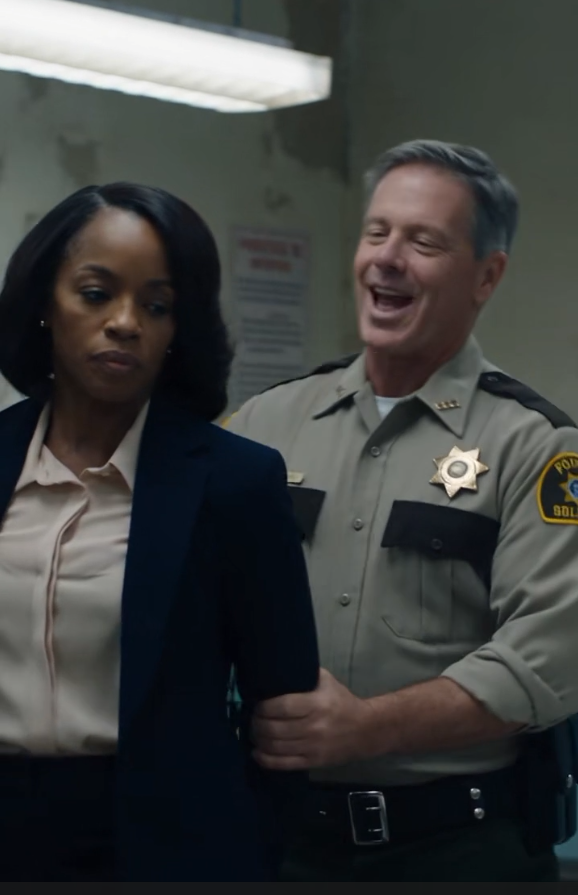
Part I — The Stop
By the time Sheriff Boyd Cleary decided Sarah Hayes needed to be taught a lesson, she had already done everything right.
The afternoon heat lay over Interstate 89 in hard, wavering sheets, bending the horizon above the asphalt and turning the distant tree line into a dark green smear. Sarah saw the first forty-five-mile-per-hour sign well before she reached Oak Haven and eased her rented silver Chevrolet Malibu down from sixty-five.
Forty-eight.
Forty-six.
Forty-four.
She held it there.
The town appeared gradually: a gas station with two pumps under a sun-bleached canopy, a tire shop with weeds splitting the parking lot, a diner whose sign had lost two letters, then a faded billboard advertising lake cabins that looked as if no one had rented one in twenty years.
Sarah noticed the sheriff’s cruiser before she saw the man inside it.
It sat angled behind the billboard in a patch of gravel, nose pointed toward traffic.
She kept both hands at ten and two.
The Malibu passed the cruiser.
Nothing happened.
Then, in her rearview mirror, a white door swung shut.
A moment later the cruiser rolled onto the highway.
Blue lights came alive.
Sarah exhaled once through her nose.
She signaled, moved onto the shoulder, put the transmission in park, switched off the engine, lowered the driver’s window, and placed both hands high on the steering wheel.
It was not fear that sharpened her attention.
It was habit.
Years of command had trained her to notice details under pressure: distance, tone, posture, exits, hands.
The approaching sheriff walked slowly.
Too slowly.
He wore mirrored sunglasses and a tan uniform stretched tight across his stomach. His thumbs rested on his duty belt as though posing for a photograph.
Sarah watched him in the side mirror until he reached the door.
“License and registration.”
No greeting.
No explanation.
“License is in my wallet inside my purse,” Sarah said. “Registration is in the glove compartment.”
His mouth tightened.
“You always narrate everything you do?”
“When an armed officer is standing beside my vehicle, yes.”
A pause.
“Get them.”
She reached carefully, first for her wallet, then for the registration.
He took both.
His nameplate read CLEARY.
His badge read SHERIFF.
He studied her driver’s license longer than necessary.
“Sarah Hayes.”
He pronounced the name slowly, then looked through the window at her.
“Long way from DC.”
“Yes.”
“What brings you through Oak Haven?”
“I’m driving to the airport.”
He tilted his head.
“I didn’t ask where you were going.”
Sarah looked at him for half a second.
“You asked what brought me through Oak Haven.”
The sheriff’s jaw shifted.
He glanced toward the road, then back at her.
“You know why I stopped you?”
“No.”
“You crossed the center line back there.”
“I did not.”
It came out without heat.
That seemed to bother him more than anger would have.
Cleary lowered his sunglasses just enough to look over the rims.
“You calling me a liar?”
“I’m telling you what occurred. My vehicle remained inside the lane.”
“You were also speeding.”
“My speed was forty-four in a forty-five when I passed your position.”
“I clocked you higher.”
“At what speed?”
He stared at her.
Sarah waited.
She had sat across conference tables from cabinet officials, intelligence officers, combatant commanders, people who could send aircraft across oceans with a sentence. Silence did not make her uncomfortable.
Cleary, however, seemed to experience silence as defiance.
“You’ve got a lot of attitude for somebody in my jurisdiction.”
“I am speaking calmly, Sheriff.”
“Doesn’t sound calm to me.”
Sarah kept her hands visible.
“Am I being cited?”
His lips pressed together.
“Excuse me?”
“Are you issuing a traffic citation, or am I being detained for another reason?”
That did it.
Not the words themselves.
The structure.
The absence of apology.
The refusal to become smaller.
Cleary stepped back from the window.
“Out of the vehicle.”
Sarah did not move.
“For a traffic citation?”
“Step out.”
She looked at him, measuring.
There were choices available to her. Some were legal. Some were tactical. None improved by turning the shoulder of an empty highway into a contest of pride.
So she opened the door.
Heat rushed into the car.
Sarah stepped onto the gravel in a dark navy blouse, charcoal slacks, and low black shoes. Nothing about her clothing announced rank. Nothing about her posture needed to.
Cleary pointed at the hood.
“Turn around. Hands on the vehicle.”
Sarah did not immediately obey.
Her voice remained quiet.
“Sheriff Cleary, I strongly advise you to reconsider this course of action.”
His face changed.
Not much.
Enough.
He moved behind her and seized her right wrist.
“Are you threatening me?”
“No.”
He twisted her arm upward.
Pain ran across her shoulder.
“I am giving you a factual assessment.”
Metal closed around one wrist.
Then the other.
The cuffs were tighter than necessary.
Cleary leaned close enough for her to smell coffee on his breath.
“Resisting arrest. Disorderly conduct. Failure to comply.”
Sarah turned her head slightly.
“I complied with your instruction to exit.”
“Keep talking.”
“You have not identified lawful grounds for an arrest.”
His grip hardened.
“We’ll call it the attitude package.”
That phrase told her more about him than anything else had.
Sarah stopped speaking.
He expected an argument.
She gave him none.
He expected tears.
None came.
He expected perhaps a sudden explanation—a desperate credential pulled from her mouth because her hands were cuffed behind her back.
Sarah looked at the empty highway, the low hills, the heat trembling over the hood of the Malibu.
Then she said, “Very well, Sheriff.”
For reasons he could not have explained, Cleary disliked those three words most of all.
The Oak Haven Sheriff’s Department occupied a square brick building beside the county courthouse, with a narrow flagpole out front and three patrol cars parked under metal awnings.
By the time Cleary drove through the rear gate, Sarah had already replayed the stop from beginning to end.
Not emotionally.
Procedurally.
The initial speed.
The lane position.
The claimed violation.
The order to exit.
The escalation.
The arrest language.
The treatment of her personal property.
The body camera.
She had seen one on his chest.
Whether it was recording was another question.
Deputy Toby Miller sat behind the booking counter when Cleary brought her in.
Miller looked young enough to still feel uncomfortable in the uniform. Late twenties, perhaps. Clean-shaven. Thin face. A wedding band. He rose from his stool.
“Sheriff.”
“Book her.”
Miller looked at Sarah, then at the cuffs.
“Charges?”
Cleary tossed a handwritten sheet onto the counter.
“Resisting. Disorderly. Failure to comply.”
Miller read it.
His eyes paused.
“Traffic stop?”
“Just book her.”
Sarah said nothing.
Miller guided her to a line painted on the floor.
“Ma’am, I need you to empty your pockets once the cuffs are off.”
Cleary unlocked them.
Sarah rubbed neither wrist.
She placed her belongings on the stainless-steel counter one item at a time.
Wallet.
Rental keys.
Lip balm.
A folded receipt.
Then a matte-black communications device slightly smaller than a normal smartphone.
Miller stopped writing.
Cleary picked it up.