The device had no visible brand. No commercial operating buttons. No camera lenses. Along one edge was a biometric strip.
“What the hell is this?” Cleary asked.
Sarah looked at him.
“A secured government communications device.”
He grinned.
“Government?”
“Yes.”
“What kind?”
“That is not information you require.”
Miller’s gaze moved between them.
Cleary rotated the device in his hand.
“Burner phone?”
“No.”
He tried the side.
Nothing happened.
“Sheriff,” Sarah said, “do not attempt to access it.”
His head came up.
“Excuse me?”
“I advise you not to tamper with that device.”
“There’s that attitude again.”
“This is not about attitude.”
He held it toward her.
“You saying this thing is classified?”
“I am saying it is secured government property and should remain undisturbed.”
Miller spoke before he could stop himself.
“Maybe we should put it in the safe.”
Cleary looked at him.
“We put property in property trays.”
“Yeah, but if it’s federal—”
“Tray.”
Miller closed his mouth.
Cleary dropped the device into a clear plastic bin.
The sound it made against the bottom was small.
Sarah watched it settle next to her keys.
Then Miller started the paperwork.
Name.
Date of birth.
Address.
Occupation.
Sarah looked at him.
“United States Army.”
Miller’s pen paused.
“Active?”
“Yes.”
Rank was not on the standard county form.
He did not ask.
Cleary snorted from the other side of the counter.
“What are you, a recruiter?”
Sarah did not answer.
That irritated him.
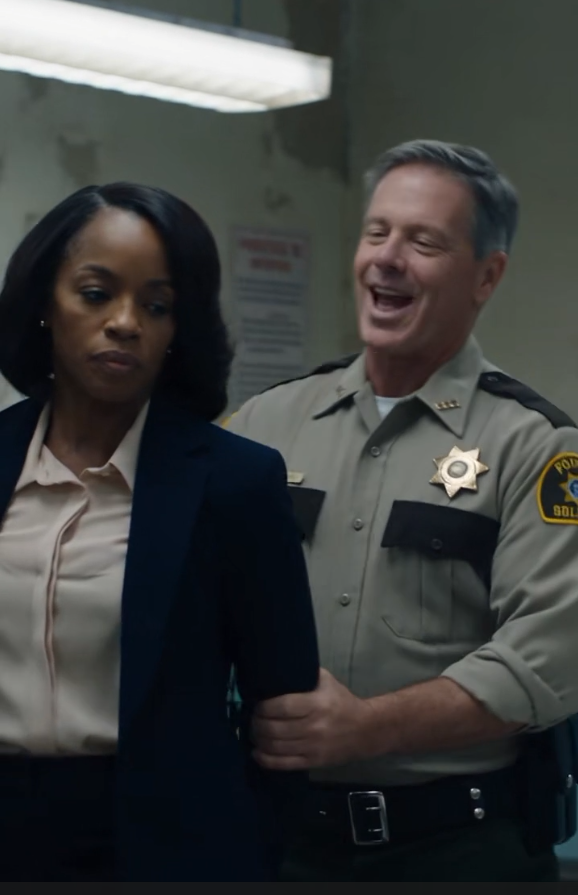
Miller finished the intake and escorted her toward the holding cells.
At the first steel door, Sarah stopped.
“I am entitled to a phone call.”
“You’ll get one.”
“When?”
Miller glanced over his shoulder.
Cleary was standing at the counter watching.
“When the sheriff authorizes it.”
Sarah looked at Miller.
Not angrily.
That made it worse.
“You know that is not the standard.”
His throat moved.
“I’ll ask.”
The door buzzed open.
Sarah stepped into the cell.
It contained a steel bench, a toilet behind a half wall, and a narrow window reinforced with wire mesh.
Miller removed the cuffs.
Before leaving, he hesitated.
“Do you need water?”
“Yes, thank you.”
He brought her a paper cup.
Cleary watched him do it.
Thirty minutes passed.
Sarah spent them seated on the bench with her back straight and her hands resting loosely in her lap.
She did not pace.
That would have made Cleary happy.
Through the small window in the cell door, she could see movement in the booking area.
Cleary talking.
Miller working.
Another deputy coming in from patrol.
At one point Cleary held up her secure device and showed it to the other man.
Sarah rose immediately.
“Sheriff.”
He turned.
“Do not activate that device.”
Cleary laughed.
“Relax, General Hospital.”
Sarah became still.
He had not understood the occupation entry.
Miller had.
She could tell from his face.
“Put it down,” Sarah said.
The sheriff’s smile faded.
For the first time, her tone had contained command.
Not volume.
Command.
He stared at her through the glass.
Then, deliberately, he placed the device back in the tray.
“You want your phone call?”
“Yes.”
“Maybe ask nicely.”
Sarah waited.
Miller looked at the counter.
Cleary waved one hand.
“Fine. Bring her out.”
Miller opened the cell and escorted her to the booking desk phone.
Cleary leaned against the wall with his arms crossed.
“Calling your lawyer or your mama?”
Sarah picked up the receiver.
She dialed twelve digits from memory.
A tone sounded.
Then a synthetic voice.
“Authentication required.”
Sarah’s expression did not change.
“Echo Seven Tango Niner. Authorization code Black Sky Four. Priority Flash.”
Miller’s pen stopped moving.
Cleary straightened slightly.
A click.
Then a man’s voice came through the receiver.
“National Military Command Center. Go ahead.”
The room seemed to contract.
Sarah stood with one hand holding the phone.
“This is Brigadier General Sarah Hayes, United States Army. My encrypted communications device has been seized. I am being held in an unsecured local law enforcement facility without legal cause. Trace the device, notify General Thomas Reed, and initiate extraction protocol.”
Silence on the line.
Then:
“Authenticate emergency status.”
Sarah gave a second code.
The voice changed.
“Confirmed. Remain available.”
“I will.”
“Do you assess immediate physical threat?”
Sarah looked at Cleary.
He was no longer smiling.
“Not at this time.”
“Understood.”
The line disconnected.
No one spoke.
Cleary pushed off the wall.
“That supposed to impress me?”
Sarah replaced the receiver.
“No.”
“What exactly are you claiming to be?”
She looked at him.
“I already stated it.”
“You said Army.”
“Yes.”
“You didn’t say general.”
“You did not ask.”
Miller turned slowly toward Cleary.
“Sheriff—”
Cleary held up a hand.
“This is ridiculous.”
Sarah’s gaze dropped briefly to the body camera clipped to his chest.
“Is that recording?”
His hand went instinctively toward it.
“That’s none of your business.”
“It will be.”
The red phone rang.
Every law enforcement office of a certain size had emergency channels few people expected to use. Oak Haven’s red handset sat beneath a dusty clear cover on the wall beside the dispatch station.
According to Miller, it had never rung.
Not during tornado warnings.
Not during the prison transport crash three years earlier.
Not when a governor’s convoy had passed through the county.
Now it rang once.
Twice.
Three times.
Nobody moved.
On the fourth ring, Miller whispered, “Sheriff.”
Cleary walked to it.
He lifted the cover.
Picked up the handset.
“Sheriff’s Department.”
His posture changed almost immediately.
“What?”
A pause.
“No, sir, I—”
Another pause.
Cleary’s face drained.
“Yes, but there’s been a misunderstanding.”
Miller looked at Sarah.
Sarah was watching the sheriff.
“Yes, sir,” Cleary said. “I understand who you said you were.”
He swallowed.
“No, sir. She is not injured.”
Another pause.
His gaze slid toward Sarah.
“I’ll have to check that.”
The caller spoke for a long time.
Cleary listened.
When he finally lowered the phone, his hand was unsteady.
Miller said, “Who was it?”
Cleary did not answer.
Then the windows rattled.
The first vibration came through the floor like distant thunder.
The second was stronger.
Miller moved toward the front lobby.
“Sheriff…”
Dust lifted outside the windows.
The sound deepened into the unmistakable chopping roar of rotor blades.
Two black military helicopters descended over the gravel lot.
Sarah closed her eyes for half a second.
Not in relief.
In calculation.
Because she knew General Thomas Reed.
And she knew if he had authorized two aircraft, this was no longer merely about getting her out.
Part II — Pressure
The first helicopter touched down beyond the sheriff’s parking lot hard enough to flatten the weeds in every direction.
The second hovered for several seconds before landing beside it.
Doors opened.
Men and women in dark uniforms moved out in disciplined groups, not running, not shouting, carrying themselves with the calm efficiency that made panic unnecessary.
Miller stepped away from the window.
“Jesus.”
Cleary snapped, “Nobody opens that door.”
Miller turned.
“What?”
“You heard me.”
“Sheriff, that’s the military.”
“This is county property.”
Sarah watched Cleary with new interest.
Fear had reached him.
But fear had not made him cautious.