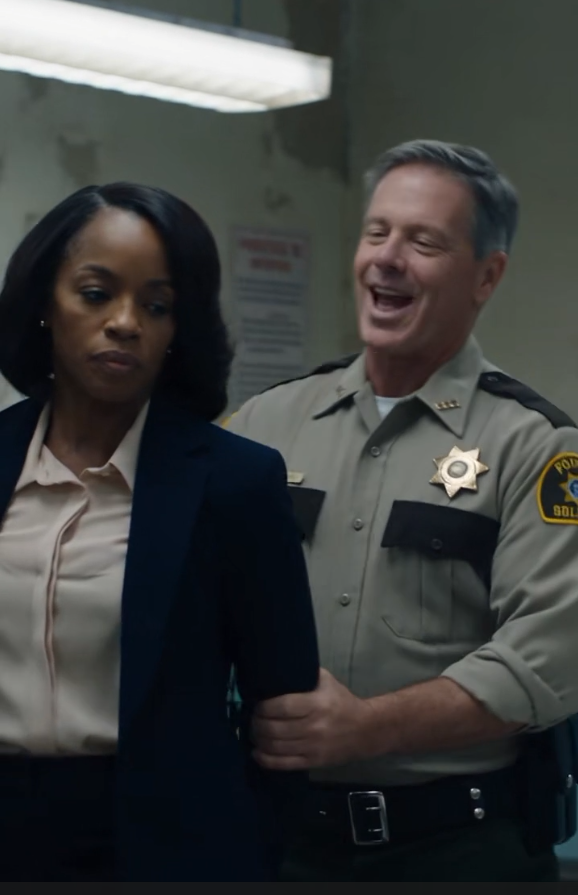
Cleary said, “Standard procedure.”
Sarah put her wallet away.
“Of course.”
She turned toward the door.
Cleary spoke behind her.
“So that’s it?”
Sarah stopped.
“What?”
“You call Washington. Helicopters show up. Everybody bows. You walk out.”
No one moved.
Sarah turned around.
She looked tired now.
Not weak.
Simply tired.
“No one bowed, Sheriff.”
“You know what I mean.”
“Yes.”
He stepped closer.
“You people come into towns like this and think your titles make you untouchable.”
Sarah held his gaze.
“My title did not prevent you from arresting me.”
His mouth opened.
She continued.
“And that is the point.”
Nothing in her voice was theatrical.
It landed harder because of that.
“If I had been a teacher, a nurse, a cashier, or an unemployed woman driving the same road, your conduct would not become more lawful.”
Cleary’s face reddened.
“You don’t know me.”
“I know what you did.”
“You had attitude from the second I got to your window.”
Sarah glanced at Mercer.
Then at Dale.
Then back at the sheriff.
“Attitude is not probable cause.”
Nobody said anything.
Sarah walked out.
General Thomas Reed was waiting beside the helicopter.
He had not come in with the first group.
Sarah saw him before he saw her, standing a short distance from the spinning rotor wash with one hand against his hip, his uniform blouse moving in the wind.
Reed was broader than she remembered from their last meeting, though perhaps that was the body armor under his jacket.
When he spotted her, he walked forward quickly.
His gaze went to her wrists.
“Sarah.”
“I’m fine.”
“That was not the question I was going to ask.”
“I know.”
He stopped in front of her.
For several seconds the general disappeared and the friend remained.
“You sure?”
“Yes.”
He nodded.
Then his professional face returned.
“The device?”
“Secure. Colonel Haskins has it.”
“Compromise?”
“Unlikely.”
Reed looked toward the sheriff’s building.
“What happened?”
Sarah gave him the abbreviated version.
Speed.
Stop.
False claim.
Order out.
Cuffs.
Charges.
Booking.
Device.
Call.
Reed listened without interrupting.
When she finished, he looked past her at the brick building.
“You want me to make one phone call?”
Sarah’s mouth almost curved.
“That depends what the call does.”
“Causes a great deal of administrative discomfort.”
“No.”
“You didn’t even ask.”
“I know you.”
Reed grunted.
“Fair.”
She looked at the helicopters.
“This was excessive.”
“You used Priority Flash.”
“I was in local custody with a secure device outside approved control.”
“So I brought appropriate resources.”
“You brought two helicopters.”
“One was already airborne.”
Sarah looked at him.
“The other?”
Reed shrugged.
“I was annoyed.”
For the first time that afternoon, Sarah smiled.
Barely.
It disappeared as quickly as it came.
Then she looked back at the sheriff’s department.
Reed followed her eyes.
“This isn’t over.”
“No.”
“What do you want?”
Sarah took several seconds.
Not because she did not know.
Because the answer mattered.
“I want the record preserved.”
Reed nodded.
“Body camera?”
“He claims malfunction.”
“Dash camera?”
“Unknown.”
“Dispatch logs?”
“Yes.”
“Booking footage?”
“Yes.”
Reed looked at her.
“And then?”
Sarah watched Deputy Miller through the front window.
He was standing at the booking counter with his shoulders bent, looking down at something in his hands.
“Then we find out whether today was unusual.”
Part III — Reversal
The first real break came from Toby Miller.
It arrived at 9:17 that night.
Sarah had been moved to a secure hotel near the airport while the Department of Defense assessed the communications-device exposure and federal officials coordinated with the state.
She stood at the window in a white hotel robe, looking down at aircraft lights moving beyond the glass, when Reed knocked.
He entered carrying a paper cup of coffee and a thin folder.
“No compromise,” he said.
“The device?”
“Seal held. No intrusion.”
Sarah nodded.
One problem closed.
He held up the folder.
“This one opened.”
Sarah sat at the small table.
“What is it?”
“Deputy Miller gave a statement.”
“To whom?”
“County attorney first. Then state investigators.”
Sarah opened the folder.
Reed sat across from her.
“He says Cleary ordered him to mark the body camera as malfunctioning.”
Sarah’s eyes stopped moving.
“When?”
“After the helicopters landed.”
She looked up.
Reed continued.
“The camera didn’t malfunction.”
“Where is the footage?”
“Miller copied it.”
Sarah said nothing.
Reed slid a small evidence receipt across the table.
“He says Cleary had a habit of deleting footage from traffic stops that became complaints. Miller started making backups six months ago.”
Sarah leaned back.
The hotel room became very quiet.
“Why?”
“Because he thought somebody would eventually need them.”
“How many?”
“Twenty-three stops.”
Sarah closed the folder.
Reed watched her.
“That’s not the reaction I expected.”
“What reaction did you expect?”
“Anger.”
“I am angry.”
“You look like you’re reading procurement numbers.”
Sarah stared at the evidence receipt.
“Anger is useful after facts.”
Reed took a sip of coffee.
“You always did know how to ruin a good rage.”
She ignored that.
“What do the twenty-three stops show?”
“Mixed. Some routine. Several complaints. A few are ugly.”
“Race?”
“Disproportionately Black motorists and out-of-county drivers.”
Sarah’s eyes lifted.
“Disproportionately?”
“Preliminary.”
“Then don’t state it as a conclusion.”
Reed nodded once.
There was the Sarah he knew.
Not interested in a narrative until the record could support it.
“He also backed up the booking-area cameras.”
“From today?”
“Yes.”
“That will show the device handling. The phone call. The detention.”
“And Cleary’s reaction.”
Sarah looked at him.
“What reaction?”
Reed opened the folder again.
“Miller says after you made the call, Cleary told him to amend the initial notes to say you had been ‘aggressive and physically resistant.’”
Sarah’s face became still.
“Did Miller do it?”
“No.”
“Did he document the instruction?”
“Yes.”
That mattered.
More than the helicopters.
More than the red phone.
More than rank.
An unlawful stop could be disputed.
A bad arrest could be defended as judgment.
But knowingly changing the record after learning the detainee’s identity was something else.
Reed said, “Sarah.”
She looked up.
“You know this is going federal.”
“It should go wherever the evidence supports.”
“He arrested a one-star general on invented charges and tried to rewrite the record.”
“He arrested a citizen.”
Reed leaned back.
She continued.
“My rank explains why the response arrived quickly. It does not make what happened more wrong.”
He studied her.
“You’re worried the rank becomes the story.”
“It already is.”
“You called the command center.”
“I had to.”
“I’m not criticizing it.”
“I know.”
She looked toward the window.
“The headline will be military helicopters descending on a rural sheriff’s department. People will argue about whether that was excessive. They’ll argue about federal overreach. They’ll argue about race. They’ll argue about my tone. They’ll argue about whether I should have identified myself sooner.”
Reed frowned.
“You shouldn’t have had to identify yourself at all.”
“Exactly.”
He understood.
The story could become spectacle so easily that the original act disappeared inside it.
A sheriff had stopped a woman who was obeying the law.