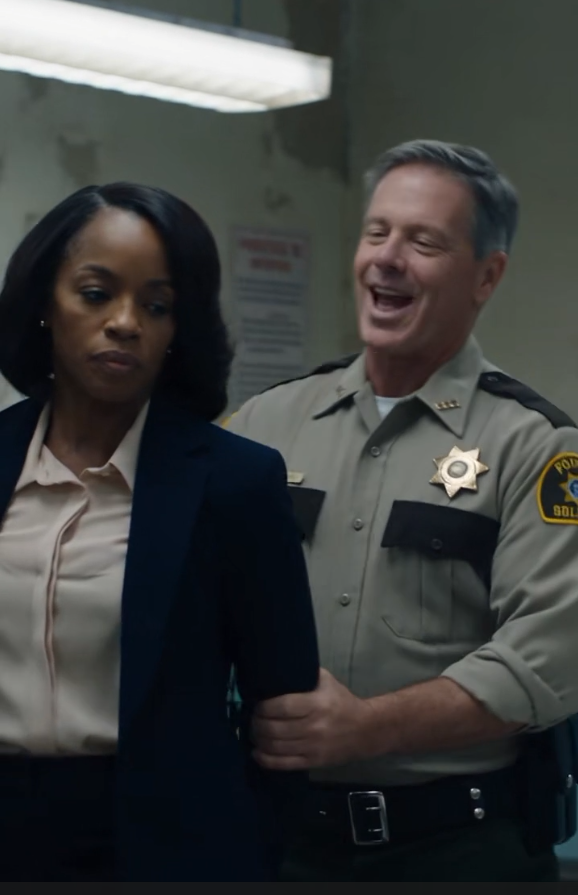
Had invented a traffic violation.
Had escalated calm questions into handcuffs.
Had labeled composure “attitude.”
Everything after that was consequence.
Sarah closed the folder.
“What does Miller want?”
“Protection.”
“From Cleary?”
“And from half the town, probably.”
“He still works there?”
“For the moment.”
Sarah stood.
“That cannot continue.”
Boyd Cleary spent the night in his office.
Not because anyone required it.
Because he refused to go home.
By midnight, three television vans were parked across from the courthouse.
By one in the morning, his phone contained eighty-seven missed calls.
By two, the county commission chairman had left him a voicemail advising him not to make public statements.
At two fifteen, Cleary went outside and made one anyway.
The cameras came alive.
“Sheriff! Sheriff Cleary!”
“Did you knowingly arrest a general?”
“Was race a factor in the stop?”
“Did you seize classified equipment?”
Cleary raised both hands.
“I’m going to say this once. The individual stopped today was treated exactly like any other motorist.”
Inside the building, Toby Miller watched the live feed on his phone.
Exactly like any other motorist.
That sentence did more damage than Cleary understood.
Miller thought of the backups on his personal drive.
Twenty-three stops.
The college student from Baltimore who had been held roadside for forty minutes because Cleary said he smelled marijuana, though none was found.
The Black contractor who had been cited for failure to signal after dash footage clearly showed his indicator flashing.
The woman from Vermont whose complaint had disappeared because Cleary said the camera battery died.
Miller had told himself for months that he was preserving evidence in case things got worse.
He had never defined worse.
Now there were military helicopters in the national news.
The sheriff continued talking.
“This woman was confrontational from the beginning.”
Miller shut off the phone.
A voice behind him said, “You backed it up, didn’t you?”
He turned.
Cleary stood in the doorway.
Miller’s stomach tightened.
“Backed what up?”
“The camera.”
Miller looked at him.
Cleary closed the office door.
“You think I don’t know you?”
Miller said nothing.
“I saw your face when Dale asked for the footage.”
“Then you know the camera wasn’t broken.”
Cleary’s expression changed.
“You’re young.”
Miller almost laughed.
“What does that have to do with anything?”
“It means you haven’t learned what this job is.”
“I know what it’s not.”
Cleary stepped closer.
“You think those people outside care about you? You think Washington cares? They’ll use you until this story dies, then you’ll still live here.”
Miller’s mouth went dry.
Cleary was not entirely wrong.
Miller’s wife worked at the elementary school.
His parents lived eight miles away.
His mortgage belonged to the local bank.
Oak Haven was not simply the place he worked.
It was the network holding his life together.
Cleary saw hesitation and mistook it for surrender.
“You made copies?”
Miller looked at him.
“No.”
The lie came smoothly.
Cleary searched his face.
Then nodded.
“Good.”
He opened the door.
Before leaving, he said, “Because loyalty is what people remember.”
Miller waited until he was gone.
Then he sat down.
His hands shook once.
He put them flat on the desk until they stopped.
Five minutes later, he called Margaret Dale.
By morning, the story had escaped everyone’s control.
The Pentagon confirmed that Brigadier General Sarah Hayes had been briefly detained by local authorities while traveling.
The Army confirmed that personnel had responded after a secure communications device was reported outside authorized custody.
The state announced a preliminary review.
Oak Haven County announced nothing.
Sheriff Cleary went on a regional morning show by phone and repeated his claim that Sarah had been treated “like anyone else.”
Sarah declined every interview request.
At ten, she met Daniel Mercer in a federal conference room near the airport.
He had three screens running.
One displayed Cleary’s body-camera footage.
Another showed his patrol-car dash camera.
The third held transcripts.
Sarah sat beside Reed.
Mercer pressed play.
The stop began.
There she was in the Malibu.
Hands visible.
Voice calm.
Cleary at the window.
The claimed lane violation.
The speed exchange.
Then:
“You’ve got a lot of attitude for somebody in my jurisdiction.”
Sarah watched herself answer.
“I am speaking calmly, Sheriff.”
Mercer paused the video.
“No ambiguity.”
Reed said nothing.
Mercer resumed.
They watched the arrest.
The warning.
The wrist twist.
The charges.
The phrase attitude package.
Reed’s jaw tightened.
Sarah stared at the screen.
Watching herself from the outside was stranger than experiencing it had been.
In the moment, she had been monitoring risk.
On video, the imbalance looked simpler.
A man with power had become irritated because she had not performed submission.
Mercer switched to the dash camera.
“Now watch this.”
The video began twenty seconds before Cleary activated his lights.
The Malibu came into view.
Centered in the lane.
No swerve.
Speed overlay: 44 MPH.
Sarah did not move.
Mercer paused it.
“This eliminates both stated bases for the stop.”
Reed said, “So he lied.”
Mercer looked at Sarah.
“Yes.”
Sarah kept her eyes on the screen.
“What about the radar?”
“We recovered the unit log.”
“And?”
“No reading above forty-four associated with your vehicle.”
Mercer turned off the monitor.
“General Hayes, I need to ask something plainly.”
“Go ahead.”
“Do you want to file a formal civil rights complaint?”
Reed looked at her.
Sarah had expected the question.
Still, she took time before answering.
“Yes.”
Mercer nodded.
“Good.”
“Not because I’m a general.”
“I understand.”
“No. I need that written into how this is handled.”
Mercer leaned back slightly.
“That may not be entirely within your control.”
“I know.”
She folded her hands.
“But if this becomes a case about embarrassing the wrong person, then we learned nothing.”
Mercer studied her for a moment.
“What do you want it to be about?”
Sarah looked at the frozen image of Cleary standing at her car window.
“Conduct.”
Part IV — Reckoning
The state suspended Sheriff Boyd Cleary three days later.
Not fired.
Not arrested.
Suspended pending investigation.
He responded by standing on the courthouse steps surrounded by supporters and accusing federal authorities of targeting Oak Haven because he had “refused to kneel to Washington.”
Sarah watched thirty seconds of the footage, then shut it off.
General Reed, seated across from her, raised an eyebrow.
“You’re done?”
“Yes.”
“He said your arrest had nothing to do with race.”
“That is a claim investigators can test.”
“He also said you provoked him.”
“I’ve seen the video.”
“You’re irritatingly difficult to bait.”
Sarah returned to the briefing memo in front of her.
Reed waited.
Then he said, “Your father would have liked that.”
Sarah’s hand stopped.
It was the first time he had mentioned him.
She looked down at the page.
“My father would have told me I should have identified myself.”
“No, he wouldn’t.”
“You didn’t know him.”
“I knew what you told me.”
Sarah leaned back.
Years earlier, when she was young enough to think rank could protect people, her father had explained something she had resisted.
A badge, a uniform, a degree, a title—none of them changed what someone decided to see before you opened your mouth.