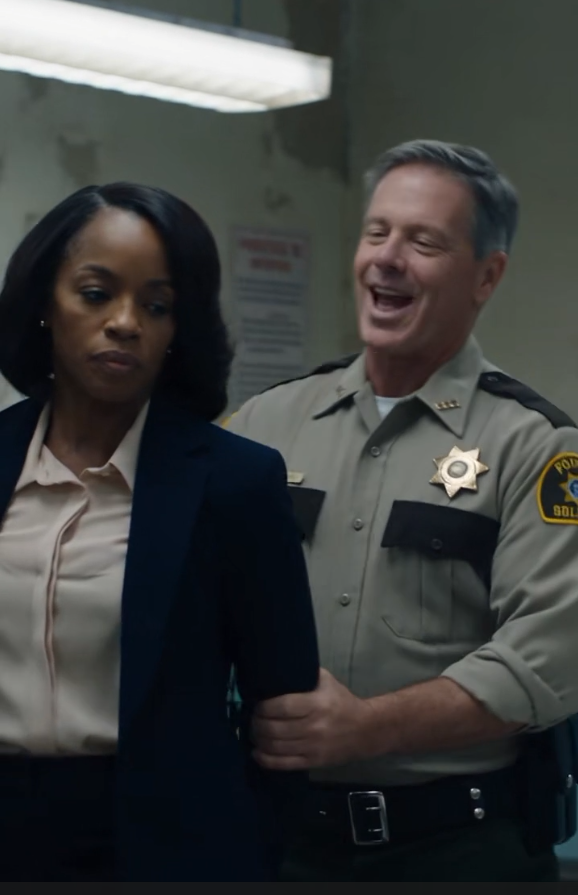
He had not taught her to be afraid of police.
He had taught her to survive uncertainty.
Hands visible.
Movements announced.
Voice level.
Do not confuse dignity with invulnerability.
Sarah looked toward the window.
“He used to say calm wasn’t safety.”
Reed nodded.
“You said that once.”
“It isn’t.”
“No.”
“But it helped.”
Reed did not answer.
He understood there was no clean lesson in that.
Sarah had done everything her father taught her.
And Cleary had arrested her anyway.
The difference was that she possessed access to institutions powerful enough to answer immediately.
Most people did not.
Toby Miller’s statement expanded the case.
Then his backups expanded it again.
Investigators interviewed drivers from the old stops.
Some wanted nothing to do with it.
Others had saved tickets, complaint emails, phone videos.
Patterns emerged carefully.
Not every stop was unlawful.
Not every complaint was valid.
But enough contained discrepancies to make coincidence difficult to defend.
Dash footage that contradicted written reports.
Body-camera files marked corrupted despite intact backups.
Search justifications that shifted after nothing was found.
Language about drivers being “aggressive,” “hostile,” or “noncompliant” when recordings showed people asking ordinary questions.
Sarah read none of those files.
She refused.
“This investigation cannot run through me,” she told Mercer.
“You’re the complainant.”
“I’m one complainant.”
“That distinction is going to become important.”
“It already is.”
Mercer looked at her.
“You understand Cleary’s attorney is claiming Miller fabricated the backups.”
“Then authenticate them.”
“We are.”
“Good.”
“You also understand they’re going to come after you.”
Sarah almost smiled.
“They already arrested me.”
“I mean publicly.”
“They can say what they want.”
Mercer looked skeptical.
Sarah added, “As long as they preserve the evidence while saying it.”
The harder problem came from Washington.
A senior civilian official called Reed.
Then Reed called Sarah.
They met in a secure office late that evening.
Reed closed the door.
“Defense wants distance.”
Sarah understood immediately.
“From the investigation?”
“From the optics.”
“Meaning?”
“They don’t want military involvement framed as coercion against local law enforcement.”
“Reasonable.”
“They want a statement emphasizing that the aircraft response was solely related to recovery of a secure communications device.”
“That is accurate.”
“They also want you not to testify publicly until the state process is further along.”
Sarah’s expression sharpened.
“That is different.”
“I know.”
“Whose request?”
“General counsel.”
“Based on?”
“Concern that anything you say in uniform can be characterized as institutional pressure.”
Sarah stood.
She walked to the far side of the office.
For three days she had worked to keep the case centered on conduct instead of rank.
Now rank was being used to silence her.
Reed watched her.
“What do you want to do?”
She turned.
“What would you do?”
“Not relevant.”
“You asked.”
He sighed.
“I’d be tempted to give a press conference on the courthouse roof.”
“That’s why I’m asking.”
He almost smiled.
Sarah did not.
“There will be a state hearing,” she said.
“Yes.”
“If subpoenaed?”
“You testify.”
“If invited voluntarily?”
“Legal wants you to decline.”
She looked at him.
“And if I disagree?”
“Then you’ll need to decide whether you’re speaking as Brigadier General Sarah Hayes or Sarah Hayes.”
That landed.
Not because the distinction was simple.
Because it was impossible.
She was both.
Cleary’s actions had happened to the same person.
But institutions preferred clean boxes.
Military official.
Citizen.
Black woman.
Complainant.
Witness.
Victim.
General.
Every label revealed something and hid something else.
Sarah sat again.
“When is the hearing?”
“Friday.”
“I’ll decide by Thursday.”
Cleary’s attorney released selected portions of the stop online on Wednesday.
The clips began after Sarah had questioned the detention and ended before the false charges were spoken.
In one, her warning—“I strongly advise you to reconsider this course of action”—was isolated without context.
In another, Cleary’s lawyer called the sentence “an implied threat from a powerful military official.”
The tactic worked on some people.
Commentators asked why Sarah had not simply identified herself.
Others asked whether a general should be permitted to activate military resources in response to a local arrest.
Sarah refused to watch.
But Toby Miller did.
He sat in his kitchen while his wife, Jenna, stood at the sink.
“You lied to Cleary,” she said.
“Yes.”
“You told him you didn’t copy the footage.”
“Yes.”
“He’s going to know.”
“He already knows.”
She turned.
“Toby.”
“I couldn’t delete it.”
“I didn’t ask you to.”
“You asked if we should leave town.”
“I asked because somebody put a dead rat in our mailbox.”
Miller looked down.
The sheriff’s suspension had divided Oak Haven.
Not cleanly.
Nothing ever divided cleanly.
Some residents wanted Cleary gone.
Others treated him like a martyr.
A few had stopped talking to Miller entirely.
His father had called and said, “You don’t turn on your own.”
Miller had asked, “What if your own is wrong?”
His father hung up.
Jenna sat across from him.
“Was it worth it?”
Miller looked at her.
The question had no easy answer.
He thought about Sarah at the booking counter, asking if the body camera was recording.
He thought about Cleary instructing him to rewrite the report.
He thought about every time he had told himself that saving copies was enough.
“No,” he said.
Jenna frowned.
He continued.
“Saving it wasn’t enough.”
She understood.
The problem was not whether evidence existed.
The problem was how long he had watched before using it.
On Thursday afternoon, Sarah made her decision.
She went to Reed’s office.
“I’m attending the hearing.”
He looked up from his desk.
“As?”
“Myself.”
“That is not how the cameras will see it.”
“I know.”
“Legal will hate this.”
“They can hate it accurately.”
Reed set down his pen.
“Why?”
Sarah considered giving him the institutional answer.
Public accountability.
Witness responsibility.
Civilian oversight.
Instead she said, “Because if I stay away to protect the Army from bad optics, Cleary will use that absence as evidence that the case is political theater.”
“He’ll use your presence the same way.”
“Yes.”
“So?”
“So I’m done making choices based on what Boyd Cleary might say.”
Reed watched her.
Then nodded.
“Fair.”
She turned to leave.
“Sarah.”
She stopped.
“If they ask whether you ordered the helicopters…”
“I didn’t.”
“If they ask whether you would make that call again?”
She looked back.
“Yes.”
Part V — Final Confrontation
The county hearing room held eighty people.
Two hundred more stood outside.
Sarah entered through a side door without uniform.
Dark suit.
White blouse.
No visible insignia.
No military escort.
General Reed stayed in Washington.
That had been her request.
Daniel Mercer sat three rows behind the state investigators.
Margaret Dale occupied a table near the front.
Toby Miller sat alone on the opposite side.
Boyd Cleary arrived last.
He wore his sheriff’s uniform.
Suspended or not, the choice was deliberate.
He wanted the badge in every photograph.
Sarah understood the strategy.
So did everyone else.
The county commission chair opened the hearing.
“This proceeding concerns the conduct of Sheriff Boyd Cleary, departmental record preservation, and related allegations arising from a traffic stop involving Ms. Sarah Hayes.”