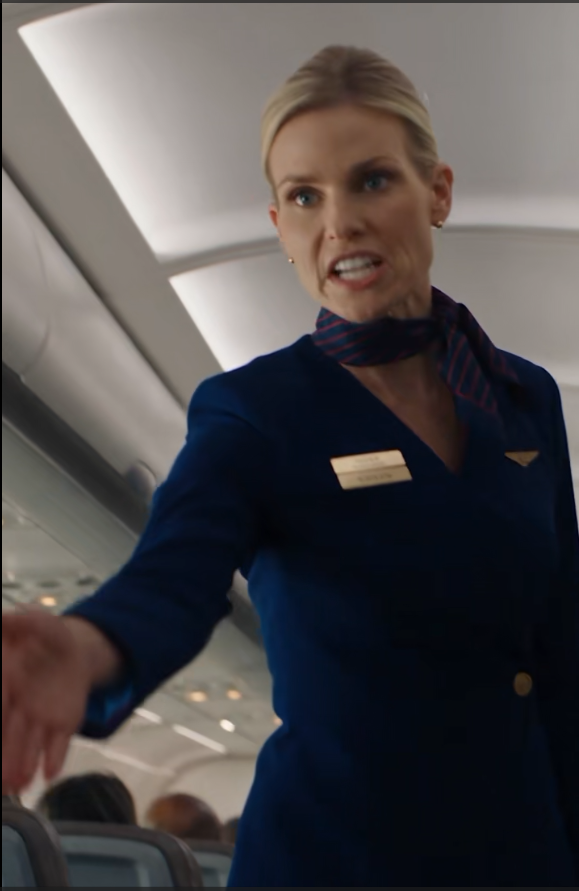
“I have a taxi app, Nathan.”
He rubbed his forehead.
“Fine.”
“How’s your day?”
He looked around the conference room.
Elise.
General counsel.
Employee relations.
Inflight operations.
Customer experience.
Corporate security.
A screen filled with complaints.
“Busy.”
“I imagine.”
“We found more.”
Willa’s voice changed.
“More what?”
“Complaints.”
“How many?”
“Enough.”
“How many?”
Nathan looked at Elise.
She nodded.
“Eleven over four years that may have similar elements.”
Silence.
“Against Brenda?”
“Nine. Two involving another lead who worked under her.”
Willa sat back in her chair at the restaurant while Charlotte argued with a waiter about splitting the dessert.
“What kind of complaints?”
“Questioning paid premium passengers about eligibility. Unnecessary upgrade verification. Uneven service. One passenger said she was told first class had ‘standards.’ Another said Caldwell demanded to see his ticket after boarding even though she didn’t check anyone around him.”
“Were they Black?”
“Most.”
“Most isn’t all.”
“Seven Black. One Latino. One South Asian. Two white passengers who were young and dressed casually.”
Willa looked through the restaurant window.
“So what did you do with the complaints?”
“Not enough.”
“That wasn’t my question.”
Nathan leaned forward.
“Three were closed as unsubstantiated. Two received service coaching. One generated a written warning for discourtesy. The others were handled by different supervisors and never connected.”
“Why not?”
“We don’t have an integrated pattern review for customer-bias complaints.”
“You mean nobody looked.”
“Yes.”
She appreciated the answer.
“What are you going to do?”
Nathan glanced at the executives around him.
“This call isn’t how you should learn that.”
“Then I’ll ask later.”
“Mom.”
“Yes?”
“Brenda’s union representative says she wants a formal hearing.”
“She should have one.”
Nathan paused.
“You mean that?”
“Of course.”
“You think she should keep her job?”
“I didn’t say that.”
Willa lowered her voice.
“If you fire her because I’m your mother, nothing changes. If she loses her job because of what she did and what your process establishes, that’s different.”
Nathan leaned back.
“You realize most people are asking why she hasn’t already been fired.”
“Most people aren’t responsible for running your company.”
“Neither are you.”
“Then why do you keep calling me?”
He smiled despite himself.
“Fair.”
Willa glanced at Charlotte, who was now waving for more coffee.
“Nathan?”
“Yeah?”
“You’re looking for the bad employee.”
He went still.
“There may be one. There may be more than one. But she didn’t keep herself on that airplane for forty minutes.”
Nathan looked toward Captain Mercer’s statement on the table.
“I know.”
“Do you?”
The line went quiet.
Willa said, “Your gate agent knew my seat was valid. Your captain knew no conflict had been shown. Your systems stored complaints nobody connected. Your performance targets made everybody afraid of delaying a departure.”
Nathan said nothing.
“And thirty passengers watched because every person assumes somebody with authority will eventually do the right thing.”
She looked down at her gold brooch.
“The dangerous part isn’t that Brenda made one bad choice.”
“What is?”
“That she kept making them and everyone around her kept finding a reason to let the next one happen.”
Captain Evan Mercer’s hearing took place that afternoon.
He did not bring a union attorney.
He brought his logbook.
Employee relations asked him to describe the event from the beginning.
He did.
When asked why he requested Willa step off despite her valid boarding pass, he stared at his hands.
“I wanted to resolve it outside the cabin.”
“Why?”
“To prevent escalation.”
“Had Mrs. Foster escalated?”
“No.”
“Had she raised her voice?”
“No.”
“Used abusive language?”
“No.”
“Refused a safety instruction?”
Mercer paused.
“Not until I characterized the seating instruction as one.”
The investigator looked up.
“Explain.”
Mercer swallowed.
“The dispute was commercial. Seat assignment. She asked for an explanation. Caldwell reframed it as compliance.”
“And you accepted that framing?”
“Yes.”
“Why?”
Mercer looked through the conference-room glass toward the ramp.
“Because I wanted the door closed.”
The room stayed quiet.
He continued.
“We were late. There was weather downstream. I thought if she stepped off, the gate could solve it and bring her back.”
“Did you believe she would be brought back?”
Mercer considered that.
“No.”
The admission hurt.
But it was true.
“Then why did you tell her the move was temporary?”
“I didn’t want to say we were removing her.”
“Why?”
“Because saying it plainly would have forced me to acknowledge that there was no documented reason.”
Mercer took off his glasses.
“I knew it didn’t make sense.”
No one interrupted.
“I also knew Caldwell was one of our most senior leads. I assumed she had something I hadn’t seen.”
“You asked for the evidence.”
“Yes.”
“She did not produce it.”
“No.”
“And you still supported removal.”
“Yes.”
The investigator set down her pen.
“Captain, what would you do differently?”
Mercer stared at the table.
“I’d stop the process the moment the gate verified the ticket.”
“Because you now know Mrs. Foster’s identity?”
His eyes lifted immediately.
“No.”
“Why?”
“Because the passenger record was enough.”
For the first time all afternoon, his voice held certainty.
“That should have been enough.”
Brenda Caldwell’s hearing was not as simple.
Her representative sat beside her.
She denied discrimination.
She acknowledged entering the local service tag but said she had intended it as a temporary notation while resolving a standby request.
She denied attempting to give 3A to her niece.
She said her niece had asked whether premium seats were available but claimed she had told her there were no guarantees.
She described Willa as “resistant.”
The investigator asked what Willa had resisted.
“Moving.”
“Why was she required to move?”
“Because I believed the seat needed to be released.”
“What led you to believe that?”
“A service request.”
“The request you created?”
Brenda’s expression tightened.
“The tablet workflow is confusing.”
“You had used it more than nine hundred times.”
Her representative objected to the characterization.
The investigator rephrased.
“Were you unfamiliar with the function?”
“No.”
“Why did you ask Mrs. Foster if she had obtained her ticket with miles?”
Brenda paused.
“It can affect upgrade priority.”
“Was she upgraded?”
“I didn’t know.”
“Her boarding record identified a full-fare first-class purchase.”
“I hadn’t checked yet.”
“You asked before checking?”
“I was trying to understand the situation.”
“Why was there a situation at all?”
Brenda looked at her.
The investigator waited.
Brenda finally said, “She didn’t present like our typical 3A passenger.”
The room went still.
Her representative turned slightly.
“Brenda.”
“What?”
The investigator spoke carefully.
“What does a typical 3A passenger present like?”
Brenda realized it.
Too late.
“I mean frequent business travelers. Certain profiles. People we recognize.”
“Was Mrs. Foster’s clothing relevant?”
“No.”
“Age?”
“No.”
“Race?”
“Absolutely not.”
“Then what made her atypical?”
Brenda folded her arms.
“I don’t know.”
The investigator did not press.
She did not need to.
That evening, Willa landed back in Atlanta.
Nathan was waiting outside baggage claim despite being told not to come.
She saw him beside a black sedan and stopped.
He opened his arms.
“You disobeyed.”
“I’m the CEO.”