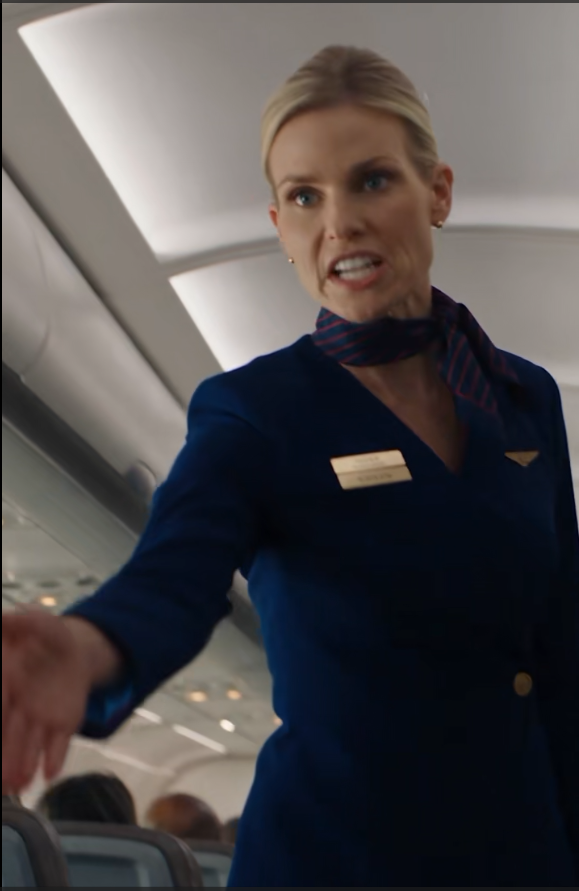
“You’re my son.”
“That outranks CEO.”
“Not in any military I know.”
He hugged her.
For the first time that day, Willa allowed herself to lean into someone.
Nathan felt how small she seemed.
Not frail.
His mother had never seemed frail.
But smaller than the corporate crisis around her had made her.
She pulled away first.
“Did you eat?”
“Yes.”
“When?”
Nathan thought.
“That means no.”
“Mom.”
She pointed toward the passenger seat.
“I’m driving.”
“Absolutely not.”
“Then take me somewhere with soup.”
They got into the car.
For several minutes they drove without discussing the flight.
Nathan asked about Charlotte.
Willa told him Charlotte had dyed her hair red at seventy-three and was pretending it was natural.
Then traffic slowed near the airport exit.
Nathan said quietly, “Brenda’s off duty pending the hearing.”
Willa looked out the window.
“Captain?”
“Also removed from the schedule temporarily.”
“Mia?”
“Still working.”
“Good.”
“You don’t know what we decided about her.”
“I know what I saw.”
“What did you see?”
“A young woman who knew the truth and was afraid of hierarchy.”
Nathan looked at the road.
“That doesn’t make it okay.”
“No.”
“Then why good?”
“Because fear can be corrected more easily than conviction.”
Nathan thought about that.
“We’re reviewing every similar complaint.”
“Good.”
“And the service-note system.”
“Good.”
“And escalation policy.”
“Good.”
“Do I get more than one-word grades?”
“You’re not in my classroom.”
“Feels like it.”
Willa turned toward him.
“Then stop asking me to tell you whether you passed.”
He looked at her.
“What do you want from me?”
“I told you this morning.”
She touched the gold airplane.
“Look at your airline.”
Part V — The Hearing
Three weeks later, CrestView convened a formal disciplinary review.
By then, Flight 812 had become national news.
The video had spread widely.
Commentators argued about race, class, airline power, employee discretion, executive privilege, and whether Nathan Foster’s involvement distorted the investigation.
Some defended Brenda, saying a short video could not show context.
Others demanded immediate termination.
Willa declined every television interview.
She released one sentence through CrestView’s communications office:
“I do not want special treatment because my son is the CEO; I want ordinary treatment to be sufficient for everyone.”
That sentence caused more problems for Nathan than a dozen interviews would have.
Employees began forwarding old complaints.
Passengers sent stories.
Some were serious.
Some were ordinary service failures.
Some had nothing to do with bias.
Nathan ordered the company not to lump them together for public relations purposes.
“Don’t build a narrative,” he told Elise. “Build a record.”
The record became uncomfortable.
Not because CrestView had a secret policy.
Because it had no policy for seeing repeated small acts across departments.
A gate supervisor might record “discourteous tone.”
Customer care might record “seat dispute.”
Inflight might record “service recovery.”
Employee relations might record “unsubstantiated conduct.”
Four different labels.
One passenger experience.
Nothing joined them.
Until Willa.
The board’s audit committee requested a briefing.
Nathan refused to present it alone.
He brought Mia Torres, Captain Mercer, Jordan Lee, and two customer-care analysts.
He did not bring Willa.
“This is not about my mother,” he told the board. “Her incident exposed it. It didn’t create it.”
One director asked whether Nathan should recuse himself from Brenda’s final employment decision.
“Yes,” Nathan said.
Several heads turned.
Nathan continued.
“I’m doing so.”
The general counsel nodded.
An independent review panel would issue the decision.
The director asked, “Do you think she should be terminated?”
Nathan paused.
Every person in the room knew what he felt.
He chose his words anyway.
“My opinion is not relevant to the disciplinary decision. The evidence is.”
It was the answer Willa had forced him to learn.
Brenda requested that Willa testify at the hearing.
Nathan called his mother immediately.
“You can refuse.”
“I know.”
“You don’t owe her anything.”
“I know.”
“Then why are you thinking about it?”
Willa sat at her kitchen table grading nothing, though an old red pen still lived in the cup beside her coffee.
“Because she wants me there.”
“That doesn’t answer the question.”
“It might.”
Nathan sighed.
“You enjoy this.”
“No.”
“You used to terrorize fifth graders with that exact answer.”
“They survived.”
“Barely.”
Willa smiled.
Then she became serious.
“I’ll go.”
“Why?”
“Because if she intends to tell the truth, I want to hear it.”
“And if she doesn’t?”
“Then I want to hear that too.”
The hearing room was smaller than Willa expected.
No courtroom.
No cameras.
No raised bench.
Just a long table.
Brenda sat with her representative on one side.
Three panel members sat at the end.
Employee relations and counsel occupied the other side.
Willa entered alone.
Brenda looked older than she had on Flight 812.
Not twenty years older.
Three weeks older.
Sometimes consequences aged people honestly.
Willa took the chair offered to her.
The panel chair explained the process.
Then Brenda’s representative asked Willa to describe the initial interaction.
Willa did.
No embellishment.
No speculation.
When she reached the line about “people sometimes find themselves where they don’t belong,” Brenda looked down.
The representative asked, “Did Ms. Caldwell ever mention your race?”
“No.”
“Did she use a racial slur?”
“No.”
“Did she explicitly say you could not afford first class?”
“No.”
“Did she state she was moving you because of your appearance?”
“No.”
The representative nodded.
“Thank you.”
Willa waited.
The panel chair asked, “Mrs. Foster, why did you believe the initial questioning was inappropriate?”
“Because the question came before the evidence.”
“Explain.”
“She looked at me, then asked how I obtained the ticket. If she had a legitimate seat conflict, the normal sequence would have been to check the reservation and tell me the conflict. Instead, she questioned whether my presence made sense to her.”
The panel chair wrote something.
Willa continued.
“That does not tell you everything about her motives. It tells you where the process began.”
Brenda looked up.
Their eyes met.
Later, during a break, Brenda approached Willa near the water dispenser.
Her representative stayed several feet away.
“Can I speak to you?”
Willa filled a paper cup.
“You already are.”
Brenda almost smiled.
Almost.
“I didn’t know your son was Nathan Foster.”
“I know.”
“I need you to understand that.”
“I do.”
“I would never have handled it that way if I’d known.”
Willa stopped with the cup halfway to her mouth.
There it was.
Not an apology.
Not even a defense.
The truth.
Brenda realized only after saying it.
Her face changed.
Willa set down the cup.
“That’s the problem.”
“I didn’t mean—”
“Yes, you did.”
Brenda looked toward her representative.
Then back.
“I mean I would have been more cautious because obviously—”
“Because I was connected to power.”
Brenda lowered her voice.
“You know how airlines work.”
“Yes.”
“We have executives’ families, loyalty elites, corporate accounts. There are passengers where mistakes become… bigger.”
“And passengers where they stay small.”
Brenda’s eyes flicked away.
Willa leaned one hand on the counter.
“You thought I was safe to inconvenience.”
“That’s not what I said.”
“No.”
Willa picked up her water.