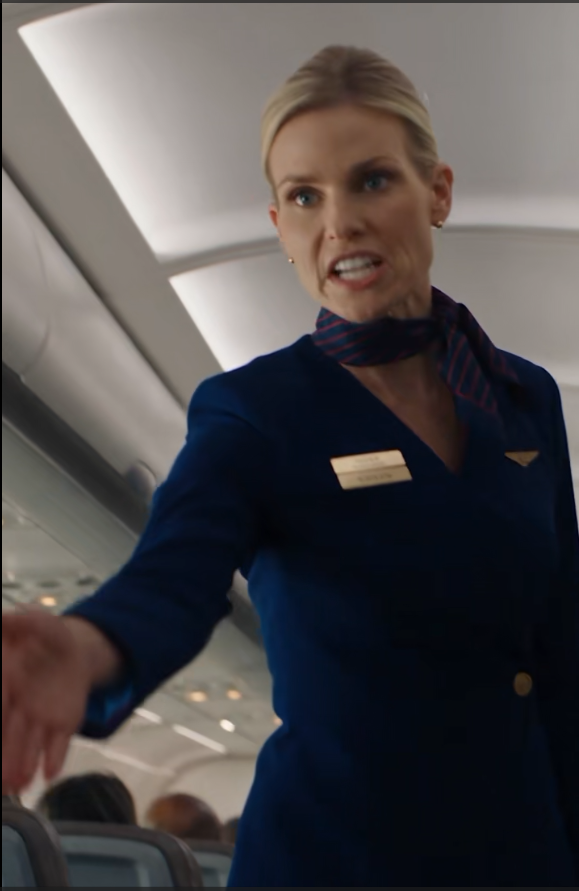
Any involuntary cabin downgrade after boarding required a documented operational reason and second-person verification.
Premium-cabin ticket challenges had to begin with reservation data, not subjective questioning.
Customer complaints involving selective verification or “belonging” language would be pattern-linked across departments.
And most controversially, captains and lead flight attendants were trained on a new escalation principle:
Authority does not become safer when it stops explaining itself.
Some employees hated the phrase.
Nathan kept it.
Three months later, he asked Willa to speak at the annual leadership meeting.
She refused.
He asked again.
She refused.
He offered lunch.
She accepted lunch and still refused.
Then he made the mistake of saying, “People need to hear your story.”
Willa placed her fork down.
“No, they don’t.”
“They do.”
“They have the video.”
“That’s not the same.”
“Nathan, companies love stories because stories let them believe one event taught them something.”
He stared at her.
She continued eating.
“What do you want them to hear?”
“That your mother was mistreated and the company fixed it.”
“No.”
Nathan sighed.
“Then what?”
Willa wiped her mouth with her napkin.
“That you almost didn’t.”
He stopped.
Willa looked at him.
“If Jordan hadn’t recognized me, what would have happened?”
“We might still have received your complaint.”
“Might.”
“Yes.”
“If I had been on my way to clean someone’s house instead of meet Charlotte, would the gate supervisor have known my name?”
“No.”
“If I had needed that flight to get to a funeral?”
Nathan said nothing.
“If I had been frightened by Brenda’s threat and moved quietly to 29B?”
His eyes dropped.
“That’s the story.”
She leaned back.
“Not that the CEO’s mother was treated badly.”
Nathan understood.
“That the system worked only after someone learned you were the CEO’s mother.”
“Exactly.”
He sat with that.
“Will you say that?”
“No.”
He laughed despite himself.
“Why?”
“Because you’re the CEO.”
“So?”
“So you say it.”
At the annual CrestView leadership meeting, Nathan stood before nine hundred managers.
Behind him was one photograph.
Not the viral image from Flight 812.
Not Brenda.
Not Willa.
The photograph showed Nathan at twenty-two years old in a baggage uniform beside his mother.
She wore the gold airplane brooch.
Nathan looked at it for several seconds before speaking.
“My mother was removed from seat 3A on Flight 812 after paying for it.”
The room was quiet.
“You already know that part.”
He clicked the remote.
A simple timeline appeared.
6:21 — Passenger boarded.
6:27 — Initial ticket challenge.
6:32 — False service note created.
6:41 — Gate record confirmed valid.
6:48 — Captain involved.
6:55 — Passenger removed.
7:02 — Executive hold.
Nathan faced the room.
“The most important line is not 7:02.”
He pointed.
“It is 6:41.”
No one moved.
“At 6:41, we knew enough.”
He clicked again.
A sentence appeared.
VALID TICKET. VALID SEAT.
“That should have ended it.”
He looked across the managers.
“It didn’t.”
Then came the line Willa had made him promise not to soften.
“My mother received justice faster because someone recognized her.”
The room changed.
Nathan continued.
“That is not a success story.”
He let the words settle.
“It is evidence of a failure with a fortunate witness.”
He clicked again.
No slogan appeared.
Only a question.
WHAT IF NOBODY KNOWS THEIR NAME?
Nathan stepped away from the screen.
“We run an airline. We make thousands of decisions every hour, and most of them must be made quickly. We give people authority because we need judgment. But judgment without accountability becomes preference. Preference without evidence becomes bias. And bias backed by authority can become policy for one passenger at a time.”
He paused.
“I am not asking you to become afraid of making decisions.”
His voice remained even.
“I am asking you to know what evidence supports them.”
In the back row, Jordan Lee listened.
Mia Torres sat four seats away.
Captain Mercer sat near an aisle.
Nathan did not mention any of them by name.
He did not need to.
“What happened aboard Flight 812 required one person to abuse discretion. But it required several more of us to defer to it.”
He looked toward the old photograph.
“My mother taught public school for thirty-eight years. When I asked what she wanted this company to learn, she told me to stop trying to turn her into my answer.”
A ripple of laughter moved through the room.
Nathan smiled.
“She’s very good at that.”
Then his expression settled.
“So here is mine.”
He looked straight ahead.
“A customer should never need to know the CEO to make us follow our own rules.”
No applause came immediately.
Nathan had asked the event organizers not to manufacture one.
A few seconds passed.
Then people began clapping.
He did not smile.
He simply stepped away from the podium.
Part VII — Seat 3A Again
Six months after Flight 812, Willa booked another trip.
Atlanta to Boston.
First class.
Seat 3A.
Nathan found out because his mother accidentally forwarded the confirmation email to him while trying to send it to Charlotte.
He called within thirty seconds.
“You booked 3A on purpose.”
“Of course.”
“Mom.”
“What?”
“Pick literally any other seat.”
“No.”
“Why?”
“Window.”
“You’re impossible.”
“You’ve known that for fifty-one years.”
He heard dishes clinking in the background.
“Are you nervous?”
Willa stopped.
“No.”
Nathan waited.
She sighed.
“A little.”
That answer mattered more than he expected.
“Do you want me to come?”
“No.”
“I can sit in 3C.”
“No.”
“Economy?”
“Nathan.”
“All right.”
She softened.
“I have to get on another airplane eventually.”
“I know.”
“And I don’t want the last seat I remember to be the one someone tried to tell me wasn’t mine.”
Nathan looked through his office window toward the runways.
“Call me when you land.”
“I’ll think about it.”
“You will call me.”
“Goodbye, Nathan.”
“Love you too.”
The morning of Willa’s flight, she arrived early.
Same terminal.
Same polished floors.
Same burnt coffee.
Airports repeated themselves so effectively that memory could feel like geography.
At security, she removed her shoes.
At the coffee shop, she bought tea.
At the gate, nobody recognized her.
That pleased her.
The agent scanned her boarding pass.
“Have a nice flight.”
“Thank you.”
No special welcome.
No hesitation.
No phone call.
Perfect.
Willa walked down the jet bridge.
When she reached the aircraft door, a young flight attendant greeted her.
“Good morning.”
“Good morning.”
“3A is just ahead on your left.”
“I remember.”
Willa placed her bag overhead and sat beside the window.
For several minutes, nothing happened.
Passengers boarded.
Someone struggled with a suitcase.
A baby cried three rows back.
A businessman asked whether his coat could be hung.
Ordinary life.
Willa opened a new paperback.
A flight attendant approached.
Willa looked up.
The woman smiled.
“Mrs. Foster?”
Willa felt something inside her tighten.
“Yes?”
The attendant held out a small object.
Willa stared.
A gold airplane brooch.
Not hers.
Similar.
Newer.
“Someone found this near the boarding door,” the attendant said. “I saw yours and thought maybe you dropped it.”
Willa touched the brooch at her collar.
“No. Mine’s right here.”
“Oh.”
The attendant looked embarrassed.
“Sorry.”
“No reason to be.”
The woman smiled and turned away.
Willa watched her go.