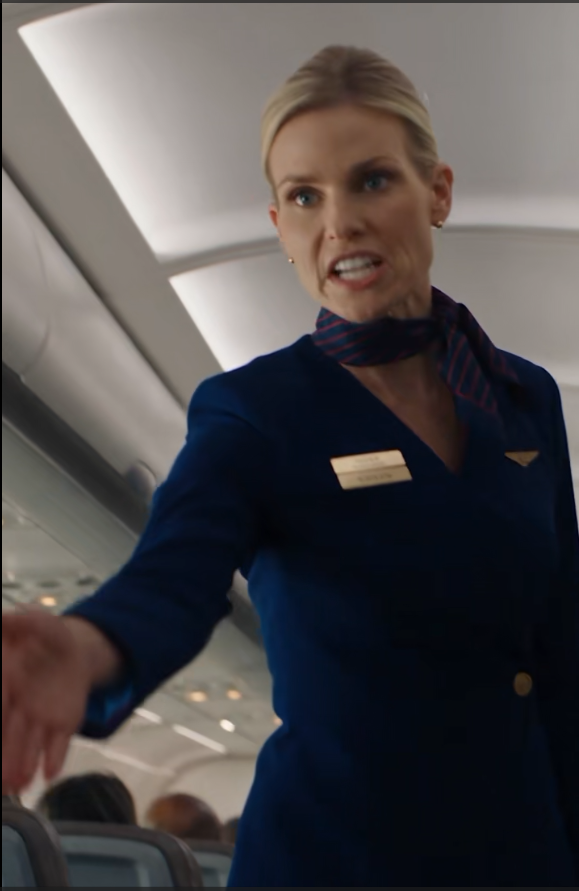
“But it’s the first honest thing you’ve told me.”
She walked back into the hearing room.
When the hearing resumed, Brenda asked to make a statement.
Her representative whispered urgently to her.
Brenda shook her head.
The panel allowed it.
She sat straight.
For several seconds, nothing came.
Then she said, “My niece was trying to get to Chicago.”
The room changed.
Brenda looked toward the table.
“She had an interview the next morning. She was traveling standby. There were empty premium seats showing during setup, but then the cabin filled.”
Her representative closed his notebook slowly.
Brenda continued.
“I saw 3A occupied and assumed it was an upgrade.”
“Why?” the panel chair asked.
Brenda swallowed.
“I don’t know.”
“Your prior testimony says the passenger did not present like a typical 3A traveler.”
“I know.”
“Was that assumption based on her age?”
“Maybe partly.”
“Clothing?”
“Yes.”
“Race?”
Brenda’s face tightened.
She looked at Willa.
Then away.
“I don’t know.”
The chair said nothing.
Brenda rubbed one thumb over the other.
“I want to say no.”
Her voice had become quieter.
“I want to say absolutely not because I don’t think of myself that way.”
Willa watched her carefully.
Brenda continued.
“But I knew the ticket was valid before I created the service tag.”
No one moved.
“I thought if I moved her to economy, she would be annoyed. Maybe complain. Maybe get miles. I thought my niece could take the open premium seat before close.”
The panel chair asked, “Did your niece request that?”
“No.”
“Did she know you intended to move another passenger?”
“No.”
“Then why Mrs. Foster?”
Brenda stared at the table for a long time.
“Because I thought she would move.”
Willa felt no satisfaction.
Brenda finally looked up.
“I thought she was alone. Older. Quiet. I thought she wouldn’t make a scene.”
Willa’s expression did not change.
Brenda’s voice thinned.
“And I thought if she complained, nobody important would know.”
The sentence sat in the room.
Not race alone.
Not class alone.
Not age alone.
Not one motive simple enough for a headline.
Something more ordinary.
Brenda had looked at another human being and calculated the cost of mistreating her.
She had believed the cost would be low.
The panel chair asked, “Did race factor into that calculation?”
Brenda closed her eyes.
“I don’t know.”
This time the answer sounded different.
Not evasive.
Ashamed of its own uncertainty.
“I can tell you I would have moved a white passenger if I thought I could get away with it.”
Willa spoke for the first time without being asked.
“That isn’t the defense you think it is.”
A panel member covered his mouth.
Brenda looked at her.
“I know.”
And for the first time, Willa believed her.
The panel suspended the hearing for deliberation.
Willa stepped outside.
Nathan was waiting at the far end of the hallway.
She frowned.
“You’re not supposed to be here.”
“I’m not in the hearing.”
“You’re standing ten yards from it.”
“Eleven.”
“Nathan.”
He walked toward her.
“How did it go?”
“She told the truth.”
His expression sharpened.
“All of it?”
“Enough of it.”
“What did she say?”
“You recused yourself.”
“I’m still allowed to be curious.”
“Be curious tomorrow.”
He looked through the glass toward the hearing room.
“Do you feel sorry for her?”
Willa considered.
“Yes.”
Nathan looked surprised.
“That doesn’t mean what she did is acceptable.”
“I know.”
“People confuse those things.”
“I know.”
Willa sat on a bench.
Nathan joined her.
“When you taught,” he asked, “did you ever have a student you knew was lying?”
“Every teacher has.”
“What did you do?”
“Depends on the lie.”
“What if it hurt somebody?”
Willa looked at him.
“You keep trying to turn me into your decision.”
“I’m asking.”
“No. You’re trying to borrow certainty.”
Nathan leaned back.
Willa’s voice softened.
“You don’t need to hate somebody to hold them accountable.”
He looked down at his hands.
“And you don’t need to forgive somebody to stop hating them.”
“I don’t hate her.”
“I know.”
“How?”
“Because you’re still asking what happened instead of what punishment would feel satisfying.”
Nathan looked at his mother.
For most of his life, he had believed her calmness came naturally.
Age had taught him it was work.
Discipline disguised as temperament.
“What would Dad say?”
Willa smiled.
“He’d ask why the airline didn’t give me champagne.”
Nathan laughed.
The hearing-room door opened.
Both of them stood.
Part VI — The Decision
The panel found that Brenda Caldwell had intentionally manipulated an internal service tool to create a false operational basis for moving a confirmed passenger, attempted to use her authority for the benefit of a family member, misrepresented the existence of a seating conflict to both a passenger and the captain, and escalated a commercial dispute into a crew-compliance issue.
On the question of discriminatory conduct, the panel’s language was careful.
It found that Brenda had applied subjective assumptions about who “presented” as a typical premium traveler and had selectively scrutinized Willa before verifying objective reservation data.
The panel did not claim to know every thought in Brenda’s mind.
It did not need to.
Her conduct violated policy regardless.
Her employment was terminated.
Her niece faced no discipline.
Captain Mercer received a thirty-day suspension, mandatory command decision training, and a formal performance warning for improperly allowing a valid commercial dispute to be reframed as a safety-compliance matter.
Mia Torres received coaching and a written commendation for accurately preserving the passenger record once challenged.
Mia hated the combination.
Willa understood why.
“It makes sense,” Willa told her when they eventually spoke.
“I feel like I’m being rewarded for being late.”
“You’re being told two things can be true.”
“I should have stopped it sooner.”
“Yes.”
“And I did stop the gate from changing your ticket.”
“Yes.”
Mia shook her head.
“That doesn’t feel clean.”
“Most useful lessons don’t.”
Nathan’s harder problem began after the disciplinary decision.
Firing Brenda was straightforward.
Fixing CrestView was not.
The airline had eighteen thousand customer-facing employees.
You could not train prejudice out of an organization with a memo.
You could not solve misuse of authority by removing authority from everyone.
You could not replace judgment with scripts because airplanes produced situations scripts had never imagined.
Nathan spent six weeks reviewing where discretion became invisible.
One meeting lasted four hours.
Operations wanted clear seat-control rules.
Inflight wanted protection from second-guessing during genuine safety situations.
Pilots objected to language that might discourage compliance with crew commands.
Civil-rights consultants warned against policies so vague that no employee knew what conduct crossed a line.
Customer-service leaders warned that overcorrection could turn every dispute into an accusation.
Nathan listened.
Then asked a question Willa had asked him in the car.
“What happens if the passenger is nobody important?”
The room became quiet.
Nathan pointed toward the screen.
“That’s the design test.”
A new protocol emerged.
Commercial disagreements—seat assignments, upgrades, fare classes, boarding priority—could not be converted into safety-compliance disputes solely because a passenger calmly requested an explanation.