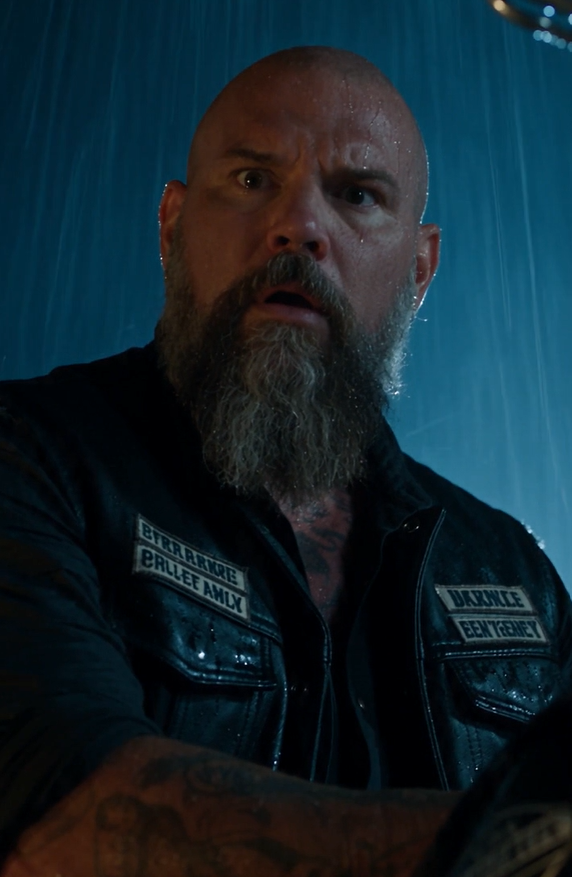
His footsteps.
His laugh.
She reached for him when he entered a room.
By the end of one week, he knew the difference between her hungry cry, tired cry, and furious cry.
He knew she loved bananas and hated peas.
He knew she preferred sleeping turned to one side.
He knew protecting her had given him a reason to get up.
Not everyone approved.
At the hardware store, Jack heard two men talking while he bought a baby gate.
“Heard that biker is mixed up with the woman who dumped her kid in a drain,” one said.
“Now he is playing house.”
The other scoffed.
“People like her do not change.”
Jack set the gate on the counter.
The men went quiet when he turned.
He was not angry.
He was tired.
“People said the same thing about me,” he said.
“They said I was dangerous.”
His voice stayed low.
“They said I would never be worth a thing.”
Neither man spoke.
“That woman is fighting harder than anybody I know.”
Jack paid for the gate.
“And she is fighting for her child.”
At the door, he looked back.
“I know what it feels like when everybody gives up on you.”
He stepped into the rain.
“So I will not.”
While Mia worked through treatment, Jack and the club worked on her apartment.
It was no place for a baby.
The faucet leaked.
The wall had a fist-sized hole.
The windows did not close.
The carpet was worn thin and sour with old neglect.
One Saturday morning, the street filled with motorcycles.
Neighbors peered through curtains as a row of big men in leather climbed off their bikes carrying tools, paint, lumber, and boxes.
They waited for trouble.
Instead, Victor patched the wall.
Another man replaced the sink.
Others tore out carpet, laid clean flooring, caulked windows, and painted the walls a warm yellow.
Jack built shelves and fixed the front door so it locked tight.
In the bedroom corner, he set up Lily’s crib.
By evening, the apartment no longer looked like a place someone had given up on.
It looked like home.
By the time the neighbors stopped hiding, an old woman from across the hall had brought lemonade.
A young father offered to help.
The story spread again.
Not with shock this time.
With wonder.
The feared bikers were building a nursery.
The woman everyone had judged was fighting to get well.
The town had to decide whether it wanted to keep hating what was broken or help repair it.
A few weeks later, Lily spoke the words that nearly brought Jack to his knees.
They were at the park under the shade of a tree.
The grass was soft.
A red ball rolled between them.
Jack lifted Lily high above his head and she shrieked with joy.
When he lowered her back to his chest, she patted his cheek.
Then her face turned serious.
“Papa.”
Jack froze.
Lily smiled.
“Papa Bear.”
The words hung in the air.
Jack had been called many things.
Dangerous.
Trouble.
Monster.
Biker.
Bear.
But not that.
Not since Emily had been alive had a child’s voice named him with love.
A tear slipped into his beard.
“Yeah,” he whispered.
“That is me.”
That night, after he dropped Lily at Mia’s apartment, Jack went home and turned Emily’s photo toward him for the first time in years.
She smiled from the frame with her gap-toothed grin.
“Hey, baby girl,” he said.
His voice shook.
“There is this little girl.”
He laughed once, soft and broken.
“She calls me Papa Bear.”
The room blurred.
“I thought that part of me was buried with you.”
He touched the glass.
“But maybe it wasn’t.”
Days later, the past reached forward in a way no one could have planned.
Jack helped Mia sort old boxes from the motel room she was leaving behind.
She was steadier now.
Still fragile.
Still working.
But her cheeks had color and her hands no longer shook every minute.
They went through clothes, baby things, a cracked mug, old papers.
Jack lifted down a battered box from a closet shelf.
The tape gave way.
Papers spilled across the floor.
Receipts.
A name tag.
Old letters.
“You worked at a pharmacy?” Jack asked, noticing the badge.
Mia nodded.
“Before things got bad.”
A small smile touched her mouth.
“I liked helping people.”
She looked down.
“I wanted to be a nurse.”
Jack picked up a stack of copied letters bound with a brittle rubber band.
The handwriting was careful.
“These yours?”
Mia flushed.
“There was a little girl who came in for medicine.”
Jack stilled.
“She was sick and scared.”
Mia touched the papers.
“I used to write her notes.”
His heart began to pound.
“What was her name?”
Mia looked at him, puzzled by the change in his voice.
“Emily.”
The room went silent.
“Emily Callahan.”
Jack could not move.
The papers trembled in his hands.
“What did you say?”
Mia repeated it.
“Emily Callahan.”
Then she described the smile.
Gap between the front teeth.
Purple as her favorite color because she said it looked like the sky before dark.
Afraid nobody would remember her.
Jack made a sound from somewhere deep in his chest.
Mia’s face changed as understanding slowly arrived.
“She was yours,” she whispered.
Jack nodded.
The tears came before he could stop them.
“She talked about you.”
His voice split.
“She called you the nice lady at the pharmacy.”
Mia covered her mouth.
“She said you told her she was brave.”
Jack pressed the letters to his chest.
“I wanted to thank you.”
He broke completely then.
Years of grief, gratitude, and disbelief poured out of him on the motel floor.
Mia crawled over and placed a hand on his back.
No words were enough.
Jack looked at her through tears.
“I pulled Lily out of that drain thinking I was saving a stranger’s baby.”
His voice shook.
“But you saved something of mine first.”
Mia cried with him.
“We were already family,” Jack whispered.
“We just did not know it yet.”
Spring came gently after that.
Mia counted sobriety like treasure.
One hundred forty-two days.
She wrote the number on a scrap of paper and stuck it to her mirror each morning.
Lily walked now, wobbling from couch to coffee table with both arms out.
The caseworker used the word thriving, and Mia carried it like a holy thing.
The custody hearing was three weeks away.
The reports looked good.
For the first time, Mia let herself believe.
Then the messages began.
The first came from a number she did not know.
Everyone knows what you did.
You left your baby to die in a sewer.
A real mother would never.
Mia’s hands went cold.
She tried to ignore it.
The next day, another came.
You think meetings make you clean?
Junkies do not change.
Then another.
And another.
Whoever sent them knew enough to strike exactly where shame still lived.
They mentioned the drain.
The recovery program.
The hearing.
They called her danger.
They called her poison.
They called her what she already feared she was.
Mia stopped writing the number on her mirror.