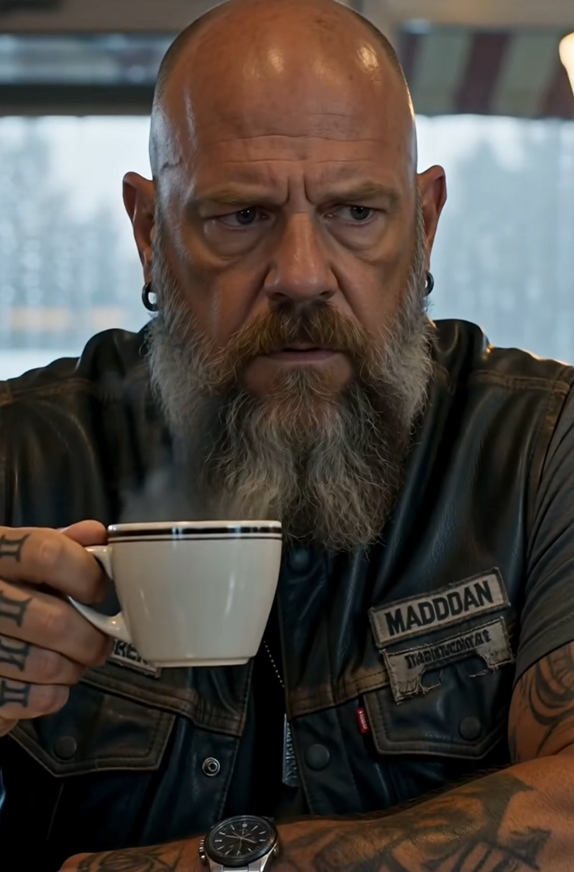
A LITTLE GIRL SHOWED HER BRUISES TO A HELLS ANGEL – THE BIKER DIDN’T EVEN FINISH HIS COFFEE
Rain hit the windows of Tess Holloway’s diner like it was trying to get inside.
By seven that morning, Willow Ridge already looked washed out and exhausted, a small Oregon town blurred behind sheets of cold water and the glow of a tired red neon sign.
The diner sat on the corner of Pine and Mercer, wedged between a shuttered hardware store and an old gas station where the pumps still smelled faintly of diesel.
Inside, coffee steamed behind the counter, bacon snapped on the grill, and nobody expected the kind of morning that would make people whisper for years.
Then the little girl came in.
She could not have been more than eight.
Her name was Marcy Reed, though hardly anyone in town knew her by anything except the quiet girl with the faded sweater and the backpack she carried like a shield.
She stepped through the door with her shoulders hunched and her hair damp from rain.
The bell above the frame gave a nervous little jingle.
No one looked up for long.
That was how small towns worked when trouble wore a child’s face.
People noticed, then looked away before noticing became responsibility.
Marcy crossed the black and white tile floor without taking off her wet hood.
Her sneakers squeaked softly with every step.
She climbed onto a stool near the counter and placed both hands over her backpack straps, as if someone might rip it from her.
Tess saw the child before anyone else truly did.
Tess saw the pale mouth.
She saw the way Marcy kept glancing at the door.
She saw the left sleeve pulled down too far, stretched tight over the wrist, clenched in the child’s fist.
That was not normal cold.
That was hiding.
Two stools away sat a man who looked like he belonged on a highway more than in a breakfast diner.
His name was Colt Matthews, though the men who rode with him called him Bear.
He was forty five, broad shouldered, and weathered by years of wind, engines, grief, and choices most people preferred not to ask about.
His black leather vest carried the red and white patch that made strangers lower their voices.
Hells Angel.
The words had power in Willow Ridge.
Some people feared them.
Some judged them before a word was spoken.
Some crossed the street when they heard the motorcycles coming.
But Colt had long stopped caring what polite people thought of his vest.
He cared about codes.
He cared about loyalty.
He cared about promises made in places nobody else dared to enter.
He cared, above all, about the kind of fear he had once carried as a boy.
That was why his coffee never reached his mouth.
Marcy sat there trembling while Tess poured her a glass of water.
The child did not drink it.
Her eyes stayed fixed on the rain streaking down the diner windows.
Colt noticed the bruises before the sleeve moved.
He noticed the stiffness in the elbow.
He noticed the way Marcy kept her arm tucked close, protecting it not from pain already suffered, but from the memory of hands that might return.
Then Marcy looked at him.
It was not a brave look.
It was the look of a child standing at the edge of a cliff, hoping a stranger would become a bridge.
Colt did not speak.
He simply turned his head enough to show he was listening.
Marcy swallowed.
Her fingers moved to the cuff of her sweater.
For a heartbeat, she hesitated.
Then she rolled the sleeve up.
The diner did not go silent all at once.
It happened in layers.
The clatter of a fork stopped at booth four.
The cook behind the pass forgot to flip the eggs.
Tess inhaled sharply but did not move.
The rain seemed louder.
Colt’s cup froze halfway between the counter and his lips.
On Marcy’s thin forearm were bruises no playground could explain.
Four dark marks curved around the skin like a grip.
A red shape near her wrist looked too much like a handprint to be anything else.
There were older yellowing patches beneath the fresh ones.
There were stories written on that arm, and every one of them was ugly.
Colt lowered the cup without taking a sip.
The sound of porcelain touching the counter was small, but everyone nearby heard it.
Marcy’s lips trembled.
“Please don’t tell him I showed you,” she whispered.
Colt felt something old and dangerous rise behind his ribs.
It was not rage in the reckless sense.
He had lived long enough to know that rage without discipline only made more damage.
This was colder.
This was the part of him that remembered locked rooms, unpaid attention, excuses from adults, and neighbors who said they had no idea when everyone knew enough.
He leaned closer, lowering his voice until it belonged only to her.
“No one’s going to hurt you here,” he said.
Marcy stared at him as if those words were in a language she had forgotten.
Tess placed both hands on the counter to steady herself.
“Are you okay, honey?” she asked.
Marcy shook her head once.
It was a small movement.
It landed harder than a scream.
Colt turned his eyes toward the door.
The parking lot outside was nearly empty, a few rain streaked cars shining under the gray morning.
Across the street, the windows of the hardware store reflected the diner sign in broken red lines.
Nothing moved.
That was what bothered him most.
Trouble had a way of waiting just beyond sight.
Colt had spent enough years reading rooms to know when a child expected someone to appear.
“Who did that?” he asked gently.
Marcy’s mouth opened.
No sound came.
Her eyes filled, but she held back the tears with the exhausted skill of a child who had learned crying made things worse.
“Raymond,” she finally breathed.
Tess’s face changed.
Not dramatically.
Not enough for a stranger to notice.
But Colt saw it.
The name meant something here.
“Stepfather?” he asked.
Marcy nodded.
Colt looked at Tess.
Tess looked away for half a second, and that half second told him the town knew more than it had admitted.
There were always names like Raymond Hayes in towns like Willow Ridge.
Men who smiled at church bake sales.
Men who paid bills on time.
Men who knew which neighbor to charm and which clerk to intimidate.
Men who kept curtains closed and children quiet.
Colt had met a thousand versions of him.
Only the addresses changed.
“Is anyone else in the house?” Colt asked.
Marcy looked at her backpack.
“My brother,” she whispered.
Colt’s jaw tightened.
“Liam.”
The name came out barely louder than breath.
Tess pressed one hand over her mouth.
Colt did not ask why Marcy had come alone.
He did not ask why she had chosen a stranger in leather over the people who had lived around her for years.
The answer sat on her arm.
Adults had been present.
Adults had not been enough.