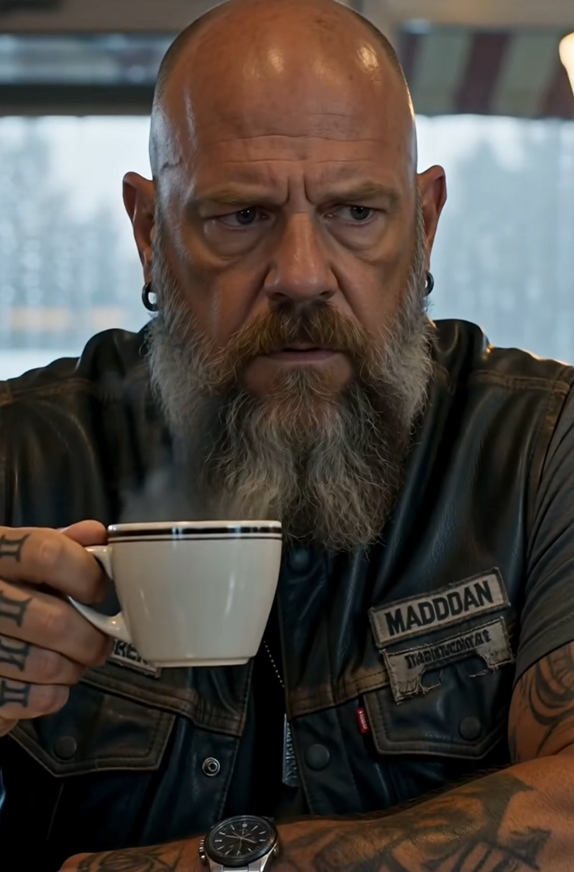
The diner door rattled under a gust of wind.
Marcy flinched so hard her water glass trembled.
That movement made the decision for him.
Colt pushed his coffee away.
He had not taken more than two sips.
He would not finish it.
There were mornings when coffee mattered.
This was not one of them.
He slid one gloved hand toward the phone in his vest pocket.
“Listen carefully,” he said.
Marcy nodded, eyes wide.
“You don’t have to explain everything right now.”
Another nod.
“You just stay where Tess can see you.”
Marcy looked toward Tess.
Tess was already moving, coming around the counter with a towel in one hand and a softness in her face that nearly broke Colt’s restraint.
“I’ve got her,” Tess said.
Her voice trembled, but her feet did not.
Colt tapped a message with one thumb.
Three words.
Child in danger.
Then he added the address Marcy whispered through a shaking mouth.
The reply came in seconds.
On our way.
Outside, thunder rolled low over the roofs.
Colt stood.
The diner changed around him.
He did not raise his voice.
He did not slam a fist.
He did not perform anger for people who had done nothing with their own.
He simply rose to his full height, adjusted his vest, and looked through the rain toward the street leading out of town.
Marcy watched him like she was afraid he might disappear.
Colt turned back.
“You did the right thing,” he said.
Her face crumpled.
No one had said that to her before.
Not in a way that sounded final.
Tess wrapped a clean towel around Marcy’s wet shoulders.
Behind the counter, the cook finally killed the burner and leaned against the wall with both hands flat, eyes lowered.
In booth four, an old man removed his cap.
Nobody spoke.
The whole diner had become a witness.
Colt stepped outside into the rain.
Cold water hit his face and ran down the creases beside his mouth.
His bike sat near the curb, black and chrome beneath the storm, waiting like an animal that understood urgency.
As he swung one leg over, he heard the first answering rumble in the distance.
Not one engine.
Several.
The sound rolled through Willow Ridge before the bikes came into view.
A low, disciplined thunder.
People at the gas station turned their heads.
A woman under the awning of the pharmacy froze with her umbrella half opened.
Curtains shifted in windows above the old laundromat.
Colt did not smile.
He only looked back once through the diner window.
Marcy stood behind Tess now, small and pale, sleeve pulled down again but no longer alone.
He touched two fingers to his brow.
A promise.
Then he kicked the bike to life.
The engines arrived together.
Wrench came first, thin faced and sharp eyed, the kind of man who could read a locked gate the way others read a newspaper.
Tiny followed behind him, enormous even seated, his beard dark with rain.
Red and Gage rolled in side by side.
More came after.
Fifteen men in leather and helmets, their bikes forming a line that made the whole corner stop breathing.
They did not come roaring like fools.
They came controlled.
That was what scared people who understood power.
Noise could be ignored.
Discipline could not.
Colt lifted one hand.
The engines settled into a growl.
“We have a kid at home,” he said.
His voice carried just far enough.
“Boy named Liam.”
Wrench’s face hardened.
“Same house?”
Colt nodded.
“Raymond Hayes.”
Tiny spat rainwater from his lip.
“That man from County Maintenance?”
Tess, standing just inside the door, looked startled.
Colt heard the confirmation without needing more.
Men like Raymond always had clean job titles.
They always had a reason nobody wanted trouble.
They always looked respectable until a sleeve came up.
“We do this right,” Colt said.
“No chaos.”
Nobody argued.
“Presence only unless there is no choice.”
Tiny nodded.
“Kid first.”
“Kid first,” Colt repeated.
The words moved through the riders like a vow.
Marcy was not taken with them.
Colt would not put her in front of the man who had made her hide her own skin.
Tess locked the diner door behind them, flipped the sign to closed, and stood with one hand on Marcy’s shoulder.
“I should have seen more,” Tess whispered.
Colt looked at her through the glass.
“See now,” he said.
Then the bikes pulled away.
Willow Ridge had never seen anything like it.
The convoy moved down Mercer Street in a dark line, rain misting off tires, chrome catching dull morning light.
No one sped.
No one swerved.
They turned past the elementary school, past the church with the peeling white steeple, past the little row of houses where every porch seemed suddenly occupied by someone pretending not to stare.
Colt led them toward the north side, where the houses grew farther apart and the lawns got bigger.
Raymond Hayes lived in a pale green house at the end of Alder Lane.
It had a neat porch, trimmed shrubs, and two flags by the mailbox.
One was American.
One belonged to the county parks department.
Everything about the place said order.
Everything about Marcy’s arm said that order was a lie.
Colt killed his engine at the curb.
The others followed.
The sudden silence was worse than the noise.
Rain dripped from helmets.
Leather creaked.
Boots touched asphalt in near unison.
Inside the house, a curtain shifted.
Colt saw it.
Wrench saw it too.
Tiny moved without being told, placing himself near the driveway where a truck sat angled toward the street.
Red and Gage spread toward the side yard, not trespassing into the shadows, just making it clear that leaving would not be simple.
Colt walked to the porch.
Each step sounded heavy on the wet boards.
A small face appeared behind the screen door.
Liam.
He was younger than Marcy, maybe six, all bones and wide eyes under a hooded sweatshirt too large for him.
He saw the leather vests and shrank back.
Colt stopped immediately.
He lowered his hands where the boy could see them.
“Hey, buddy,” he said.
“My name’s Colt.”
The boy’s eyes darted over Colt’s shoulder to the bikes.
“Are you here because of Marcy?” Liam whispered.
The door behind him opened hard.
Raymond Hayes filled the frame.
He was not the monster strangers would expect.
That was the worst part.
He was clean shaven.
His hair was combed.
His shirt was tucked.
His face had the practiced annoyance of a man used to being obeyed.
“What is this?” Raymond asked.
His eyes moved from Colt to the line of bikers.
Panic crossed his face for half a second.
Then arrogance tried to cover it.
“You people lost?”
Colt did not step closer.
He did not need to.
“We’re here about the kids.”
Raymond’s jaw worked.
“What kids?”
Liam made a sound behind him.
Raymond’s hand twitched toward the boy.
Tiny shifted in the driveway.
It was subtle.
It was enough.
Raymond froze.
Colt’s voice stayed quiet.
“About Marcy.”
Raymond swallowed.
“And about Liam.”