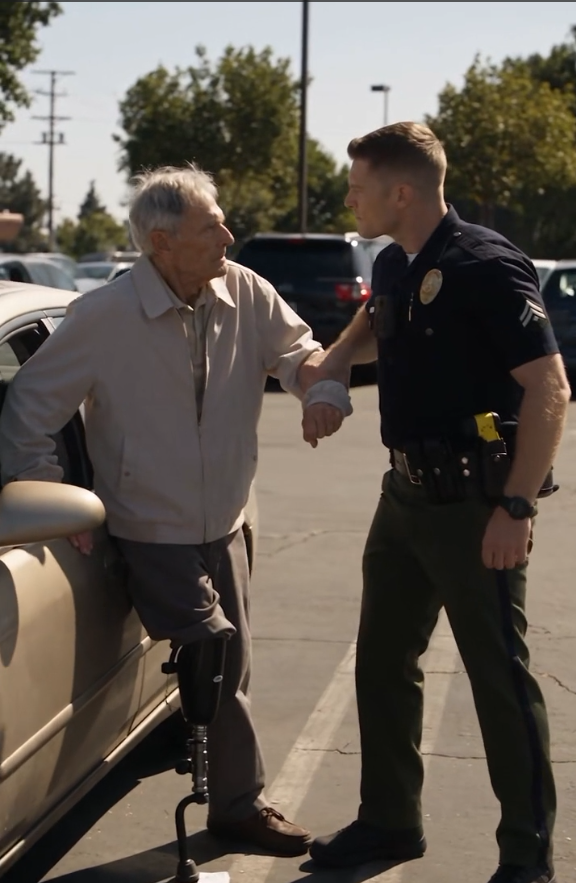
Part I — The Watch in the Dirt
The radio died before Officer Miller understood whose wrist he had grabbed.
One second, routine dispatch traffic spilled through the open window of his cruiser—plate numbers, traffic stops, somebody asking for a tow. The next, after I held the black phone’s side button for three seconds, the speaker gave a short electronic tone and went completely silent.
Miller looked toward the cruiser.
His hand was still near his holster.
My father’s watch was still lying broken on the asphalt between us.
Neither of us moved for half a breath.
Then Miller turned back to me.
“What did you do?”
The heat coming off the municipal parking lot seemed to rise through the sole of my canvas shoe and into the socket of my prosthetic leg. I had been standing too long. The skin above my right thigh was already raw, and the phantom pain in the arm I had lost years earlier had begun its familiar electric crawl across fingers that no longer existed.
At seventy-one, I had learned there were pains you treated and pains you negotiated with.
I had not expected Officer Miller to become one of them.
The secure handset remained pressed against my left ear.
A faint digital hum steadied into a live connection.
A woman answered.
“Priority desk.”
Her voice was calm, almost flat.
“Credential seven-four-one,” I said.
Miller took one step toward me.
“Put the phone down.”
I kept my eyes on him.
“Challenge.”
The woman on the line gave me three words.
I answered with three numbers.
There was a pause of less than a second.
“Authenticated.”
Miller stared at the phone, then at me.
The anger was still there, but something had moved underneath it. Uncertainty. He did not know what kind of device I was holding, why there had been no ring, or why his patrol radio had gone dead the instant the call connected.
Neither did the family beside the SUV twenty yards away.
The mother had both children behind her now. She was watching from over the hood of the vehicle, one hand pressed against the boy’s shoulder.
Miller pointed at the pavement.
“Phone. Down. Now.”
The woman at the priority desk spoke into my ear.
“State your condition.”
“Armed municipal officer,” I said. “Badge four-one-one-seven. Physical detention in progress. Public parking facility. Possible evidence preservation required.”
Miller heard enough.
His expression hardened.
“You’re interfering with police communications.”
“No,” I said quietly. “I’m making a call.”
“That radio went out when you touched that phone.”
I looked toward his cruiser.
The display inside had changed from its normal blue glow to a steady amber block.
Miller saw it too.
His jaw tightened.
“Hands on the car.”
I lowered the secure handset slowly until it hung near my hip.
My father’s watch glittered on the asphalt near my shoe.
Ten minutes earlier, it had been intact.
Ten minutes earlier, all I had wanted was medication and a cold glass of water.
I had parked in the marked accessible space beside the pharmacy entrance. My placard was displayed correctly. The vehicle registration was current. The permanent disability credential attached to the placard had been issued in my name years ago.
Miller had not asked to see any of it.
He had watched me cross the curb awkwardly, decided he understood what he was seeing, and approached before I had managed to put my pharmacy bag on the passenger seat.
“We’re done playing this game,” he had told me as he grabbed my wrist.
“You people buy these fake tags online and think you own the lot.”
The words had been loud enough for strangers to hear.
I had told him the placard was mine.
He had leaned closer.
“I watched you walk out of that store. You hesitated on the curb. A real amputee doesn’t forget which leg is gone.”
I had almost laughed.
Not because it was funny.
Because the sentence was so confidently stupid that for a moment I had no other response.
I had not forgotten which leg I was missing.
I had hesitated because the prosthetic socket had rubbed a blister into the scarred tissue of my right thigh, and stepping down from a curb had sent a line of pain through my hip.
I had also spent decades learning not to explain my body to strangers simply because they demanded a story.
Then Miller had seen the silver watch in my left hand.
I had removed it because phantom pain in my missing right arm sometimes made the strap on my remaining wrist feel unbearably tight, as irrational as that was. The nervous system did not care much for logic.
Miller had taken it from me.
The spring bar had snapped.
The watch had hit the asphalt.
The crystal broke into three bright pieces.
He had looked down at it for barely a second.
That had been the moment I stopped thinking of the encounter as an inconvenience.
My father had worn that watch for thirty-eight years.
He had worn it while repairing city buses in winter garages where the doors never fully closed. He had worn it to my high-school graduation, to my wedding, and to the hospital the first time he saw me after the blast that took my right arm and leg.
When he died, it was the only thing of his I asked for.
Miller had dropped it into the dirt like loose change.
Now he pointed again at my car.
“Last warning.”
The secure operator spoke through the phone.
“Local supervisor has been notified. Do not terminate the session.”
I said nothing.
Miller stepped closer and took the handset from my hand.
I did not resist.
He examined it quickly.
No manufacturer logo.
No normal screen.
No camera.
Just a black rubberized shell, a small status window, and the single side switch.
“What is this?”
“A government-issued communications device.”
That answer did not calm him.
Quite the opposite.
“For who?”
“For me.”
“Doing what?”
I watched him for a moment.
“You haven’t asked my name yet.”
His face changed slightly.
Not embarrassment.
Annoyance.
He did not like being reminded that he had skipped a step.
“Name.”
I gave it to him.
He repeated it into the shoulder microphone clipped to his uniform.
Nothing happened.
He pressed it again.
Static.
Then silence.
He looked toward the cruiser.
“Dispatch.”
No answer.
He crossed to the open driver’s door and reached for the dash radio.
The amber block remained on the display.
He pressed a control.
Nothing.
A message appeared.
SUBSCRIBER ISOLATED — PRESERVE DEVICE STATE.
He read it.
Then he looked at me.
I knew what he was thinking because I had seen that expression in control rooms, hearings, and command posts for most of my professional life.
He had assumed the equipment belonged to him in the same way he assumed the parking lot belonged to his judgment.
Now the equipment was telling him otherwise.
“What did you do to my radio?”
“I didn’t touch your radio.”
“You shut it down.”
“No.”
“Then who did?”
I looked at the black handset in his hand.