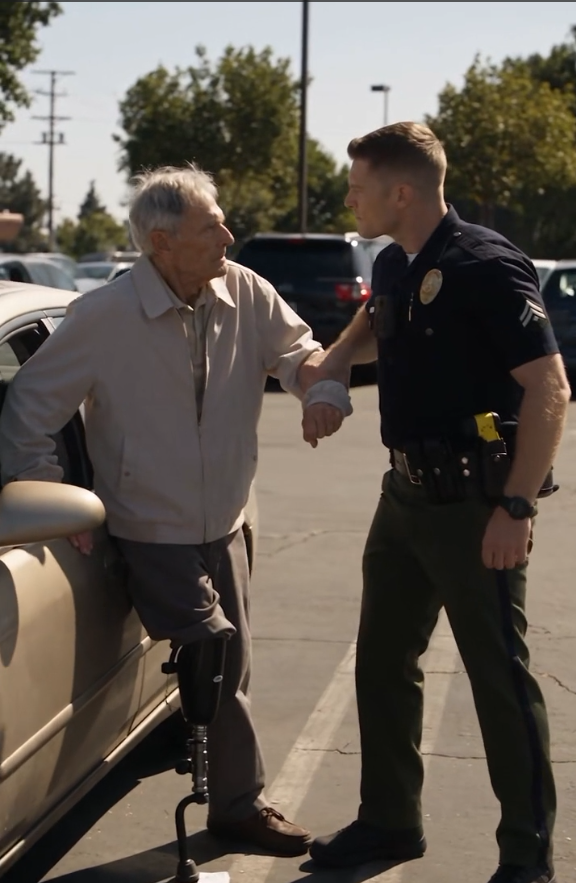
“The person you took that from can explain it better than I can.”
He stared at me.
A second patrol vehicle entered the lot.
No siren.
No dramatic arrival.
It simply turned in from the street, crossed two rows of parked cars, and stopped behind Miller’s cruiser.
A woman in a sergeant’s uniform got out.
She was in her mid-forties, compact, dark hair pulled neatly back. She did not hurry, but she moved with the particular speed of someone who understood that moving faster could make everybody else move faster too.
Her eyes went first to Miller.
Then to me.
Then to the broken watch.
Then to the black handset in Miller’s hand.
“Officer Miller,” she said.
He began talking immediately.
“Sergeant, this subject interfered with—”
“Stop.”
One word.
Not loud.
Effective.
She walked to the cruiser and leaned toward the dash.
Her expression shifted when she saw the amber message.
“Did you power-cycle this unit?”
“No.”
“Touch any reset?”
“No.”
“Good.”
Miller frowned. “He disabled it.”
The sergeant looked at him.
“Did you hear what I asked?”
He stopped talking.
She turned toward me.
“Sir, are you injured?”
“My wrist hurts.”
Her eyes dropped to my prosthetic leg, then to the empty right sleeve pinned neatly inside my windbreaker.
Unlike Miller, she did not stare.
“Do you need medical assistance?”
“No.”
“You sure?”
“Yes.”
She nodded once.
Then she looked toward the family beside the SUV.
“Did anyone see what happened?”
The mother lifted her hand slowly.
“I did.”
Miller exhaled through his nose.
“Sergeant—”
“Body camera on?”
“Yes.”
She glanced at the small unit on his chest.
The indicator light was active.
Then her gaze settled on his right hand.
“What are you holding?”
He hesitated.
“A phone.”
“Whose?”
“His.”
The sergeant closed her eyes for less than a second.
When she opened them, she held out her hand.
“Put it on the hood.”
Miller did.
“Do not press anything.”
He looked at her.
“You know what it is?”
“No,” she said. “Which is why I’m not pressing anything.”
That was the first intelligent sentence anyone in uniform had said to me since I left the pharmacy.
The handset emitted one soft tone.
The sergeant stepped closer but did not touch it.
A voice came from the device’s tiny speaker.
“Priority desk. Local supervisory officer, identify.”
The sergeant stared at it.
Then at me.
Then she gave her name, rank, and department.
The operator responded.
“Maintain scene integrity. Preserve all radio, vehicle terminal, body-worn camera, and dispatch records associated with badge four-one-one-seven and current incident. Do not restart isolated mobile subscriber until released by network control.”
Miller’s face went very still.
The operator continued.
“Credential holder remains connected. Confirm physical condition.”
The sergeant looked at me.
“Sir?”
“I’m stable.”
She relayed it.
“Copy. Secure review initiated.”
The line disconnected.
A hot breeze moved a receipt across the pavement.
Miller looked at me as though I had changed shape.
I had not.
I was still the same seventy-one-year-old man he had decided, five minutes earlier, was pretending to be disabled.
The sergeant took a notebook from her pocket.
“Officer Miller, step over by my unit.”
He did not move.
“Sergeant, this guy reached into his jacket after refusing instructions.”
“I said step over by my unit.”
“He had an unknown device.”
“And now it’s known enough that a communications center just ordered us not to touch your radio.”
His voice dropped.
“He did something.”
The sergeant held his gaze.
“Maybe. Which is why we preserve things and find out.”
Miller finally stepped away.
The family by the SUV remained where they were.
I bent carefully toward the asphalt.
The sergeant noticed.
“Sir, don’t. I’ll get it.”
She crouched and picked up the largest piece of the watch.
Then the metal back.
Then one bent section of the bracelet.
The movement caught Miller’s attention.
He looked over.
For the first time since he had broken it, he seemed to understand that the object mattered.
“What happened to that?” the sergeant asked.
I looked at Miller.
“He took it off me.”
The sergeant stopped collecting pieces.
“Why?”
Miller answered before I could.
“He was manipulating something in his hand.”
“It was my watch,” I said.
“I didn’t know that.”
“You pulled it out of my hand.”
“I believed he might be concealing—”
The mother by the SUV spoke.
“No.”
Everybody turned toward her.
She was holding a grocery bag in one arm. Her other hand was wrapped around her phone.
“He told you it was his watch.”
Miller stared at her.
The woman swallowed but did not look away.
“You grabbed it anyway.”
A long pause followed.
Then the sergeant finished gathering the pieces.
She placed them in my palm.
The cracked crystal made a faint clicking sound against the metal case.
My father had once told me a good watch was not delicate.
“It’s supposed to get scratched,” he said when I was twelve and afraid I had ruined his new one after dropping it in our driveway. “Otherwise you bought jewelry, not a watch.”
I closed my fingers around what remained of it.
The movement hurt my wrist.
The sergeant saw that too.
“Sir, I’m going to need your statement.”
“I assumed so.”
“And I need to ask you not to leave yet.”
“I wasn’t planning to.”
Miller gave a short, humorless laugh.
“Of course he wasn’t.”
The sergeant turned.
“Officer.”
He looked at her.
She said, “Not another word unless I ask you a question.”
That was when the first layer of his confidence finally broke.
Not completely.
Just enough for me to see what had been beneath it all along.
He had never expected anyone else to control the scene.
Part II — The Report
They did not handcuff me.
Miller wanted to.
I could see it in the way he kept returning to the idea that I had “interfered with public safety communications.”
The sergeant refused.
Instead, she asked whether I would sit in the passenger seat of her air-conditioned patrol vehicle while she contacted her watch commander.
I accepted because my leg was beginning to tremble.
The pharmacy bag sat inside my sedan exactly where I had dropped it.
I could see the white paper sack through the window.
The ordinary sight of it bothered me more than Miller did.
A prescription.
A bottle of water.
A parking placard.
A broken watch.
There should have been no story there.
Inside the sergeant’s car, cold air hit the sweat at the back of my neck.
She stood outside the open passenger door.
“I’m Sergeant Ruiz.”
I nodded.
She had already given her name to the priority desk, but repeating it to me mattered.
“I want to be clear,” she said. “Right now I’m trying to establish facts. I’m not asking you to waive anything.”
“Understood.”
“Was the black device issued to you by a federal agency?”
“Yes.”
Miller, standing ten feet away, turned his head.
Ruiz saw him listening and moved farther from him.
“Are you employed by that agency?”
“Not exactly.”
She waited.
I appreciated that.