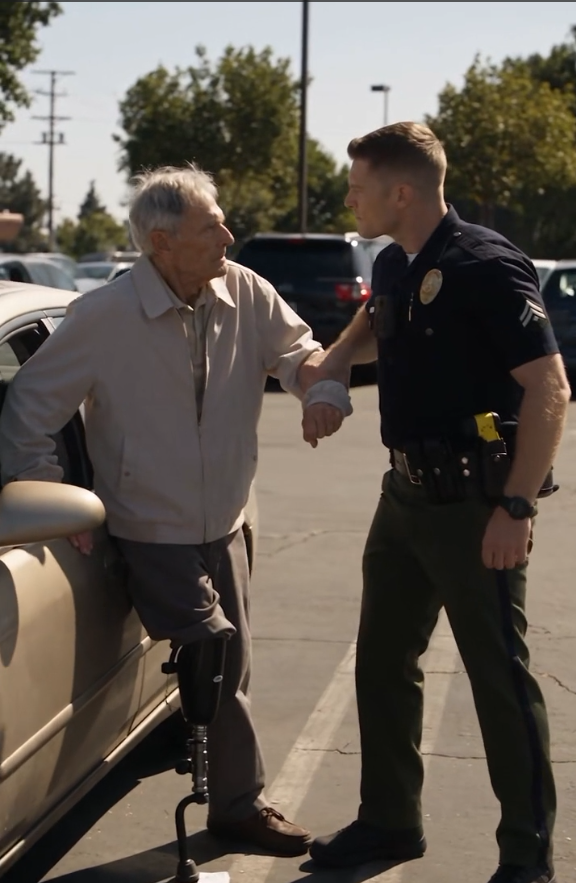
We met in a conference room at his attorney’s office.
No uniforms.
No hearing officer.
No record unless either of us chose to make one.
I brought no secure handset.
Miller arrived first.
He stood when I entered.
I sat.
He sat.
For several seconds neither of us spoke.
Then he said, “I’m not asking you to forgive me.”
“Good.”
He nodded.
“I figured you’d say that.”
“Why did you want to meet?”
He looked down at his hands.
“I’ve been reading the reports.”
“Yours?”
“All of them.”
“That sounds unpleasant.”
“It is.”
I waited.
He rubbed his thumb along a mark on the table.
“You said something at the hearing.”
“I said several things.”
“That your status shouldn’t have mattered.”
“Yes.”
“I didn’t know who you were.”
“I know.”
“That’s been bothering me.”
I leaned back.
“Why?”
“Because after the radio died, I thought you had connections.”
“I did.”
“I know.”
“No,” I said. “I mean I did have connections.”
He looked up.
“And for a while I hated you for it.”
“That seems backward.”
“I know.”
His mouth tightened.
“I kept thinking if you’d just told me who you were, none of this would’ve happened.”
I studied him.
“Do you still think that?”
“No.”
The answer came quickly.
Then he corrected himself.
“Sometimes.”
That was more believable.
He looked toward the window.
“I keep going back to the minute before I touched you.”
“The terminal.”
He nodded.
“I saw the record.”
“Yes.”
“I saw your picture.”
“Yes.”
“I told myself the placard could still be misused.”
“It could have been.”
“I told myself your walk looked wrong.”
I said nothing.
He gave a short breath.
“I don’t even know what that means anymore.”
“You thought you did then.”
“Yes.”
He looked at me.
“I’d written a lot of tickets for placard fraud.”
“I heard.”
“Some were real.”
“I know.”
“People do abuse them.”
“I know.”
His voice sharpened slightly.
“I’m not making that up.”
“I didn’t say you were.”
He stopped.
The reflex interested both of us.
He exhaled.
“Sorry.”
I waited.
He continued.
“The more of them I caught, the more I started thinking I could tell.”
There it was.
Not an excuse.
An explanation.
Experience had become confidence.
Confidence had become certainty.
Certainty had become permission.
“I was good at spotting patterns,” he said.
“No,” I said.
His eyes lifted.
“You became good at seeing the pattern you expected.”
He took that in.
After a while, he nodded.
“Maybe.”
“Probably.”
He almost smiled.
It disappeared quickly.
“I shouldn’t have touched the watch.”
“No.”
“I shouldn’t have grabbed you.”
“No.”
“I shouldn’t have written the report the way I did.”
“No.”
He looked down.
“That one’s the worst.”
I had not expected him to understand that.
“Why?”
“Because I had time.”
The room became very still.
He continued.
“In the parking lot, I was angry. I thought you were challenging me. I was embarrassed when the radio went down. Then Ruiz showed up and I knew something was wrong.”
He swallowed.
“But the report…”
He shook his head.
“I sat there and made it cleaner.”
I watched him.
“I told myself I was making it clearer. That’s the thing.”
“Yes.”
“I didn’t sit down thinking, I’m going to lie.”
“I believe you.”
He looked surprised.
“That doesn’t help you,” I said.
“No.”
“You removed facts that made your judgment look worse.”
“Yes.”
“You changed language that made my behavior look worse.”
“Yes.”
“You turned your action with the watch into mine.”
His eyes closed briefly.
“Yes.”
“That is lying, even if you didn’t use the word while you were doing it.”
He nodded.
We sat in silence.
Finally he asked, “Why did you agree to see me?”
“I’m still deciding.”
He gave a tired laugh.
Then he looked at my bare wrist.
“Did they fix it?”
“The watch?”
“Yes.”
“I pick it up tomorrow.”
“I’m glad.”
“That seems to be a popular sentiment in your department.”
His face flushed.
I regretted the sentence immediately.
Not because it was false.
Because it was cheap.
He deserved consequences.
He did not need every opening turned into punishment.
I leaned back.
“Why did you really ask to meet?”
Miller took a folded piece of paper from his pocket.
He placed it on the table.
“I wrote something.”
I did not reach for it.
“What?”
“An apology.”
“You can say it.”
“I know.”
“Then say it.”
He looked at me.
For a moment he was the same man from the parking lot—square jaw, controlled posture, instinctively resistant to being directed.
Then the posture left him.
“I’m sorry I decided I knew what was wrong with your body better than you did.”
No performance.
No excuse.
He continued.
“I’m sorry I grabbed you. I’m sorry I broke something that belonged to your father. And I’m sorry I wrote the report to protect myself.”
His voice tightened on the last sentence.
He stopped.
I let the silence stay.
Then I said, “Thank you.”
He looked almost disappointed.
Maybe he wanted absolution.
Maybe anger.
Maybe a sentence that would turn the meeting into a clear ending.
I had none.
“Is that it?” he asked.
“Yes.”
“You don’t want to say anything else?”
I thought about my father.
About all the times he answered serious moments with less than people expected.
“No.”
Miller nodded.
I stood.
So did he.
At the door, I stopped.
“There is one thing.”
He waited.
“You weren’t fired because my phone was important.”
His expression changed.
“You were fired because the record was.”
He looked at me for a long time.
Then he nodded.
I left.
Part VII — What Survives
The watchmaker called at ten the next morning.
“It lives.”
Those were his exact words.
I drove across town.
The silver watch rested on the black cloth where I had first seen it dismantled weeks earlier.
New crystal.
Repaired bracelet.
Clean dial.
The second hand moved smoothly around the face.
But the case still carried the deep scar from the parking lot.
I picked it up.
For a second, I could not speak.
The watchmaker pretended not to notice.
“Movement’s running well,” he said. “A little fast. Old mechanical pieces sometimes do after service. Bring it back in two weeks.”
I turned it over.
My father’s initials.
The date.
Still there.
“You didn’t polish this.”
“You told me not to.”
“Yes.”
He pointed at the scar.
“Some people would want that gone.”
“I’m not some people.”
“So I gathered.”
He helped me fasten it around my wrist.
The weight returned so naturally that I wondered how three weeks without it had managed to feel so long.
“How much?”
He gave me the amount.
I paid it myself.
The city had offered reimbursement.
I submitted the receipt later.
Not because I needed the money.
Because records mattered.
That afternoon I drove back to the municipal lot.
I had no reason to.
That was why I went.
The same pharmacy stood at the end of the row.