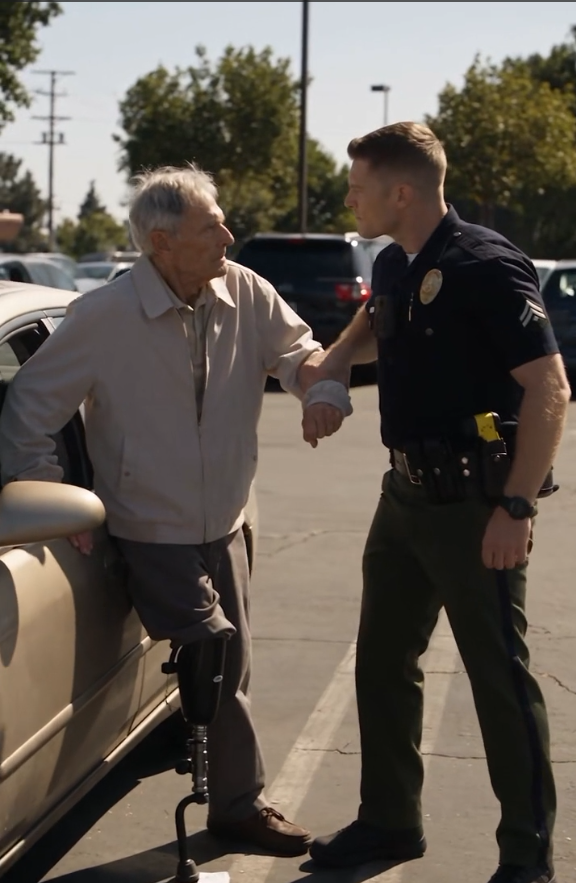
Miller thought.
The answer was obvious.
Nothing.
Not yet.
His first direct command—hands on the roof—came after the watch broke.
The attorney let the silence do its work.
Then she asked, “Officer Miller, did you approach that parking space intending to determine whether the placard was valid?”
“Yes.”
“Did the database tell you it was valid?”
“Yes.”
“Did it identify the registered holder?”
“Yes.”
“Did you view the registered holder’s photograph?”
“Yes.”
“Was the man standing beside the car the same man?”
A long pause.
“Yes.”
“Then what fact were you still investigating when you put your hand on him?”
Miller looked at me.
His voice was quieter.
“Whether he was disabled enough to use it.”
Nobody moved.
His attorney closed his eyes.
The hearing officer leaned slightly forward.
The city attorney asked, “Disabled enough according to what standard?”
Miller had no answer.
That was the climax.
Not the radio dying.
Not the secure call.
Not the body-camera still.
A man saying aloud what had been hidden beneath every decision he made that afternoon.
He believed he was entitled to measure my body against his private idea of what disability should look like.
And when I failed his test, the official records became inconveniences.
The city attorney returned to her table.
“No further questions.”
Part VI — The Harder Choice
The hearing officer did not issue a decision that day.
The department had one more question for me before the record closed.
Not about Miller.
About the secure communications system.
The city attorney wanted to introduce a technical declaration explaining why the radio isolation occurred.
My office objected to public disclosure of several details.
Miller’s attorney argued that without those details, his client could not fully challenge whether the system itself had improperly escalated the encounter.
The solution was a sealed technical session.
I was asked whether I would testify.
I could have declined.
Elaine reminded me of that.
“You’ve already provided an engineering declaration.”
“I know.”
“The system logs are enough.”
“I know.”
“You don’t owe them a tutorial.”
“I know.”
We were sitting in her office forty miles from the city.
The secure handset rested between us.
It had been replaced after the incident, not because it was damaged, but because anything involved in an evidence-preservation event was removed from field service pending forensic review.
The new unit looked exactly like the old one.
“Then why are you considering it?” she asked.
“Because Miller’s attorney is making a fair point.”
Elaine stared at me.
“That hurt to say?”
“A little.”
“He’s claiming the isolation made his client think you were dangerous.”
“It probably did.”
“After his client had already broken the watch.”
“Yes.”
“After grabbing you.”
“Yes.”
“After ignoring the credential result.”
“Yes.”
She leaned back.
“What exactly are you trying to save here?”
“Process.”
“Oh, don’t become noble on me.”
I smiled.
“I’m serious.”
“So am I.”
I picked up the handset.
“We built this system to preserve communications integrity, not win arguments.”
“It did what it was designed to do.”
“Yes.”
“Then testify to that.”
“If I testify as the architect, the whole story tilts.”
“Again with this.”
“Yes, again.”
I placed the device down.
“People already think I had some magic phone that punished a police officer for touching me.”
“You didn’t.”
“I know.”
“You authenticated an emergency. The network classified the incident and isolated one subscriber.”
“I know.”
“It didn’t disable dispatch. It didn’t interfere with other units. It didn’t erase anything.”
“I know.”
“It preserved evidence.”
“I know.”
She stared at me.
“Then say that.”
I looked out her window.
Below us, traffic moved along the interstate.
Years earlier, I had helped design the first versions of the protocol after a series of failures exposed how vulnerable shared public-safety networks could become during emergencies.
The secure handset was never meant to make the person carrying it powerful.
It was meant to make the record resilient.
That distinction mattered.
Maybe more than anything.
“I’ll testify.”
Elaine nodded.
“But only to system function.”
“Good.”
“No biography.”
She laughed.
“You think their attorney isn’t going to ask?”
“He can ask.”
“And when he asks why you had the phone?”
“I’ll answer.”
“What are you going to say?”
“That I was authorized to carry it.”
“That’ll drive him crazy.”
“I can live with that.”
The sealed session lasted ninety minutes.
I explained authentication.
Priority routing.
Automatic subscriber isolation.
Evidence retention.
I did not disclose restricted architecture.
Miller’s attorney asked whether I personally commanded his client’s radio to shut down.
“No.”
“Could you have?”
“Not with that handset.”
“Could someone at the priority desk?”
“Not directly.”
“Then what happened?”
“The system applied an automated security rule after the event classification reached a predefined threshold.”
“What threshold?”
“Protected.”
He looked annoyed.
“Convenient.”
“No.”
I looked at the hearing officer.
“Restricted.”
Miller’s attorney changed tactics.
“Did the system know Officer Miller had committed misconduct?”
“No.”
“Did it determine he was dangerous?”
“No.”
“Did it conclude you were telling the truth?”
“No.”
“What did it conclude?”
“That a credentialed user reported an armed-contact event under conditions requiring preservation and temporary communications isolation.”
“So the system took your word for it.”
“No.”
“It reacted because you pressed a button.”
“It reacted because I authenticated.”
“That sounds like semantics.”
“It isn’t.”
He stepped closer.
“What’s the difference?”
I looked at him.
“The system didn’t know I was right. It knew who I was.”
He paused.
I continued.
“That’s why it preserved evidence instead of deciding the dispute.”
The hearing officer looked up from her notes.
That was the point I had wanted made.
Not that the network believed me.
That it refused to let either of us rewrite the encounter after the fact.
A week later, the ruling arrived.
Officer Miller was terminated for multiple sustained violations: improper physical handling, inaccurate reporting, failure to disclose material pre-contact information, conduct inconsistent with department policy, and repeated documentation deficiencies revealed through the expanded review.
The ruling did not call him evil.
It did not say every stop he had ever made was illegitimate.
It did not claim the department was corrupt.
It was narrower than public outrage wanted and broader than Miller’s defenders wanted.
In other words, it was probably close to fair.
The city referred the inaccurate-report findings to the appropriate prosecutorial office for independent review.
I was told that process would continue separately.
I did not ask for predictions.
The other placard cases were reopened.
Two prior complainants were contacted.
Training was revised.
Supervisors were instructed to document pre-contact database checks explicitly when those checks formed part of an officer’s decision to initiate an investigation.
The department also changed its evidence-retention procedure so that certain complaints automatically preserved mobile-terminal history along with body-camera footage.
None of that restored my father’s watch.
But it mattered.
Three days after the ruling, Miller asked to speak with me.
Through his attorney.
I said no.
Then I spent the night wondering whether I had said no because it was wise or because it felt good.
The next morning, I changed my answer.