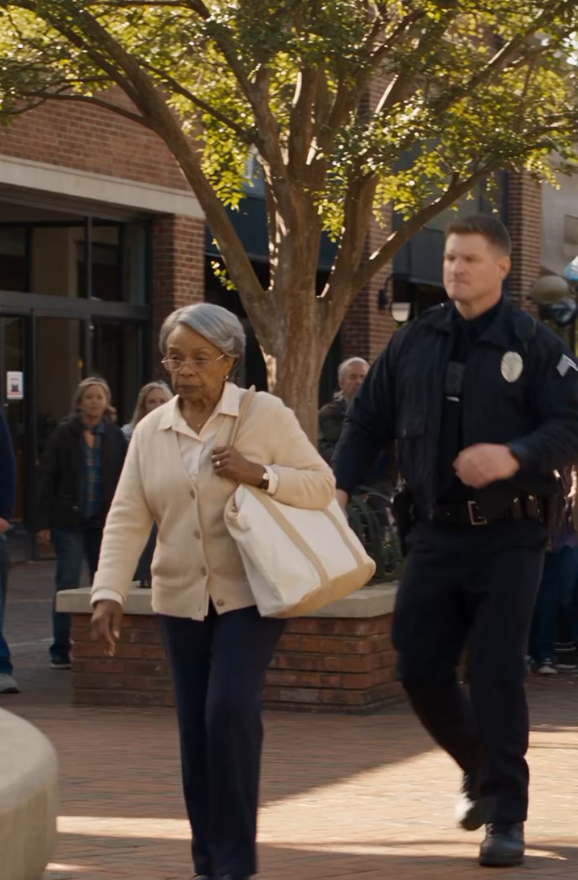
Then dropped.
That movement stayed with me.
The sergeant came over.
“Ms. Freeman?”
“Colonel Freeman.”
Keegan heard it.
So did Hollow.
The sergeant paused.
“Colonel?”
“United States Army.”
I didn’t elaborate.
Keegan studied me again.
This time differently.
My rank changed nothing about what had happened to Odessa, and I hated that I could see him recalculating because of it.
He should have treated my mother lawfully if I had been a cashier, a mechanic, unemployed, or standing in another state.
The sergeant said, “I need to take a statement.”
“You’ll have one.”
Keegan’s voice came from behind him.
“She threatened me.”
I looked past the sergeant.
“What?”
Keegan nodded toward me.
“She came in aggressive and issued threats.”
Mrs. Gable barked a laugh.
Several phones shifted toward him.
He continued anyway.
“Said she was going to change my life.”
“I never said that.”
“You implied consequences.”
“I told you to lower a Taser pointed at my mother.”
“Same thing.”
“No, Officer. It isn’t.”
The sergeant rubbed the bridge of his nose.
“Keegan, go stand by your vehicle.”
“She interfered.”
“Go.”
Keegan held my eyes for another moment.
Then walked away.
The paramedic asked Odessa to follow his finger.
Her eyes tracked normally.
The swelling on her cheek bothered me more than I wanted to admit.
I had seen far worse injuries.
That wasn’t the point.
She was my mother.
There are facts the professional mind can understand while the human part refuses them completely.
My mother had been standing in this square carrying books for children.
Someone wearing a badge had struck her.
And then lied about why.
The paramedic recommended that she be evaluated at the hospital because of her age and the force of the fall.
“I’m fine,” Odessa said.
“You’re going.”
“Nyla.”
“That wasn’t a question.”
She gave me a long look.
“You became very bossy after forty.”
Mrs. Gable said, “She was bossy before forty.”
For the first time since the phone call, something almost normal passed through the moment.
Then the sergeant approached again.
“Colonel Freeman, before you leave, I need you to understand something.”
I waited.
“There’s going to be an internal review.”
“There should be.”
“And Officer Keegan is alleging that your mother physically resisted him.”
My mother turned slowly toward us.
The sergeant continued.
“He’s also claiming you interfered with an active detention.”
“Am I under arrest?”
“No.”
“Is my mother?”
“Not at this time.”
Not at this time.
I looked toward Keegan.
He leaned against his patrol car while Hollow spoke to him.
Keegan saw me watching.
Then he smiled.
Only slightly.
It wasn’t triumph.
It was confidence.
The kind that comes from experience.
Whatever had happened here, Travis Keegan believed the system around him would absorb it.
That scared me more than the Taser.
I turned back to the sergeant.
“I want every recording preserved.”
“They will be.”
“Both body cameras. Patrol cameras. Dispatch audio. CAD logs. Any city cameras covering this square.”
His expression sharpened.
“I know how evidence works, Colonel.”
“Good. Then you understand why I’m saying it now, in front of witnesses.”
Keegan’s smile disappeared.
The sergeant stared at me for a moment.
Then nodded.
“I understand.”
The ambulance crew helped my mother inside.
Before she climbed in, Odessa reached for my wrist.
“Nyla.”
“I’m here.”
Her voice dropped so only I could hear.
“Do not use your rank to hurt him.”
I looked toward Keegan.
Then back at her.
“He hit you.”
“I know what he did.”
“He lied.”
“I know.”
“You want me to ignore it?”
“No.”
She tightened her fingers around my wrist.
“I want you to make him answer for what he did without becoming the reason he gets to say this was about power.”
The ambulance doors waited open behind her.
For several seconds, I said nothing.
Then I nodded.
“I promise.”
She released my wrist.
That promise would become the hardest order I had ever accepted.
Because before the day was over, Travis Keegan would give me several opportunities to break it.
And one of them would have felt very good.
Part II — The Version They Wrote Down
The hospital examination confirmed what the square had already told me.
Bruising.
A cut inside my mother’s cheek.
A scraped palm.
A strained shoulder from the fall.
No fracture.
No concussion.
No serious neurological injury.
The doctor called that good news.
Odessa thanked him.
I stood by the window and watched the parking lot six floors below.
Good news was relative.
“You’re doing that thing,” my mother said.
I looked over.
“What thing?”
“Standing very still when you’re furious.”
“I’m not furious.”
“You’ve been my daughter for forty-three years.”
I pulled a chair closer to the bed.
She had been given temporary plastic frames from an old pair of reading glasses kept in her purse. They sat slightly crooked on her face.
“Mrs. Gable sent me her video.”
Odessa sighed.
“Nyla.”
“I’m not posting it.”
“Good.”
“I’m preserving it.”
“That sounds like your lawyer voice.”
“I don’t have a lawyer voice.”
“You absolutely do.”
I almost smiled.
Then my phone vibrated.
Unknown number.
I answered.
“Colonel Freeman?”
“Yes.”
“This is the department’s internal affairs office. We’re opening a formal administrative investigation regarding this morning’s incident.”
I walked into the hallway.
“Good.”
“We would like a recorded interview with you and Dr. Freeman.”
“You can schedule it through counsel.”
A pause.
“Have you retained counsel?”
“I will before the interview.”
Another pause.
“That’s your right.”
“I also want written confirmation that all digital evidence has been placed under preservation.”
“We have procedures—”
“I asked for confirmation.”
The voice on the other end became cooler.
“We’ll make a note of the request.”
“Not a note. Confirmation.”
“We’ll get back to you.”
The line ended.
I stared at the phone.
When I returned to the room, Odessa was watching me.
“What?”
“You get that line between your eyebrows when somebody says something bureaucratic.”
“They said they’ll get back to us.”
“That bad?”
“Worse than bullets.”
She smiled despite the swelling.
Then she winced.
I sat down.
“I made you a promise.”
“Yes.”
“That doesn’t mean I’m going to be passive.”
“I didn’t ask you to be.”
“What exactly are you asking?”
She looked toward the window.
For years, my mother had possessed a talent I had never managed to acquire.
She could wait before speaking.
Not because she was unsure.
Because she considered language worth choosing carefully.
Finally, she said, “When you were fifteen, you got suspended for punching that boy who made fun of your father leaving.”
I leaned back.
“This is where you’re going?”
“You were convinced being angry made you right.”
“I was right.”
“You broke his nose.”
“He deserved—”
She raised one eyebrow.
“Fine.”
“I told you something then.”
I remembered.
“You told me being right doesn’t excuse choosing the wrong weapon.”
“Yes.”
I looked at her bruised face.
“This is different.”
“Of course it is. You’re older now.”
That was my mother.
No speech.
No sermon.