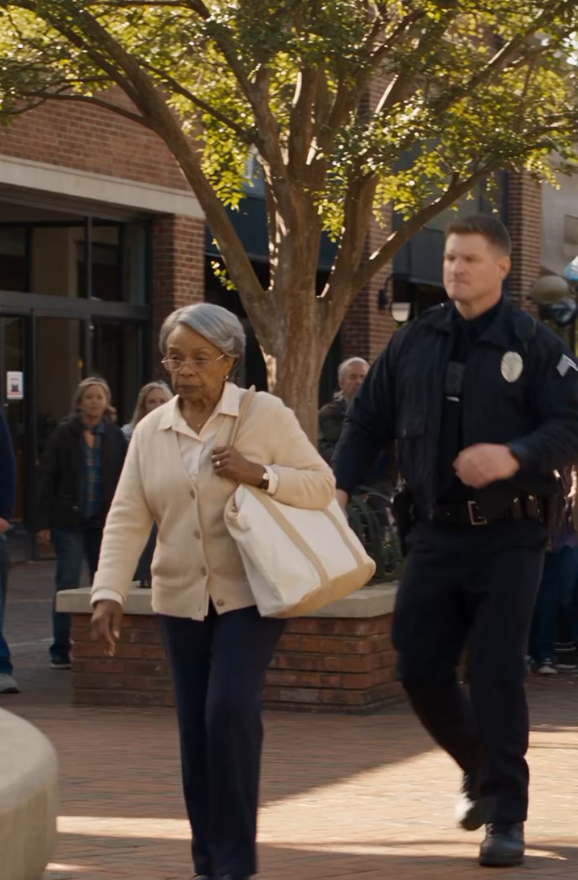
One sentence placed exactly where it needed to be.
My phone vibrated again.
This time it was Mrs. Gable.
She had sent eleven video clips collected from people who had been in the square.
The first seven showed only the aftermath.
The eighth showed Keegan ripping the bag from Odessa’s shoulder.
The ninth showed the slap.
The angle was from behind a parked car. Keegan’s body blocked part of the frame, but the motion was unmistakable.
Odessa reached for the bag.
Keegan’s arm came across.
Her glasses flew.
She went down.
I watched it once.
Then again.
My hand tightened around the phone.
My mother said quietly, “Stop watching it.”
I locked the screen.
That afternoon, our attorney obtained the preliminary incident report.
I read it at my mother’s kitchen table.
Officer Keegan wrote that he and Hollow had been dispatched to investigate a jewelry store robbery. According to the report, the suspect was described as a “female individual carrying a large bag and moving quickly away from the commercial district.”
Keegan stated that Odessa matched the description.
He claimed he asked to inspect her bag.
He claimed she became “verbally confrontational.”
He claimed she grabbed his wrist.
He claimed he used “minimal open-hand defensive contact.”
He claimed she lost her balance.
He claimed I arrived moments later, “behaving aggressively and attempting to interfere with lawful police duties.”
I read the report twice.
Then a third time.
Odessa sat across from me drinking tea.
“You’re going to burn a hole through it.”
“He wrote ‘minimal defensive contact.’”
“I can read.”
“He slapped you.”
“Yes.”
“He wrote that you grabbed his wrist.”
“I did not.”
“I know.”
“Nyla.”
I set the pages down.
She waited.
“What?”
“You are arguing with paper.”
“I’m analyzing it.”
“No. You are trying to make the paper ashamed.”
I pushed back from the table.
The kitchen looked exactly as it had when I was twelve.
Same oak cabinets.
Same little ceramic bowl beside the stove where she kept tea bags.
Different refrigerator.
Same magnets.
One held a picture of me in uniform from years earlier.
Another held a handwritten note from a child at the library.
THANK YOU DR. O FOR THE BOOK.
I stared at it.
“How many complaints has he had?”
Odessa didn’t ask who.
“I don’t know.”
“I’m going to find out.”
Our attorney had already submitted records requests for disciplinary histories, dispatch data, body-camera metadata, and prior complaints involving both officers.
The police department released almost nothing immediately.
Active investigation.
Personnel confidentiality.
Pending review.
The phrases changed.
The meaning did not.
Wait.
Two days after the incident, the department issued a public statement.
It acknowledged that an “interaction occurred” between officers and “an elderly local resident.”
It said force had been used “following physical resistance.”
It said the department took all allegations seriously.
It urged the public not to “draw conclusions from incomplete social-media footage.”
They did not name Odessa.
They did not name Keegan.
They did not mention the Taser.
By lunchtime, Keegan’s name was everywhere anyway.
So was mine.
Someone identified me from a photo taken in the square.
News sites reported my rank.
Then came the version I had expected.
MILITARY COLONEL CONFRONTS LOCAL POLICE AFTER MOTHER DETAINED.
Some headlines emphasized the slap.
Others emphasized me.
A few made it sound as though two armed institutions had nearly gone to war beside a fountain.
My command called before dinner.
Not to pressure me.
To remind me that anything I said publicly could be interpreted as representing the Army.
“I understand,” I told my commanding general.
“Do you need anything?”
“No, sir.”
A pause.
Then, “How’s your mother?”
“Bruised. Angry about missing her library shift.”
He laughed softly.
“She sounds formidable.”
“She is.”
“Handle your family. Let legal handle legal.”
“Yes, sir.”
“And Nyla?”
“Sir?”
“Don’t let anybody bait you into becoming part of their defense.”
My eyes moved to my mother across the room.
She had apparently recruited the general to her side without ever meeting him.
“Understood.”
The internal affairs interview took place the following morning.
Odessa wore navy blue.
She had always believed serious conversations deserved serious clothing.
Keegan and Hollow were interviewed separately.
We were not present for those.
My mother answered every question calmly.
Yes, Keegan asked for her bag.
No, he did not explain a robbery before demanding it.
Yes, she gave him identification.
No, she did not consent to a search.
No, she did not touch him intentionally.
She reached for the bag when he pulled it because the strap caught around her wrist.
Then came the question I had expected.
“Dr. Freeman, did you say anything that might have been interpreted as confrontational?”
My mother considered it.
“I told him that citizens retain constitutional rights after retirement.”
The investigator blinked.
I looked down at my hands.
“What did Officer Keegan say?”
“He said I watched too much television.”
“Then what happened?”
“He took the bag.”
“And when you reached for it?”
“He struck me.”
“Could it have been accidental?”
“No.”
No anger.
No emphasis.
Just certainty.
The investigator shifted.
“Did you attempt to leave?”
“No.”
“Did you resist physically?”
“No.”
“Did you threaten him?”
My mother almost smiled.
“I taught middle-school history for thirty-six years. I have survived much worse behavior than Officer Keegan without threatening anyone.”
The investigator cleared his throat.
Our attorney asked for the body-camera footage.
The investigator glanced at a folder.
“There’s a technical issue.”
Every muscle in my body became still.
“What technical issue?” our attorney asked.
“Officer Keegan’s camera did not properly record the relevant portion.”
“And Hollow’s?”
“Partial data appears to be unavailable.”
I looked directly at the investigator.
“Unavailable?”
“We’re working with the vendor.”
“How much is missing?”
“That’s still being determined.”
“From when to when?”
“Colonel Freeman—”
“How much?”
Our attorney put one hand lightly on my arm.
I stopped.
The investigator said, “We don’t have a definitive answer yet.”
I thought of the square.
Hollow’s body camera.
The red light.
His fingers moving toward it.
“I saw Officer Hollow’s camera recording when I arrived.”
The investigator’s face gave me nothing.
“Your observation will be noted.”
I heard my mother inhale.
Not because she was surprised.
Because she knew exactly what that phrase would do to me.
I leaned back.
“Please do.”
That afternoon, Hollow signed a supplemental statement supporting Keegan’s version.
Odessa had resisted.
Keegan had used reasonable force.
I had arrived aggressively.
I stared at Hollow’s signature until his face returned to me.
The hesitation.
The way he had looked at Keegan after Mrs. Gable said people were filming.
The hand reaching toward the blinking body camera.
He had been afraid.
I had mistaken fear for conscience.
For the first time, I understood that proving what happened in Lincoln Square was not going to be difficult because the truth was unclear.
It was going to be difficult because the people involved knew exactly what the truth was and had begun deciding which version could survive on paper.
Part III — Three Minutes
My mother went back to the library five days after the asNextlt.