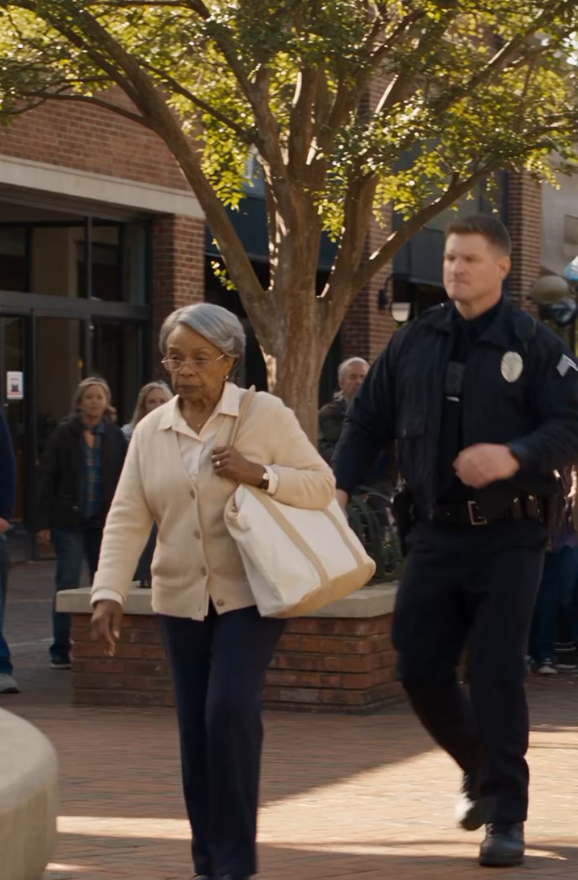
“What would have happened if you had hit him?”
“I would have been arrested.”
“Probably.”
“I might have damaged the case.”
“Yes.”
“He would have made it about me.”
“Yes.”
“And maybe people would have believed him.”
“Yes.”
She let the answers accumulate.
Then said, “That is why I asked you for the promise.”
“You knew I was going to want revenge.”
“I knew you loved me.”
Those words landed harder than I expected.
She continued.
“People like to talk about anger as if it’s the opposite of love. Often it is what love becomes when something precious gets hurt.”
She glanced toward me.
“The problem is that anger is very bad at choosing targets.”
I sat with that.
A few minutes later, footsteps approached.
Brent Hollow.
I recognized him before my mother did.
He wore jeans, work boots, and a heavy jacket. No uniform.
He was carrying a canvas bag.
A different bag.
The one he had tried to give my mother at the library.
It was full.
He stopped when he saw us.
For one awkward second, all three of us considered pretending the meeting had not happened.
Then Hollow lifted the bag slightly.
“I did what you said.”
My mother stood.
“Let me see.”
He opened it.
Children’s books.
New and used.
Adventure stories.
History.
Science.
Picture books.
A dictionary.
Odessa inspected the contents like an officer checking equipment.
“This is good.”
Hollow nodded.
“I’ve been doing it every month.”
I looked at him.
“Every month?”
He seemed embarrassed.
“Different libraries.”
My mother said, “Good.”
He shifted his weight.
“I’m working construction now.”
Neither of us had asked.
I realized he wanted us to know he was not trying to become a cop somewhere else.
“I heard your certification was surrendered,” I said.
“Yeah.”
A pause.
“Probably for the best.”
I did not answer.
He looked toward the place beside the fountain where Odessa had fallen.
Then toward her.
“I still think about it.”
My mother said, “You should.”
He nodded.
No comfort.
No reassurance.
Just the truth.
He started to leave.
Then turned back.
“Colonel?”
I almost corrected him.
Didn’t.
“Yes?”
“I used to think courage was what you did when somebody dangerous was in front of you.”
I waited.
He looked toward Odessa.
“Turns out sometimes it’s what you do when the dangerous person is standing beside you.”
Then he walked away.
My mother sat again.
“You forgive him yet?” I asked.
“No.”
I laughed.
She smiled.
“But I believe him.”
“That seems inconsistent.”
“Only if you think forgiveness and belief are the same thing.”
I shook my head.
“You should have been a lawyer.”
“I preferred children.”
“Less argumentative?”
“Much.”
The library opened at nine.
We carried the books together.
Inside, the morning reading group was already gathering.
A girl ran toward Odessa.
“Dr. O!”
My mother bent carefully and hugged her.
The girl noticed me.
“Are you the soldier daughter?”
I looked at my mother.
She looked delighted.
“I’m afraid so.”
The girl considered me.
“Were you scared when the police man hurt Dr. O?”
The room changed for me.
Not for anyone else.
Just me.
Children ask questions adults spend years avoiding.
I crouched so we were eye level.
“Yes.”
She frowned.
“But soldiers aren’t scared.”
“Soldiers are scared all the time.”
“Really?”
“Really.”
“What do you do?”
I thought about twenty years of answers.
Training.
Breathing.
Procedure.
Leadership.
All true.
None complete.
I looked toward my mother.
She was placing the repaired canvas bag on the desk.
“You decide what matters more than being scared.”
The girl nodded as though I had explained something obvious.
Then she ran back to her chair.
My mother looked at me.
“That was good.”
“Don’t sound surprised.”
“I raised you. I’m allowed.”
She began unpacking the books.
At the bottom of the tote was the blue hardcover.
The child’s note remained inside.
PLEASE GIVE THIS TO SOMEBODY WHO NEEDS A BRAVE STORY.
My mother held it out to me.
“No.”
“Yes.”
“It belongs here.”
“It does.”
“Then put it on the shelf.”
“I am.”
She pressed it against my chest.
I looked down.
“Mom.”
“Read it.”
“I don’t need a children’s book.”
“That is exactly what people say before they need a children’s book.”
I accepted it.
She smiled and turned away.
That should have been the end.
For a long time, I thought it was.
Then, nearly a year after Lincoln Square, an envelope arrived at my mother’s house.
No return name I recognized.
Inside was a photocopy of the first complaint ever filed against Travis Keegan.
Twelve years earlier.
A young man had written that Keegan stopped him without explanation, searched his backpack, shoved him against a patrol car, then claimed the young man had been “acting suspiciously.”
The complaint had been dismissed.
Attached to it was a handwritten note.
Dr. Freeman,
I saw what happened to you on the news. I filed this when I was nineteen. Nobody believed me. When your case happened, investigators contacted me again. I just wanted you to know that what you did mattered to people you will never meet.
My mother read the letter at the kitchen table.
Then passed it to me.
I reached the final sentence.
There was the twist I had not expected.
Not a secret conspiracy.
Not hidden evidence.
Not some grand revelation about Keegan.
Something simpler.
The case had never really begun with my mother.
She was merely the first person he hurt whose evidence became impossible to dismiss.
“How many others?” I asked.
Odessa shook her head.
“I don’t know.”
Subsequent review identified several older complaints that had been closed too quickly.
Two people received formal apologies from the city.
Procedures changed.
Supervisors were required to audit body-camera activation after any reported use of force.
Complaint reviews could no longer be closed solely on an involved officer’s written statement when civilian video contradicted it.
None of that repaired the past.
It mattered anyway.
One afternoon, I found my mother writing a response to the man who sent the old complaint.
“What are you telling him?”
She covered the paper.
“Private.”
“Mom.”
“Colonel Freeman, do you need another lesson about warrants?”
I raised both hands.
“Understood.”
She finished the letter.
Sealed it.
Then reached for her repaired canvas bag.
I watched her fill it with books.
The same ritual she had followed before Lincoln Square.
No ceremony.
No speech.
One book after another.
When the bag was full, she lifted it onto her shoulder.
The repaired strap held.
“You want a ride?” I asked.
“No.”
“You sure?”
“The weather is nice.”
She walked toward the door.
Then stopped.
“Nyla.”
“Yes?”
She looked back.
“You spent months thinking you saved me that day.”
I frowned.
“I never said that.”
“No.”
Her smile appeared.
“You didn’t have to.”
I leaned against the kitchen counter.
“What’s your point?”
She adjusted the canvas strap.
“You arrived after I had already been hit.”
“I remember.”
“You couldn’t undo that.”
“No.”
“You couldn’t control the department.”
“No.”
“You couldn’t decide what Keegan said, what Hollow did, what people online believed, or what sentence a judge gave.”
I waited.
“Then what exactly did you save?”
I thought about the question.
Finally, I understood.
Nothing.
Not in the way I had wanted.
I had not rescued my mother from what happened.
She had survived it before I arrived.
What I had done was stand beside her afterward.
Preserve evidence.
Keep a promise.
Choose law when anger offered something faster.
Accept imperfect accountability.
Let a guilty man tell the truth without demanding that every consequence satisfy my rage.
And learn that strength did not always look like taking control.
Sometimes it looked like refusing to.
“I didn’t save you,” I said.
My mother nodded.
“No.”
Then she opened the door.
“But you believed me.”
She stepped into the morning sunlight with the bag of books against her side.
I stood in the doorway watching my sixty-eight-year-old mother walk toward the library on her own, exactly as she had before any officer decided she needed to prove she belonged there.
The canvas strap held firm across her shoulder.
The scar beside her temple had faded almost completely.
At the corner, she turned and raised one hand.
I raised mine.
Then she disappeared beyond the oak trees.
And for the first time since Lincoln Square, I did not follow.