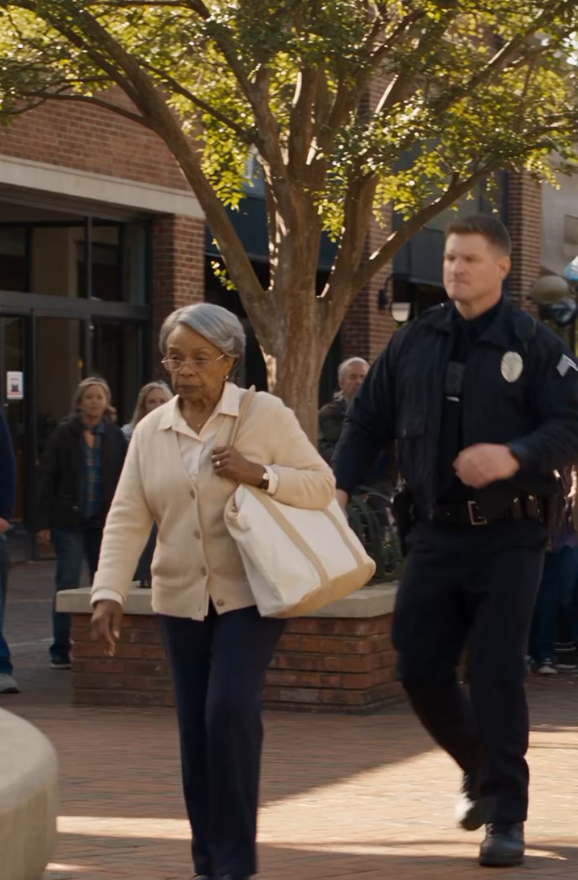
Not taking it.
Just close.
Counsel asked, “When did you first learn of the robbery?”
“After the confrontation had begun.”
“Then why did you write that it caused you to stop her?”
No answer.
“Officer Keegan?”
“I believed it became relevant.”
“Afterward?”
“Yes.”
“Relevant to explaining why you had already seized her property?”
His attorney stood again.
Keegan spoke over him.
“I was trying to make sense of a chaotic situation.”
Counsel stopped.
“What was chaotic before you took her bag?”
Keegan’s face changed.
The discipline cracked.
“She was refusing instructions.”
“She was refusing a search.”
“She was being difficult.”
The room changed.
Not loudly.
But everyone heard it.
Counsel’s voice softened.
“Difficult.”
Keegan realized too late.
He tried to correct.
“She was noncompliant.”
“What lawful order was she refusing?”
“She wouldn’t hand over the bag.”
“On what legal basis were you demanding it?”
Keegan looked toward his attorney.
No help came.
Counsel waited.
Then Keegan said the sentence that finished him.
“Sometimes people need to understand that when an officer tells them to do something, arguing only makes the situation worse.”
My mother closed her eyes for one second.
That was it.
Not the slap.
Not the video.
Not the paperwork.
The belief beneath all of it.
Counsel asked one final question.
“Even when the officer has no lawful reason?”
Keegan looked at the panel.
Then at Hollow.
Then at my mother.
Finally, at me.
He said nothing.
The hearing ended forty minutes later.
The panel did not announce a decision immediately.
We were asked to remain nearby.
Outside the chamber, reporters gathered behind a rope line.
I avoided them.
My mother did not.
One journalist called, “Dr. Freeman, what outcome do you want?”
I turned toward her.
She could have said termination.
Prison.
Accountability.
Justice.
Instead, she stopped.
“I want people to understand that rights are not acts of disrespect.”
The reporter leaned forward.
“Do you forgive Officer Keegan?”
My mother looked through the chamber doors.
“No one asked me to.”
Then she walked away.
The panel returned before sunset.
Travis Keegan was terminated for excessive force, unlawful seizure, dishonesty, falsification of an official report, and conduct inconsistent with department standards.
His state certification was referred for revocation.
The criminal charges remained pending.
Months later, he pleaded guilty to official misconduct and filing a false report, while the battery charge was resolved as part of the agreement. He received probation, community service, mandatory de-escalation instruction as a condition of sentence, and a permanent bar from serving as a police officer in the state.
Some people said it was too little.
Others said it was too much.
My mother read the sentence once.
Then folded the newspaper.
“What do you think?” I asked.
She considered it.
“I think he cannot do it again wearing a badge.”
“That’s enough?”
“No.”
She placed the paper on the table.
“But enough and perfect are different things.”
I had spent much of my adult life in environments where objectives were defined with brutal clarity.
Take the position.
Secure the route.
Recover the personnel.
Destroy the threat.
Civilian life resisted that simplicity.
There was no moment when someone handed me a document saying the world had been corrected.
There was only the next decision.
And the next.
And the next.
But one decision still waited for me.
It concerned the promise I had made beside the ambulance in Lincoln Square.
I had kept it.
Mostly.
Now I needed to understand what keeping it had cost.
Part VI — The Bag of Books
Winter came quietly to Georgia.
By December, the oak trees around Lincoln Square had lost most of their leaves.
The fountain had been shut off for the season.
I avoided the square for months.
Not intentionally.
At least that’s what I told myself.
There was always another route.
Another coffee shop.
Another place to park.
My mother noticed.
Of course she did.
One Saturday morning, she called at seven.
“I need a ride.”
“Where?”
“The library.”
“You have a car.”
“It’s cold.”
“Your car has heat.”
“Mine is making a noise.”
“What kind of noise?”
“The kind that requires a daughter.”
I stared at the ceiling.
“You’re lying.”
“Probably.”
Twenty minutes later, I pulled into her driveway.
She came outside carrying the repaired canvas tote.
The original one.
Mrs. Gable’s stitching still crossed the torn strap.
I watched my mother climb into the truck.
“What’s in the bag?”
“Books.”
I looked at her.
She smiled.
“Don’t start.”
We drove toward downtown.
When I turned onto the usual street for the library, she said, “Not this way.”
“What?”
“Go through the square.”
I kept driving straight.
“Nyla.”
“The other road is faster.”
“You have led people through active war zones.”
“That doesn’t mean I enjoy inefficient routes.”
“Turn left.”
I turned.
Lincoln Square appeared ahead.
Nothing dramatic happened.
No music.
No sudden memory so overwhelming I had to stop.
The square was just a square.
A few people walked dogs.
A delivery truck idled beside a bakery.
Two children chased each other around the dry fountain while their father tried unsuccessfully to make them put on gloves.
I parked.
My mother opened her door.
“What are you doing?”
“Walking.”
“To the library?”
“Yes.”
“It’s six blocks.”
“I have survived worse.”
I got out.
We crossed the street.
When we reached the fountain, Odessa stopped.
I looked at her.
“What?”
She placed the canvas bag on the stone edge.
For several seconds she said nothing.
Then she reached inside and removed a children’s book.
The same blue hardcover that had landed in fountain water.
The cover was slightly warped.
“You kept that?”
“Of course.”
“Why?”
She opened it.
Inside the front cover was a library donation sticker.
Below it, in a child’s handwriting:
DR. O — PLEASE GIVE THIS TO SOMEBODY WHO NEEDS A BRAVE STORY.
I read it twice.
“When was that written?”
“Before.”
“Before the square?”
“Yes.”
I looked at her.
She closed the book.
“I found it that night after the hospital.”
“You never showed me.”
“No.”
“Why?”
“Because you would have turned it into a symbol.”
I laughed.
“You know me too well.”
“Yes.”
She placed the book back in the tote.
We sat on the stone edge of the fountain.
For a while, neither of us spoke.
A patrol car passed on the street.
My body noticed before my mind did.
Shoulders tight.
Eyes following.
My mother noticed that too.
“Still angry?” she asked.
“Yes.”
“At Keegan?”
“Yes.”
“At Hollow?”
“Some.”
“At the department?”
“Sometimes.”
“At yourself?”
I looked at her.
She waited.
There was no point lying to the woman who had raised me.
“Yes.”
“Why?”
“Because when I saw you on the ground, I wanted to hurt him.”
“You didn’t.”
“I wanted to.”
“That is not the same thing.”
“It didn’t feel different.”
She watched the children near the fountain.
“You think discipline means never having the wrong impulse?”
“No.”
“It means choosing what you do with it.”
I looked at my hands.
“I’ve given that speech.”
“I know. You use too many words.”
I smiled.
She nudged my shoulder.
Then her expression became serious.