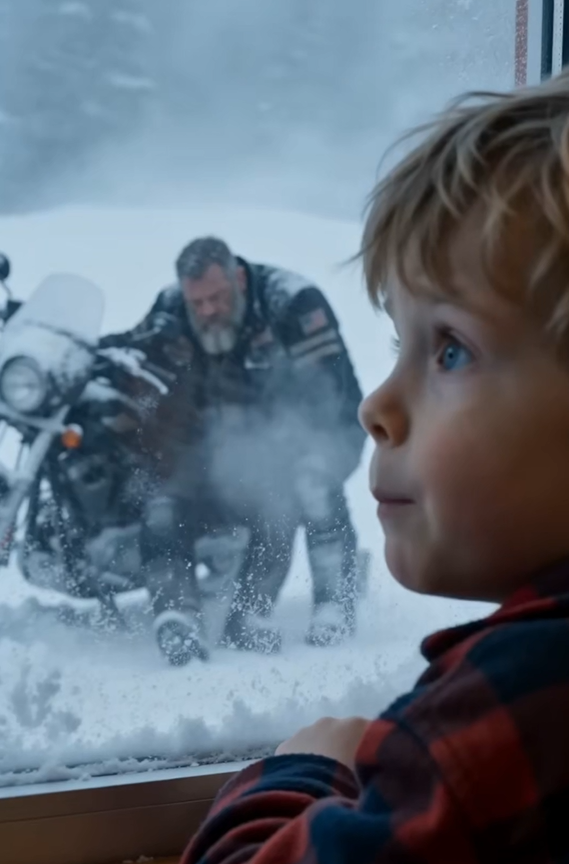
A TOWN LOCKED OUT 59 BIKERS IN A BLIZZARD – THEN A 6-YEAR-OLD BOY SAW ONE COLLAPSE
The night fifty-nine motorcycles rolled into Hollow Creek, the town did what it had always done when fear knocked first.
It shut the lights off.
Curtains snapped closed along the main street.
Porch lamps died one by one.
Shop signs went dark, locks turned, and families backed away from windows as if the storm had carried something worse than snow down from the pass.
By seven that evening, Route 9 was already disappearing beneath white.
By seven fifteen, the wind had begun to scream against the buildings hard enough to make old glass tremble in its frames.
By seven thirty, Emily Carter was standing behind the counter of the Hollow Creek Cafe with a foreclosure notice pinned behind her coffee station and nine days left before the bank took the last piece of her husband she still had.
Then her six-year-old son pressed his palm against the front window and whispered, “Mom.”
Emily did not move at first.
She was tired in the way that sleep did not fix.
Her hands were dry from dishwater, her back ached from standing, and the little cafe around her smelled of old coffee, lemon cleaner, and worry.
The register held forty-seven dollars.
The freezer was overstocked because a catering job had canceled two days earlier.
The roof needed work.
The back sink leaked.
The power had flickered twice.
And behind her, on the corkboard she refused to look at, the foreclosure notice sat like a quiet accusation.
“Mom,” Noah said again.
This time, his voice was different.
Emily knew every version of her son’s voice.
She knew the sleepy one, the stubborn one, the one he used when he had colored outside the lines and wanted her to notice anyway.
This was the voice he used when he had seen something real.
She walked around the counter.
Before she reached him, she felt the sound through the floor.
It began as a tremor beneath the boards, a low mechanical pulse almost swallowed by the wind.
Then it grew.
Engines.
Not one.
Not two.
Dozens of them.
The headlights came through the snow like ghost lights, blurred and wavering, pushing slowly into the parking lot from the mountain road.
Motorcycles.
So many motorcycles that Emily tried to count them and lost track before she got halfway across the lot.
They moved carefully, not like men trying to frighten anyone, but like men who had been fighting the storm too long and had nothing left for performance.
The first bike stopped near the diner sign.
The second stopped beside it.
Then another.
Then ten more.
Then a line of them filled the lot until there was no more room between the cafe and the road.
Noah stood so close to the glass that his breath fogged it.
“Step back,” Emily said.
He obeyed halfway.
He moved only enough to let her body stand between him and the window.
That was the kind of child Noah was.
He listened, but he still watched.
Emily’s hand went to his shoulder by instinct.
Outside, the riders cut their engines one by one.
The sound collapsed into the storm.
For three seconds, everything was only snow, leather, exhaust, and shape.
Large men climbed off their bikes stiffly.
Some leaned against handlebars.
Some bent over with their hands on their knees.
Their jackets were heavy and dark, crusted with ice along the seams.
On the back of the nearest one, Emily saw the words Iron Brotherhood.
Below it was another patch.
Colorado.
Her phone was already in her hand before she remembered taking it out.
Donna Marsh answered on the second ring.
“Emily,” Donna said, and her voice was tight enough to cut thread.
“You see them?”
“They’re in my parking lot,” Emily said.
“Lock the door.”
“Donna -”
“Lock the door and turn the sign off.”
“They look half frozen.”
“Those are Iron Brotherhood patches,” Donna said.
“I can see them from my diner window.”
Emily looked through the glass again.
One of the men had dropped down beside his bike and was sitting with his back against the front tire.
Two others crouched near him.
The rest were turning, watching, waiting, not rushing the cafe, not pounding on doors, not doing anything except trying to stay upright in weather that was eating through their bones.
“You do not want those men inside your place,” Donna said.
Emily heard the old town fear in her voice.
It was the kind of fear that did not need evidence because gossip had fed it for years.
The Iron Brotherhood were dangerous.
The Iron Brotherhood were criminals.
The Iron Brotherhood were men you did not cross, men you did not serve, men you did not invite into your business with your child nearby.
Emily had heard all of it in pieces.
She had never cared enough to sort rumor from truth because she had a cafe to keep open and a son to raise.
Then Noah tugged her sleeve.
“Mom,” he said.
The man sitting by the bike was no longer sitting.
He was lying on his side in the snow.
The two riders beside him were standing now.
One of them shouted something the storm took apart before it reached the glass.
The parking lot shifted.
Heads turned.
Bodies moved.
Emily looked at the fallen man, then at the phone in her hand, then at the lock on the door.
Donna was still talking.
“Emily, listen to me.”
Emily hung up.
For three seconds, she stood very still.
Then she unlocked the door.
Cold slammed into the cafe like a living thing.
It smelled of pine, gasoline, frozen wool, and mountain snow.
The nearest biker turned toward her.
He was enormous, at least six foot four, with shoulders wide enough to block half the storm behind him.
His face was weathered into a permanent severity, and a scar ran along one side of his jaw like a memory that had never healed completely.
“We’re not looking for trouble,” he said.
His voice was low and even.
Emily lifted her chin.
“I didn’t ask what you were looking for.”
The man stared at her.
Emily pointed toward the rider in the snow.
“I said bring him inside.”
That was how Ethan Cole entered the Hollow Creek Cafe.
He was twenty-six years old, though he looked younger when the ice came off his face.
He was hypothermic, dazed, and barely responsive by the time they got him onto the floor with a booth cushion beneath his head.
Emily moved before she had time to be afraid.
Two years after her husband died, she had taken emergency medical training because grief had made her restless and useless in her own body.
She had needed instructions.
She had needed checklists.
She had needed steps that mattered.
Check the pulse.
Check breathing.
Remove wet outer layers.
No hot water.
Warmth slowly.
Keep him still.
Keep him awake if he can wake.
Those steps came back now with brutal clarity.
“Blankets,” she said.
Noah was already moving.
He appeared beside her with a stack of clean kitchen towels held in both hands, solemn as a little priest bringing an offering.