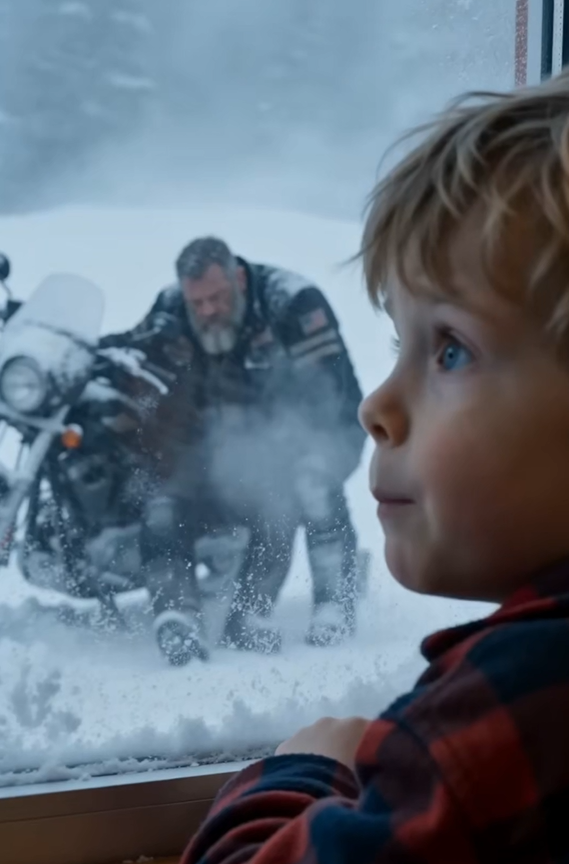
Emily took them.
She should have sent him to the storeroom.
She should have told him to look away.
Instead, she let him stand there because his steadiness steadied her.
The big man from the doorway stepped closer.
“Jack Reynolds,” he said, as if the name mattered, as if she deserved it before he asked anything else of her.
“Emily Carter,” she said.
She did not look up from Ethan.
“Your man is going to live if we keep him warm.”
Jack’s jaw moved once.
“What do you need?”
“Warm water, not hot.”
“Done.”
“Coffee.”
“Done.”
“And someone needs to call 911.”
A rider near the register lifted the landline.
A moment later, he said, “Line’s dead.”
Emily closed her eyes for half a breath.
Of course it was.
The storm outside wanted them alone.
“Then coffee first,” she said.
Within minutes, the cafe was full.
Fifty-nine riders occupied every booth, stool, wall space, and patch of floor.
Their boots left melting trails across the old boards Marcus had sanded by hand the winter before he got sick.
Their jackets steamed near the heaters.
Their faces, frightening from a distance, became human up close.
Exhausted.
Cold.
Careful.
Some of them were old enough to have gray in their beards.
Some were young enough to still be proving they did not need help.
All of them watched Noah like they were afraid of taking up too much space in his world.
When Emily opened the kitchen, she did not make a speech.
She simply turned on the propane griddle, pulled onions from the walk-in, set Marcus’s cast iron pot on the flame, and began making chili.
The smell changed the room.
Not dramatically.
Not all at once.
But something loosened.
Men who had been holding themselves like locked doors slowly shifted toward warmth.
Hands wrapped around mugs.
Shoulders lowered.
Noah, too small and too serious to be stopped, began carrying bowls one at a time from the pass-through window.
The first rider he served was a bearded man named Gus.
Noah set the bowl down with both hands.
“It has carrots,” he said.
Gus looked at him as if this information deserved full respect.
“I don’t mind carrots.”
Noah nodded, satisfied, and moved on.
Emily turned away before anyone saw what that did to her.
In her kitchen, under the crooked pendant light Marcus had hung wrong and she had never fixed, she stood with the smell of garlic rising around her and tried to name what she was feeling.
It was not fear anymore.
Or it was, but fear had moved to the back of the room.
Something else had taken the counter seat.
By nine fifteen, Jack Reynolds stood in the kitchen doorway.
“You didn’t have to do this,” he said.
Emily scrubbed a pot.
“Your man needed help.”
“Most people would have locked the door.”
“Most people did.”
He took the dish towel from the counter and began drying plates without asking.
Emily looked at him sideways.
He looked at the wall as if drying plates in the kitchen of a stranger during a blizzard was a perfectly natural thing for a man like him to do.
“How long have you had this place?” he asked.
“My husband’s parents opened it in 1987.”
“You and him took it over?”
“Eight years ago.”
She handed him another plate.
“He passed four years ago.”
Jack’s face changed only slightly.
“I’m sorry.”
“So am I.”
Silence settled between them, but it did not feel empty.
It felt like two people standing near the same kind of wound without having to describe it.
The wind groaned along the northwest corner of the roof.
Emily looked up.
“That roof,” she muttered.
“I noticed,” Jack said.
“It’s on a list.”
“Lists are good.”
This time, Emily almost laughed.
“Lists are all I’ve got.”
By midnight, no one was leaving.
The storm had swallowed the valley.
Hollow Creek sat buried and dark beyond the cafe windows.
Every road was impassable.
Every house had turned inward.
Inside the cafe, the Iron Brotherhood settled into exhausted quiet.
Some slept in booths.
Some played cards in silence.
Some stared into coffee as if it held answers they were too tired to ask for.
Emily cleaned because stopping felt dangerous.
Her feet throbbed.
Her back hurt.
The foreclosure notice behind the coffee station might as well have been glowing.
Nine days.
Nine days, and she had just fed fifty-nine men for free.
Nine days, and she would do it again.
Jack appeared in the kitchen doorway sometime after midnight.
“You should sleep.”
“When you can tell me when.”
“Fair.”
He looked at the corkboard.
Not directly, but enough.
Emily followed his gaze.
The notice was there.
Bank language.
Filing number.
Due date.
A clean official way of saying that grief had finally become debt.
“The bank is taking the building,” she said.
She had not meant to say it.
She had not told Donna.
She had not told her cousin in Denver.
She had barely said it aloud to herself.
Jack did not pity her.
That was why she did not regret it.
“How much?” he asked.
She told him.
He nodded like the number landed exactly where he expected it to.
“Okay.”
Emily frowned.
“Okay what?”
“Get some sleep, Emily.”
“That is not an answer.”
“The storm breaks by morning.”
He turned toward the dining room.
“We’ll be here when you wake up.”
The sentence stayed with her after he left.
It was not a promise exactly.
It was heavier than that.
In the morning, the world was white and painfully bright.
Emily woke on the storeroom floor beside Noah and smelled coffee before she opened her eyes.
For one wild second, she thought Marcus was in the kitchen.
Then memory returned.
The storm.
The bikers.
Ethan on the floor.
Jack in the doorway.
The notice.
She came out and found three men on the northwest corner of her roof, already prying up damaged decking in the pale morning light.
Ethan Cole was sitting upright in the back booth, wrapped in a blanket, holding a mug with both hands.
He looked better, but his eyes were not peaceful.
They followed her as soon as she appeared.
“There’s something I need to tell you,” he said.
Emily stopped.
“About last night.”
His voice dropped.
“We weren’t just riding through the storm.”
She sat across from him.
Ethan stared into his coffee.
“We were riding away from something.”
The cafe around them was waking slowly.
Boots shifted.
Men coughed.
Coffee poured.
Nobody seemed to listen, but the air around Ethan made the conversation feel sealed off.
He told her about Darren Voss.
A trucking operator out of Pueblo.
Legitimate on paper.
Regional freight.
Contracted routes.
Clean documents.
Underneath that, something else.
Smuggling, dirty money, hidden loads, shell companies, and a network that had survived for years because Voss understood exactly how to leave no single thread strong enough to hang him.
Ethan told her about Dell Cortez.
Former Army.
Iron Brotherhood rider.
Logistics man.
A person who could read route patterns, axle weights, and freight discrepancies the way other men read weather.